Mastering the Minor Scale on Guitar
Minor Scale Basics
The Sound of Minor
If major scales often sound bright and happy, minor scales bring a different mood. They can sound more somber, thoughtful, or even tense. This distinct character comes from a specific pattern of notes.
This article will focus on the natural minor scale, which is the most basic form of the minor scale. Its unique sound is defined by the distances, or intervals, between its notes.
The natural minor scale is built on a specific formula of whole and half steps, just like the major scale, but the pattern is different.
The Minor Scale Formula
Every natural minor scale follows the same pattern of steps. A whole step is a distance of two frets on the guitar, while a half step is one fret.
The formula for the natural minor scale is:
Whole – Half – Whole – Whole – Half – Whole – Whole
Let's write that out more clearly. If we call our starting note (the root) 'R', the pattern looks like this:
| Step | Note 1 | Note 2 | Note 3 | Note 4 | Note 5 | Note 6 | Note 7 |
|---|---|---|---|---|---|---|---|
| Interval from Root | Root | Whole | Half | Whole | Whole | Half | Whole |
| Pattern | R | W | H | W | W | H | W |
This pattern of whole (W) and half (H) steps is what gives the minor scale its identity. No matter which note you start on, following this W-H-W-W-H-W-W pattern will always produce a natural minor scale.
Building an A Minor Scale
Let's build a scale using this formula. A minor is a great place to start because it has no sharps or flats, meaning it uses only the white keys on a piano. Our root note is A.
- Start on A. This is our first note.
- Go up a whole step (two frets) to B.
- Go up a half step (one fret) to C.
- Go up a whole step to D.
- Go up another whole step to E.
- Go up a half step to F.
- Finally, go up a whole step to G.
After G, another whole step takes you back to A, one octave higher, and the pattern repeats. So, the notes of the A natural minor scale are:
A - B - C - D - E - F - G
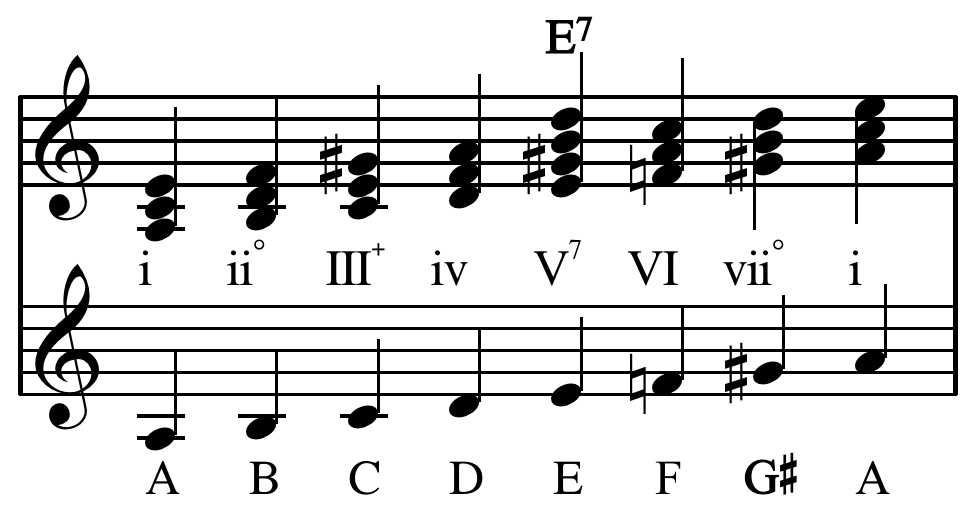
The image above actually shows the harmonic minor scale. The only difference is that the seventh note, G, is raised by a half step to G#. For now, just focus on the natural minor pattern we discussed: A, B, C, D, E, F, G. We'll get to other types of minor scales later.
Notice the key intervals that define the minor sound. Compared to a major scale, a natural minor scale has a flatted third, sixth, and seventh degree. It is this minor third () that gives the scale its characteristic minor quality.
Ready to test your knowledge?
What is the correct pattern of whole (W) and half (H) steps for a natural minor scale?
Which set of notes makes up the A natural minor scale?
Understanding this formula is the first step. Once you have it memorized, you can build a minor scale starting from any note on the fretboard.