Mastering the Mechanics of Modern AI and Machine Learning
Core Mechanism Deep Dive
The Attention Engine
Previous architectures like Recurrent Neural Networks (RNNs) processed text sequentially, like reading a book one word at a time. This approach created two major problems: it was slow, and the model often forgot the beginning of a long sentence by the time it reached the end. This is known as the long-range dependency problem.
The Transformer architecture solves this with a mechanism called self-attention. Instead of processing words one by one, it looks at all the words in a sentence at once. This allows it to weigh the importance of every word in relation to every other word, creating a rich, context-aware understanding of the entire sequence in a single step.
Self-attention lets the model ask, for a given word, which other words in the sentence are most important to understanding its meaning?
To do this, the model creates three vectors for each input token (word): a Query (Q), a Key (K), and a Value (V). These vectors are generated by multiplying the token's embedding by three distinct weight matrices that are learned during training.
Here’s a simple analogy: think of retrieving a video online.
- Query: The search term you type, like "how to bake bread."
- Keys: The titles and descriptions of all the videos in the database.
- Values: The actual content of the videos themselves.
The system calculates a similarity score between your Query and each Key. Videos with high scores (relevant titles) are given more weight. The final result is a blend of the most relevant Values (video content), giving you the information you were looking for.
This process is captured mathematically in the scaled dot-product attention formula.
More Than One Perspective
A single self-attention mechanism, or "head," can only focus on one type of relationship between words at a time. But language is complex; words can relate to each other syntactically, semantically, or in other subtle ways.
To capture this richness, Transformers use Multi-Head Attention. Instead of just one set of Q, K, and V weight matrices, it uses multiple sets in parallel. Each head learns to focus on a different aspect of the relationships within the sequence. For example, one head might learn to track subject-verb agreement, while another might focus on pronoun references.
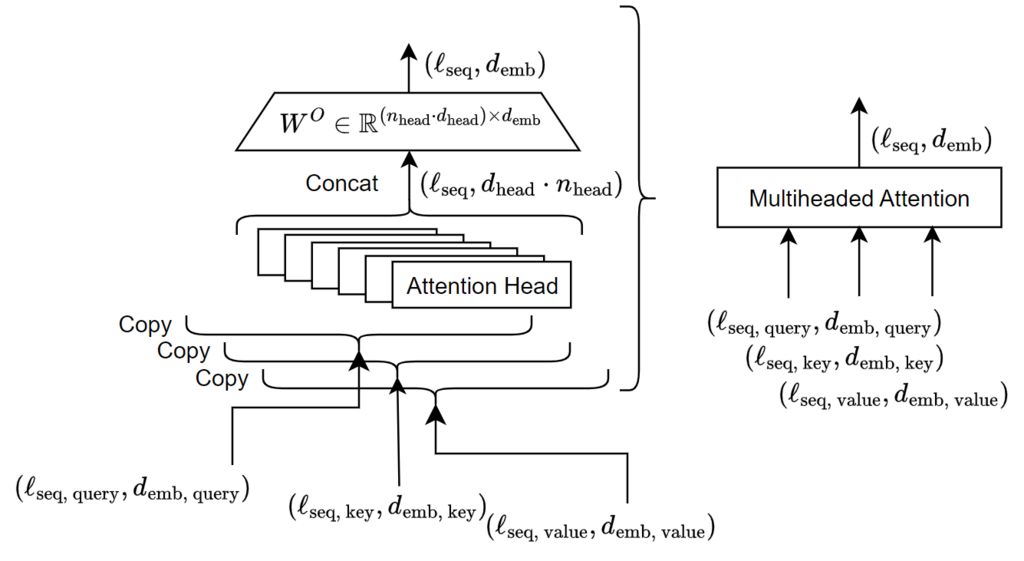
After each head produces its output vector, the vectors are concatenated together and passed through a final linear layer. This allows the model to integrate the different perspectives learned by each head into a single, unified representation.
Keeping a Sense of Order
Because self-attention processes all tokens simultaneously, it loses the original sequence order. The model sees the words "the dog chased the cat" and "the cat chased the dog" as identical bags of words. To fix this, Transformers inject information about each token's position using Positional Encodings.
These are vectors of the same dimension as the word embeddings, and they are simply added to the embeddings before being fed into the first encoder layer. The original paper used a clever combination of sine and cosine functions to generate these encodings, creating a unique positional signature for each token.
Finally, two other components are crucial for making these deep networks trainable: Residual Connections and Layer Normalization.
Imagine the data flowing through the network as traffic on a highway. A residual connection is like a bypass lane that allows some of the original input signal to skip a processing block (like an attention layer) and be added back later. This prevents the signal from degrading as it passes through many layers.
Layer Normalization acts like a traffic controller at the end of each block. It recalibrates the outputs, ensuring they have a standard mean and variance. This keeps the training process stable and allows information to flow more smoothly.
This combination of self-attention, multi-head perspectives, positional awareness, and stable training components is what makes the Transformer so powerful. It can process vast amounts of data in parallel, capture intricate long-range dependencies, and serve as the blueprint for nearly all modern large language models.
What is the primary problem in Recurrent Neural Networks (RNNs) that the Transformer architecture's self-attention mechanism was designed to solve?
In the self-attention mechanism, a token's Query (Q) vector is used to...