Mastering the Mechanics and Strategy of Martial Arts
Integrated Kinetic Chains
The Body as a Whip
The snap of a whip doesn’t come from its tip. The power starts in the handle, travels in a wave, and accelerates until the final crack. A powerful strike or throw works the same way. It's not about arm strength or leg muscle alone; it's about a perfectly timed sequence of movements, a wave of energy flowing through the body.
This sequence is called the kinetic chain. Think of it as a series of connected body segments. When you move, you're not just moving a limb. You're transferring force from one link in the chain to the next. The most powerful martial artists aren't necessarily the strongest in a weight room. They are masters of this energy transfer, starting from the ground up.
Every powerful movement, whether a punch, kick, or takedown, begins with your connection to the floor.
Forging the Links
The power for any technique starts with a push against the ground. This generates a ground reaction force—the equal and opposite force the ground exerts back on you. This is the raw energy you have to work with. Your feet, ankles, and legs act as the initial launchpad, converting this upward push into rotational force, or torque.
This initial power is generated by the —the large muscles of your glutes, hamstrings, and lower back. Think of this group as the engine of your body. When you drive your hips forward and rotate your torso, you're engaging this engine to create the immense torque that travels up the kinetic chain.
To ensure this energy isn't wasted, you need proper This concept, often called skeletal stacking, means aligning your bones so that force can transfer through them efficiently, like electricity through a wire. If your posture is broken or a joint is out of place, the energy dissipates. A well-aligned skeleton provides a solid framework for muscles to pull against, maximizing power output.
The Flow of Power
Once generated, force must travel up through the core and out to the limbs. In striking, the sequence is key. A punch starts with the foot pivoting, which drives the hip to rotate. This rotation whips the torso and shoulder around, which then extends the arm. Each segment adds its own momentum to the chain, accelerating the fist toward the target.
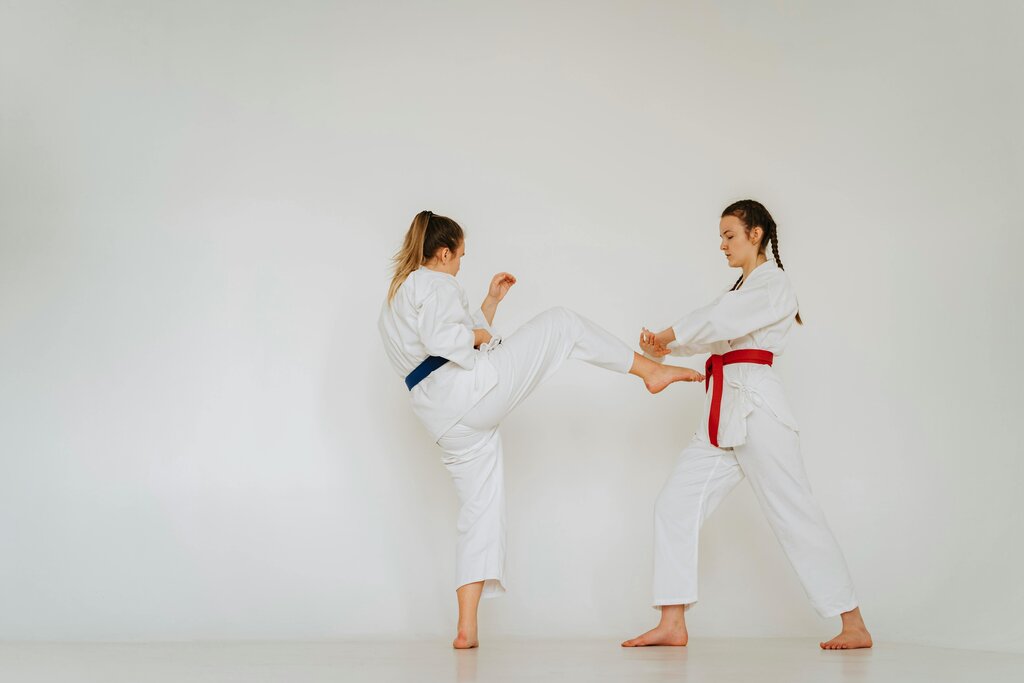
Grappling relies on the same principles. A throw isn't just lifting with your arms; it's using the ground reaction force from your legs, combined with the powerful rotation of your hips, to unbalance and project your opponent. Your skeletal structure is used to create leverage, redirecting your opponent's momentum.
Any break in this chain results in an "energy leak." This happens when a body part is misaligned or moves out of sequence. Common leaks include raising the heel too early, failing to rotate the hips fully, or letting your posture collapse. This forces smaller, weaker muscles to do the work, drastically reducing your power and efficiency.
By leveraging the kinetic chain, optimizing speed through relaxation, and training with intention, martial artists can develop more powerful and faster strikes.
Let's test your understanding of how the body generates and transfers power.
What is the term for the sequence of connected body segments that transfers force from the ground through the body to execute a powerful movement?
An 'energy leak' occurs when...
Mastering the kinetic chain turns martial arts from a collection of movements into an integrated system of power. It's the difference between moving your body and your body moving as one.