Mastering the Mechanics and Philosophy of Martial Arts
Striking Biomechanics
The Body as a Kinetic Chain
A powerful strike isn't born in the fist or the foot. It starts from the ground up. Every punch, kick, elbow, or knee is the final expression of a chain reaction, a concept in biomechanics known as the or kinetic linking. Think of it like cracking a whip: the energy starts in the handle (your feet on the ground), flows up the length of the whip (your legs, hips, and torso), and culminates in a final, explosive snap at the tip (your striking limb).
The process begins with ground reaction force. By pushing off the ground, a fighter initiates a sequence of rotations. The ankles, knees, hips, and torso twist in succession, each segment building on the momentum of the last. This coordinated movement multiplies the force, channeling the power of the entire body into a single point of impact.
Muay Thai's Driving Power
Muay Thai is called the "Art of Eight Limbs" for its use of fists, elbows, knees, and shins. Biomechanically, its power comes from a relentless application of driving force. Unlike the quick, snapping motions of styles like Karate, a Muay Thai roundhouse kick is designed to drive through the target. It's less like a whip and more like a baseball bat swung by the entire body.
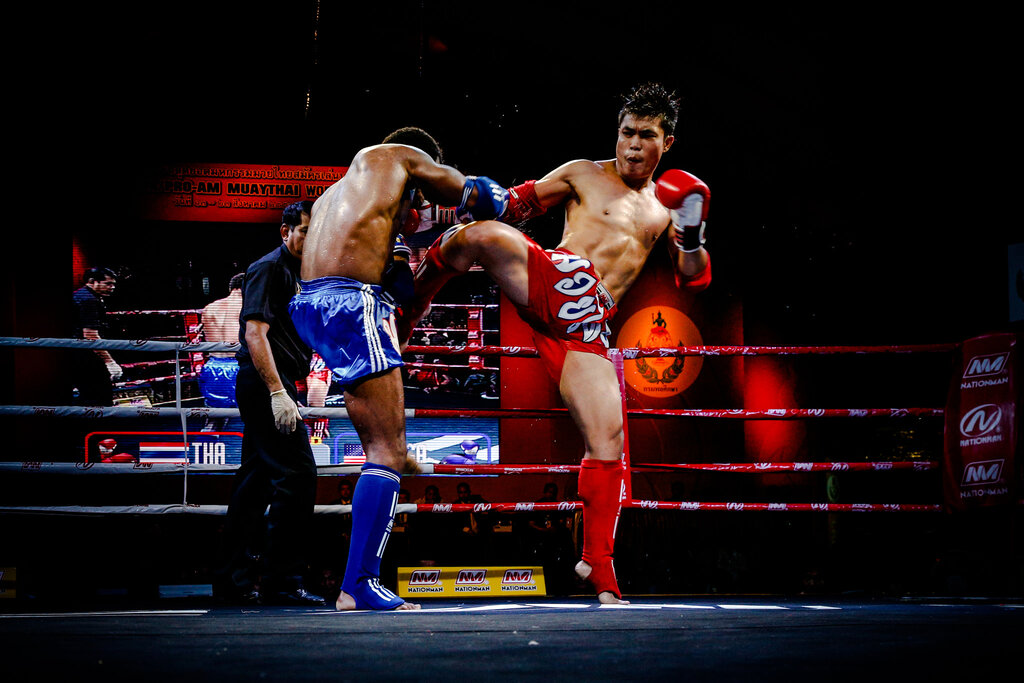
This is achieved through a deep rotation of the hips and torso, often initiated by a pivot on the standing foot. The kicking leg remains relatively straight, turning the shin into a powerful, weight-bearing lever. The fighter isn't just kicking with their leg; they are throwing their entire body's mass into the opponent. This commitment of mass is what creates the devastating impact associated with the style.
Boxing's Rotational Engine
Boxing generates its knockout power from the same principle of rotational torque, but channels it differently. A powerful cross isn't just an arm punch; it's a full-body rotation concentrated into the two knuckles of the fist. The movement begins with the pivot of the back foot, which initiates the rotation of the hips and then the torso. This sequence rapidly accelerates the shoulder, which slingshots the arm forward.
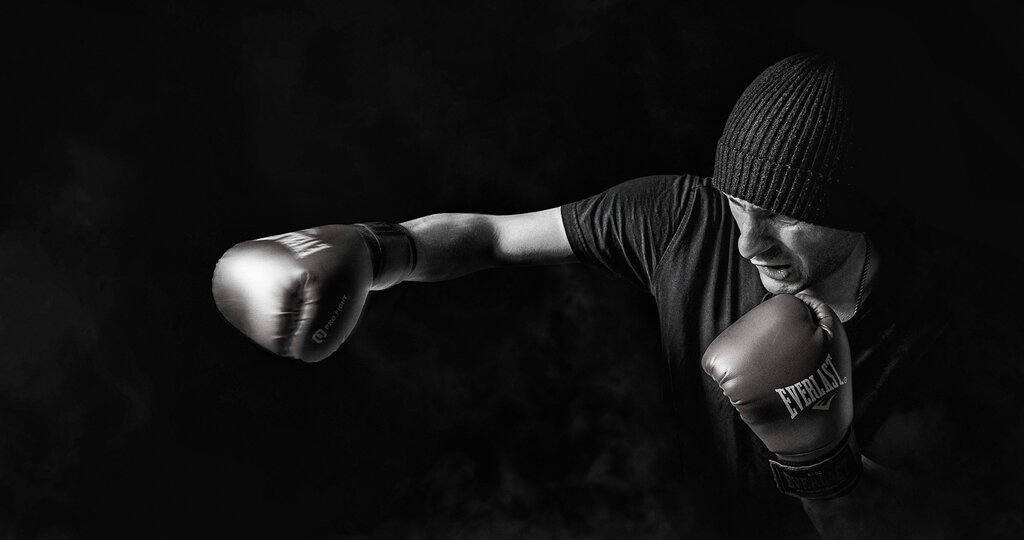
At the moment of impact, structural alignment is critical. The bones of the forearm and upper arm must align to create a solid frame, preventing the wrist or elbow from buckling. This solid structure ensures that the immense force generated by the body's rotation is transferred efficiently to the target. The goal is to maximize pressure, which is force divided by area (). By concentrating the force onto the small surface area of the knuckles, a boxer can generate thousands of pounds per square inch (PSI) of pressure.
Snapping vs. Driving
We can categorize strikes based on their energy profile. A Karate or Taekwondo kick often uses a "snapping" motion. The lower leg snaps out quickly from the knee, creating high velocity but involving less total body mass. This makes the strike very fast and difficult to see coming, but it sacrifices some destructive power.
Muay Thai and boxing, in contrast, use "driving" energy. They commit more of the body's mass into the strike and follow through the target. This increases the impact duration and transfers more momentum, resulting in greater destructive power. The trade-off is that these movements are often larger and slightly slower, but their effect on the target is far more significant. The choice between snapping and driving is a constant strategic trade-off between speed and power.
Now, let's test your understanding of these biomechanical principles.
According to the principle of the kinetic chain, where does the power for a strong strike primarily originate?
A Muay Thai roundhouse kick is biomechanically compared to a baseball bat, whereas a Karate kick is compared to a whip. What is the key difference this analogy illustrates?