Mastering the Martial Arts Landscape
Striking Biomechanics
Generating Force From the Ground Up
A powerful strike doesn't start in the arm or the leg. It begins with your feet on the floor. Think of your body as a whip. The handle is your connection to the ground, and the tip is your fist or shin. To make the tip crack, you don't just flick your wrist; you initiate a wave of energy that travels the entire length. This is the essence of the in martial arts.
Every powerful movement, from a boxer's cross to a Muay Thai kick, follows this principle. You push off the ground, rotate your hips and torso, and allow that energy to transfer into the striking limb. The ground is the ultimate source of your power. Without a solid connection and proper sequencing, even the most muscular fighter will throw weak, ineffective strikes. It's about efficient energy transfer, not just brute strength.
The Art of Rotation
Rotation is the engine of the kinetic chain. Let's compare two different roundhouse kicks to see how styles apply this principle differently.
In traditional Muay Thai, the roundhouse kick is thrown with the leg kept relatively straight, using a 'long-lever' principle. The practitioner swings their entire leg like a baseball bat, rotating the hip completely to generate maximum force. The goal is to drive through the target, often causing debilitating damage to an opponent's leg or body.
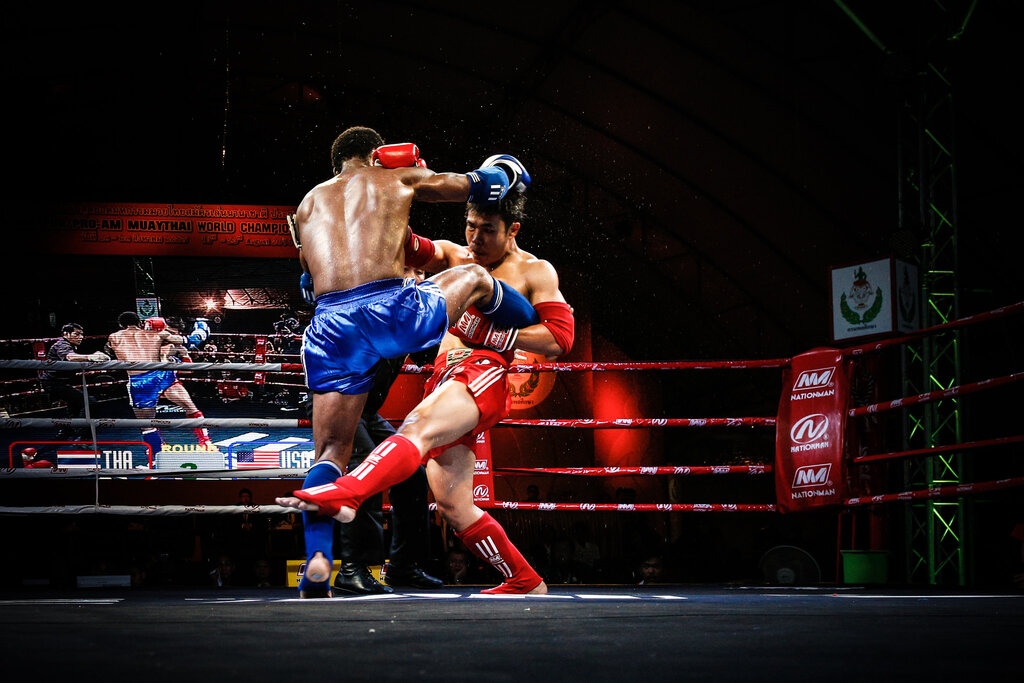
In contrast, a Dutch Kickboxing or Karate roundhouse is often 'chambered.' The knee is brought up high first, and then the lower leg snaps out to strike. This uses a shorter lever, which generates less raw power but is significantly faster and allows the fighter to retract the leg more quickly into a defensive position. This technique prioritises speed and the ability to throw combinations.
Neither approach is inherently superior. The choice reflects a different strategic philosophy, shaped by the sport's rules and cultural origins. The Thai emphasis on singular, powerful blows contrasts with the Dutch preference for high-volume striking combinations.
Defence Dictates Offence
A fighter's guard is not just for blocking; it's the platform from which they launch their attacks. The structure of a guard reveals a lot about a style's core principles. For instance, the traditional Muay Thai keeps the hands extended further forward than a boxing guard. This posture is excellent for measuring distance, parrying kicks, and initiating a clinch. However, it can leave the head more vulnerable to quick punching combinations.
Compare this to the high-guard common in Western boxing. Boxers keep their hands tight to their chin and temples. Since they only need to defend against punches to the head and body, this offers maximum protection for the most valuable targets. This compact guard allows for subtle head movement, slips, and rolls, and enables fighters to throw rapid-fire punches from a protected position. The evolution of each guard is a direct response to the weapons allowed in the sport.
The Speed vs Power Dilemma
Every strike is a trade-off. Committing your body's full rotation and momentum into a strike maximises its power, but it also creates a moment of vulnerability. If you miss, you are out of position and open to a counter-attack. This is the central dilemma for any striker.
A fighter must constantly calculate the risk and reward. Is it better to throw a single, fight-ending power shot or to score with faster, less committal strikes while maintaining a solid defence?
This calculation is influenced by a fighter's style and attributes, but also by their understanding of distance and timing, a concept known in Japanese martial arts as . This refers to the fighting distance between two opponents. Mastering Maai means understanding the precise distance from which you can strike your opponent without being struck in return. It's about controlling the space to create opportunities for powerful, committed strikes while minimising your own risk.
Understanding these mechanical principles—from the ground-up force of the kinetic chain to the strategic trade-offs of speed, power, and defence—is what separates a brawler from a true martial artist. It allows you to analyse your own technique and understand the science behind the art.
Time to test your knowledge on the biomechanics of striking.
According to the principle of the kinetic chain, what is the ultimate source of a powerful strike's energy?
A 'chambered' roundhouse kick, common in Dutch Kickboxing, prioritises speed and combinations over the raw, singular power of a traditional Thai kick.
By understanding the why behind these techniques, you can make smarter choices in your own training and application.