Mastering the Likert Scale
Introduction to Likert Scales
Measuring Feelings and Opinions
How do you measure something you can't see, like an opinion or an attitude? You can ask a simple yes-or-no question, but that doesn't capture the whole story. If you ask someone, "Do you like spicy food?", a "yes" could mean anything from enjoying a little kick to loving ghost peppers. This is where the Likert scale comes in.
A Likert scale is a psychometric tool used in surveys to measure attitudes or opinions. Respondents are asked to rate their level of agreement with a statement on a symmetric, balanced scale.
For example, instead of asking if someone likes spicy food, you could present a statement: "I enjoy eating spicy food." The response options might be:
- Strongly Disagree
- Disagree
- Neither Agree nor Disagree
- Agree
- Strongly Agree
This gives you a much richer understanding of their preference. The key is that it measures the intensity of a feeling, not just its presence or absence.
psychometric
adjective
Relating to the design, administration, and interpretation of quantitative tests for the measurement of psychological variables such as intelligence, aptitude, and personality traits.
The scale is named after its creator, Rensis Likert, a social psychologist who developed this method in the 1930s. At the time, researchers were struggling to quantify subjective human experiences. Likert's approach provided a simple but effective way to turn complex attitudes into data that could be analyzed statistically.
How Likert Scales Work
A common misconception is that a single question with a rating scale is a Likert scale. Technically, a single question is a "Likert item." A true Likert scale is the composite score from a series of related Likert items.
For instance, to measure overall job satisfaction, you wouldn't just ask one question. You would create several statements, each targeting a different aspect of the job:
- "I am satisfied with my pay."
- "I feel valued by my manager."
- "My workload is manageable."
- "I enjoy the company of my colleagues."
Each statement uses the same agree-disagree response options. By summing or averaging the responses (which are assigned numerical values, like 1 for "Strongly Disagree" up to 5 for "Strongly Agree"), a researcher can calculate a single score that represents an individual's overall job satisfaction.
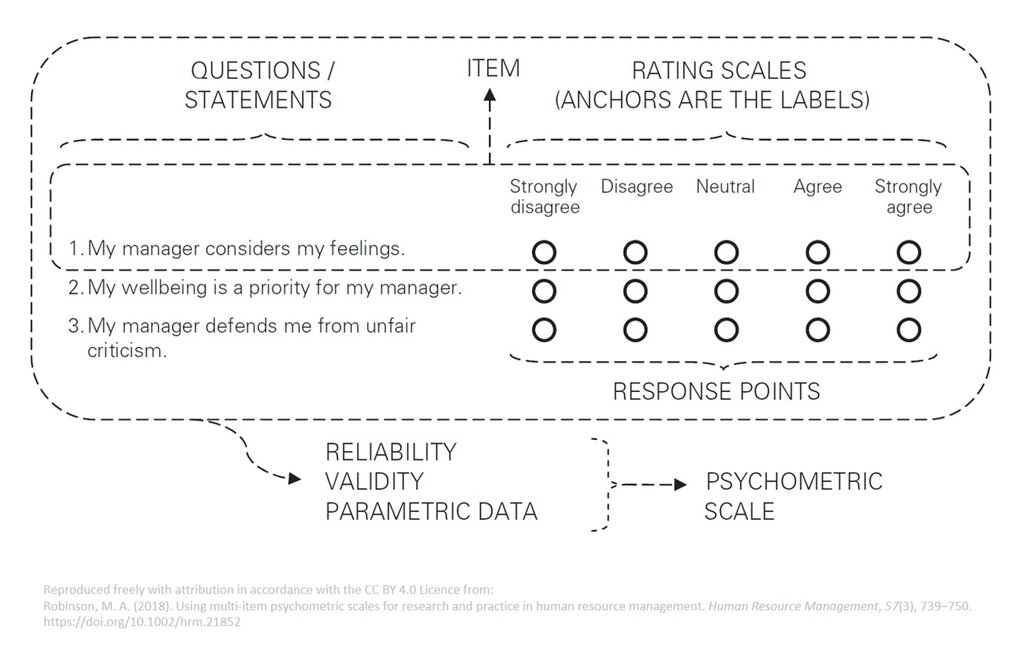
This method is more reliable than a single question because it reduces the impact of a person's response to any one particular item. Someone might feel strongly about their pay but be neutral about their colleagues. The composite score provides a more balanced and accurate picture of their overall attitude.
Advantages and Limitations
Likert scales are popular for a reason, but they aren't perfect. It's helpful to understand their pros and cons.
| Advantages | Limitations |
|---|---|
| Easy for respondents to understand and use. | People may avoid extreme answers (central tendency bias). |
| Captures more nuanced opinions than yes/no questions. | The meaning of the middle option can be ambiguous. |
| Simple to design and administer. | Social desirability bias can lead people to give agreeable answers. |
| Provides quantitative data that is easy to analyze. | It doesn't reveal why someone feels a certain way. |
Compared to other survey types, Likert scales offer a great balance. Dichotomous (yes/no) questions are too simple. Open-ended questions provide deep insight but are difficult to analyze quantitatively. Multiple-choice questions are good for facts, but less so for opinions. The Likert scale hits a sweet spot, offering structured, quantifiable data about subjective feelings.
What is the primary purpose of using a Likert scale in a survey?
True or False: A single survey question that asks a user to rate something on a 1-to-5 scale is, by itself, a Likert scale.
By providing a structured way to measure attitudes, Likert scales have become a cornerstone of research in psychology, sociology, marketing, and many other fields.