Mastering the Law of Supply and Producer Logic
Profit Maximization Logic
The Producer's Playbook
Just as consumers aim to maximize their satisfaction, or utility, firms have their own primary goal: maximizing profit. It's the central assumption behind producer behavior. The logic is surprisingly similar. While you analyzed how consumers make choices at the margin to get the most happiness from their budget, producers think at the margin to squeeze the most profit from their operations.
The basic formula for profit is simple. It's what's left over after you subtract your costs from your revenue.
Total Revenue (TR) is the price of the good multiplied by the quantity sold (). Total Cost (TC) is the sum of all expenses incurred in production. But economists think about costs a little differently than accountants do, which leads to a crucial distinction.
Two Kinds of Profit
An accountant's job is to track where money actually goes. They calculate accounting profit by subtracting explicit, out-of-pocket costs (like rent, wages, and materials) from total revenue. It's the number you’d see on a standard income statement.
Economists, however, have a broader view. They are interested in the full cost of a decision. This means they also include implicit costs, often called opportunity costs—the value of the next-best alternative that was given up. The result is economic profit.
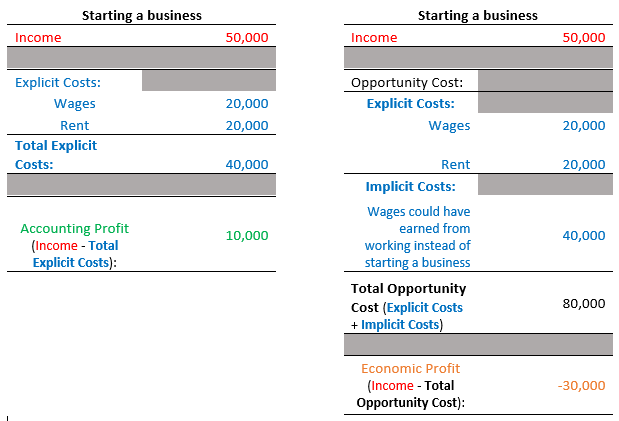
Imagine you quit a $100,000 per year programming job to open a coffee shop. In the first year, your shop brings in $250,000 in revenue and you pay $160,000 for rent, beans, and employee wages.
Your accounting profit is straightforward: $250,000 - $160,000 = $90,000. Not bad!
But an economist would also subtract the $100,000 salary you gave up. So, your economic profit is $250,000 - $160,000 - $100,000 = -$10,000. From an economic standpoint, you actually lost money because you would have been better off financially by staying at your old job. A positive economic profit means you're doing better than your next-best alternative.
The Golden Rule of Production
So, how does a firm decide exactly how much to produce? By thinking one unit at a time. A rational producer will ask: "If I produce and sell one more widget, how much additional revenue will I get, and how much additional cost will I incur?"
This brings us to two critical concepts:
- Marginal Revenue (MR): The extra revenue gained from selling one more unit.
- Marginal Cost (MC): The extra cost incurred from producing one more unit.
As long as the marginal revenue of a unit is greater than its marginal cost (), producing that unit adds to the firm's total profit. It makes sense to keep going. But if the marginal cost exceeds the marginal revenue (), producing that unit would actually reduce the firm's total profit. The firm has gone too far.
The profit-maximization point is where the marginal revenue from the last unit sold is exactly equal to its marginal cost.
This principle of is the producer's version of the consumer's logic. It's a powerful tool for optimizing any decision, from production levels to hiring one more employee. This rule is why the supply curve slopes upward. To entice a producer to make one more unit, the price must be high enough to cover the (often rising) marginal cost of producing that unit.
What is the primary goal that economists assume drives the decisions of a typical firm?
A chef quits her $80,000/year job to start a restaurant. In the first year, her restaurant earns $400,000 in revenue and her explicit costs (rent, ingredients, staff) are $350,000. What is her economic profit?