Mastering the Language of Music
Advanced Rhythmic Patterns
Lengthening Notes
You already know how basic note values work, but music often needs durations that fall between these standard lengths. Two common tools for this are dotted notes and ties. They both extend a note's duration, but they do it in different ways and in different situations.
Dotted Notes
Adding a dot to a note increases its duration by half of its original value. Think of it as a shorthand for tying a note to another one half its length.
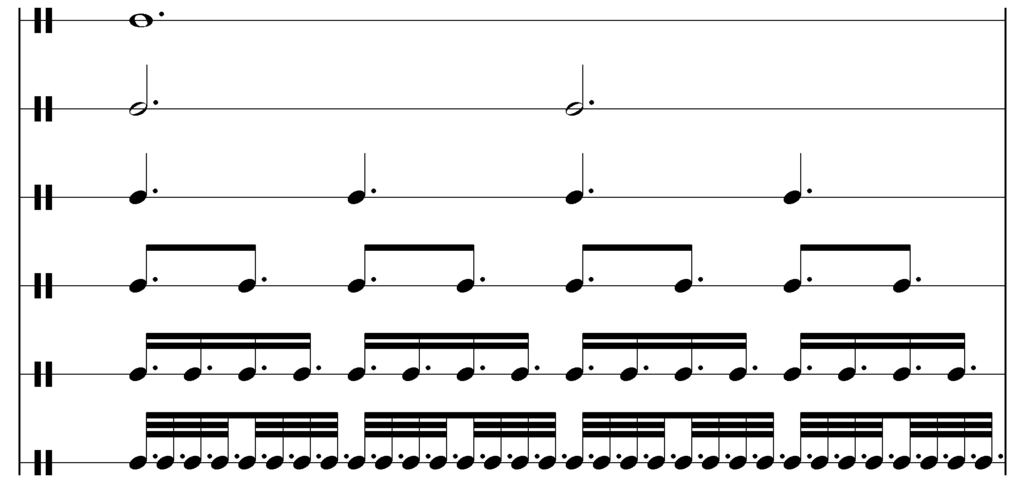
You can even add a second dot. A double-dotted note adds another dot that's worth half the value of the first dot. So, a double-dotted crotchet would be worth a crotchet + a quaver + a semiquaver, or 1.75 beats.
While dots are useful, they have a limitation: their duration can't cross a bar line. If you need a note to sustain from one measure into the next, you need a different tool.
Ties
A tie is a curved line that connects two notes of the same pitch. It merges them into a single, uninterrupted sound. The duration of the new sound is the sum of the two tied notes. Unlike dots, ties are perfect for holding a note across a bar line or creating durations that don't fit neatly into a single beat.
Don't confuse ties with slurs! A tie connects two notes of the same pitch to create one longer note. A slur is a curved line over two or more notes of different pitches, indicating they should be played smoothly (legato).
Dividing the Beat
Most of the time, we divide beats into two, four, or eight parts. Time signatures with a 2, 3, or 4 on top, like 4/4 or 3/4, follow this pattern. These are called simple time signatures, as the main beat naturally divides into two.
But what if we want the main beat to have a different feel, one that divides into three? This is where compound time comes in. In time signatures like 6/8, 9/8, or 12/8, the main beat is a dotted note that naturally divides into three smaller parts. This creates a flowing, triple feel.
| Time Type | Main Beat Division | Example Time Signatures | Feel |
|---|---|---|---|
| Simple | Divides into 2 | 2/4, 3/4, 4/4 | March-like, straight |
| Compound | Divides into 3 | 6/8, 9/8, 12/8 | Lilting, swinging |
In 6/8, for example, there are two main beats per measure, and each one is a dotted crotchet. It feels like ONE-and-a, TWO-and-a.
Tuplets
Sometimes a composer wants to temporarily borrow a division from another time signature. This is done with tuplets. The most common tuplet is the triplet, which squeezes three notes into the space normally occupied by two.
You can create triplets with any note value. For example, three quaver triplets fit into the time of one crotchet.
While triplets are most common, other tuplets exist. You might see duplets (two notes in the time of three in compound time), quadruplets (four in the time of three), quintuplets (five in the time of four), and sextuplets (six in the time of four). Sextuplets are especially common in piano music for fast, flashy runs.
Syncopation
Rhythm is all about expectation. We expect strong beats to land on '1' and '3' in 4/4 time. Syncopation plays with this expectation by accenting the weak or 'off' beats. This creates rhythmic tension and interest, making the music feel more energetic and unpredictable. It’s the engine that drives genres like jazz, funk, and reggae, but it's found in all kinds of music.
Syncopation
noun
A disturbance or interruption of the regular flow of rhythm; a placement of rhythmic stresses or accents where they wouldn't normally occur.
Syncopation can be created in several ways:
- Accenting an off-beat: Placing an accent mark ( or ) on a quaver that falls on an 'and'.
- Using rests: Placing a rest on a strong beat, forcing the following note on a weak beat to feel more important.
- Ties: Tying a note from a weak beat to a strong beat. This anticipates the strong beat, shifting the rhythmic weight.
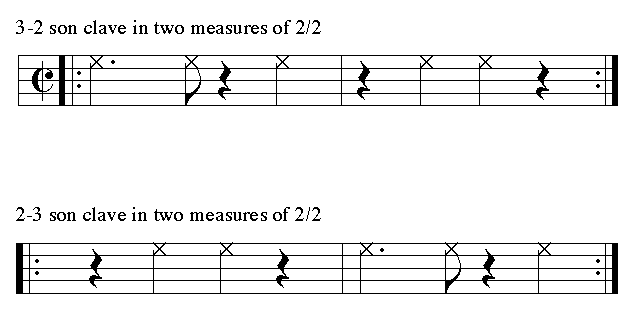
The key to understanding syncopation is to always feel the underlying pulse. Tap your foot to the main beats and notice how the syncopated notes pull away from it before returning. When you can feel this push and pull, you can deconstruct even the most complex rhythms you'll find in an orchestral or piano score.
How does adding a single dot to a note affect its duration?
Which of these time signatures is an example of compound time?
Mastering these rhythmic concepts will allow you to read, perform, and appreciate music on a deeper level. They are the tools composers use to create rhythmic variety, drive, and expression.