Mastering the Ice Coast
Edge Pressure Mechanics
Preparing for the Boilerplate
To survive the icy slopes of the Eastern United States, often colloquially called the , your standard factory tune simply won't cut it. On man-made snow that has been frozen, thawed, and groomed into a surface resembling a parking lot, your edges are your only lifeline. Unlike the forgiving powder of the West, requires a specific mechanical setup to ensure that when you tip your skis or board, they actually bite into the surface rather than skidding into the woods.
The Geometry of Grip
The most critical adjustment for hardpack performance is the bevel angle of your edges. Most standard tunes use a base and side bevel, which is a great all-arounder. However, for the high-friction environment of the East, you need a more aggressive bite. For the side edge, moving to a or even angle increases the 'sharpness' of the wedge, allowing it to penetrate the ice more deeply. On the base side, keeping the bevel between and ensures that you don't have to tip the ski too far before the edge engages, which is vital when every millisecond counts.
Tuning for these angles requires precision tools. You'll need a file guide that holds your metal files and at the exact degree required. If you attempt this by hand, you will inevitably round over the edge, making the ski perform worse than it did when it was dull.
Key Rule: A 3-degree side bevel provides the ultimate grip on ice, but it requires more frequent maintenance because the thinner edge is more prone to 'rolling' or dulling after a few runs.
Daily Maintenance and Deburring
You don't always need a full file tune. In fact, most of your daily work will involve removing the burr—the jagged 'lip' of metal that forms on the edge after a day of high-pressure carving. To do this, you use a sequence of diamond stones. Start with a coarse stone (around 200 grit) to knock down the rough spots, and finish with a fine stone (600 to 1000 grit) to polish the edge until it shines. A polished edge isn't just for show; it actually glides faster and stays sharp longer because there are fewer microscopic pits for the ice to grab onto.
burr
noun
A rough ridge or edge left on a metal surface after it has been filed, cut, or subjected to heavy friction.
Fighting Base Burn with Hard Wax
The friction generated by sliding over artificial ice is significantly higher than on natural snow. This heat can actually melt the polyethylene base of your ski, leading to a condition known as , which looks like white, fuzzy patches near the edges. To prevent this, you must use temperature-specific hard waxes. In the East, this usually means reaching for the Blue or Green waxes, which are designed for temperatures well below freezing.
| Wax Color | Temp Range (°F) | Best For |
|---|---|---|
| Purple | 18° to 28° | Standard cold days, transition snow |
| Blue | 10° to 20° | Aggressive man-made ice, firm pack |
| Green | -22° to 10° | Extreme cold, abrasive boilerplate |
When applying these hard waxes, remember that they have a much higher melting point. You'll need to be careful with your iron temperature to ensure the wax flows smoothly without smoking. Once scraped and brushed, these waxes provide a durable shield that resists the 'sandpaper' effect of the ice.
What is the primary reason for a specialized ski tune for the "Ice Coast"?
A skier is preparing for a race on a notoriously icy course. Which edge bevel combination would provide the most aggressive grip?
With your bevels set and your bases hardened against the friction of the ice, you're no longer just a passenger on the slope. A properly prepared ski turns the 'ice' back into 'snow,' giving you the confidence to drive your turns through the hardest boilerplate the East can throw at you.
On the Ice Coast, the turn does not begin at the fall line; it begins while you are still moving across the hill from your previous arc. To hold an edge on snow, you must treat the ski as a high-tension system. If you wait until you are facing downhill to apply pressure, the sudden force spike causes the ski to 'chatter' or skip across the ice like a stone on a pond. Instead, you must initiate the weight transfer at the apex of the previous turn.
By loading the early, you are essentially pre-tensioning the system. This prevents the 'late-turn blow out' where the ski suddenly loses grip because it wasn't properly seated in the snow. Think of it as a bridge: a pre-stressed concrete beam can handle far more load than one that is simply resting on its supports. In skiing, your leg is the piston that applies this pre-stress.
The Dynamic Edge Roll
Advanced carving on boilerplate requires more than just leaning; it requires extreme edge angles, often between and . Achieving this angle through a whole-body lean (inclination) is dangerous on ice because it moves your center of mass too far from the edge, causing a 'low side' crash. Instead, you must use angulation, which is achieved by rolling the ankles and knees into the hill while keeping the upper body stable and oriented down the fall line.
This rolling motion should feel like you are trying to touch your kneecaps to the snow. When done correctly, the sidecut of the ski engages fully, and the ski bends into an arc. On ice, this bend is your only source of turning power. Without that high-tension arc, you are just a passenger on a sliding piece of plastic.
100% OUTSIDE SKI balance with Early Weight Transfer: being over the outside ski (regarding pressure or balance) increases the penetrating force and reduces lateral shear force on the edges.
Stability in High Tension Systems
To a physicist, this state is one of . You are balancing the outward push of centrifugal force with the inward bite of the metal edge. If the edge angle is too low, the frictional force is insufficient to hold the turn, and you skid. If the angle is high but the pressure is uneven, the ski oscillates, creating the 'chatter' that East Coast skiers dread. Continuous vertical pressure—pushing 'through' the ski into the ice—is the dampening field that kills these oscillations.
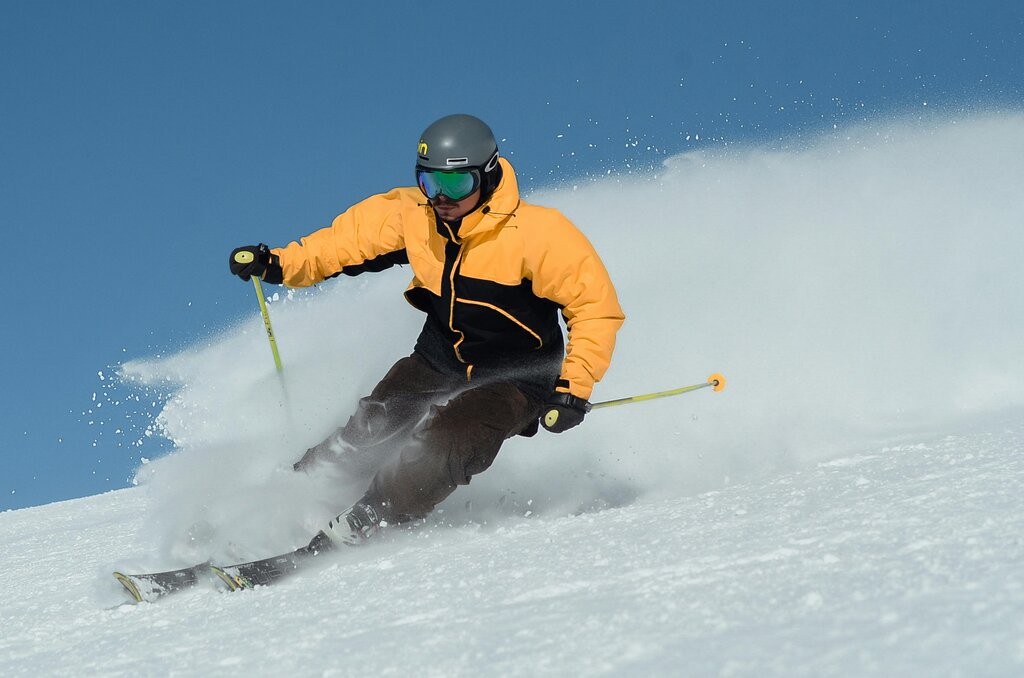
As you move through the turn, focus on the transition. As the old turn ends, your weight should already be shifting to the new outside ski. This proactive approach turns the ice from an enemy into a high-performance surface that allows for speeds and G-forces impossible on soft snow.
angulation
noun
The act of creating angles between different body segments, such as the hips, knees, and ankles, to maintain balance while the skis are on edge.
According to the principles of Ice Coast skiing, when should you begin applying pressure to initiate a new turn?
What is the primary reason for using angulation (rolling ankles and knees) rather than inclination (whole-body lean) on hard, icy snow?
Mastering these high-tension mechanics transforms your experience on the mountain. Instead of fearing the ice, you begin to seek it out, knowing that your early weight transfer and deep edge angles will hold you steady through even the slickest boilerplate.