Mastering the Hindi Language
Devanagari Script
Meet Devanagari
Hindi is written in a script called Devanagari. It might look complex at first, but it's remarkably logical. Devanagari is an abugida, a type of writing system where consonants have an inherent vowel sound that can be changed by adding different marks. This means that once you know the rules, you can pronounce almost any word just by reading it. What you see is what you say.
Learning the Devanagari script opens the door to faster reading, clearer pronunciation, and a much deeper understanding of how Hindi works.
Let's start with the building blocks: vowels and consonants. A key feature of Devanagari is the horizontal line that runs across the top of most letters, called a shirorekha (शिरोरेखा). Letters are generally written from top to bottom and left to right, with the horizontal line drawn last to connect them into words.
The Vowels (स्वर)
Hindi has 13 vowels, known as svar (स्वर). They each have a unique sound and an independent form when they start a word or stand alone. When they follow a consonant, they usually take a different form, a diacritical mark called a matra (मात्रा). For now, let's focus on their independent forms and sounds.
| Vowel | Romanization | Pronunciation Guide |
|---|---|---|
| अ | a | like the 'u' in 'but' |
| आ | ā | like the 'a' in 'father' |
| इ | i | like the 'i' in 'pin' |
| ई | ī | like the 'ee' in 'see' |
| उ | u | like the 'u' in 'put' |
| ऊ | ū | like the 'oo' in 'pool' |
| ऋ | ṛ | like the 'ri' in 'river' |
| ए | e | like the 'ey' in 'they' |
| ऐ | ai | like the 'ai' in 'aisle' |
| ओ | o | like the 'o' in 'go' |
| औ | au | like the 'ow' in 'how' |
| अं | aṃ | like the 'un' in 'bunk' |
| अः | aḥ | makes a soft echo of the previous vowel, followed by an 'h' sound |
Memorizing these sounds is your first big step. Listen to them, say them out loud, and get comfortable with how they feel and sound.
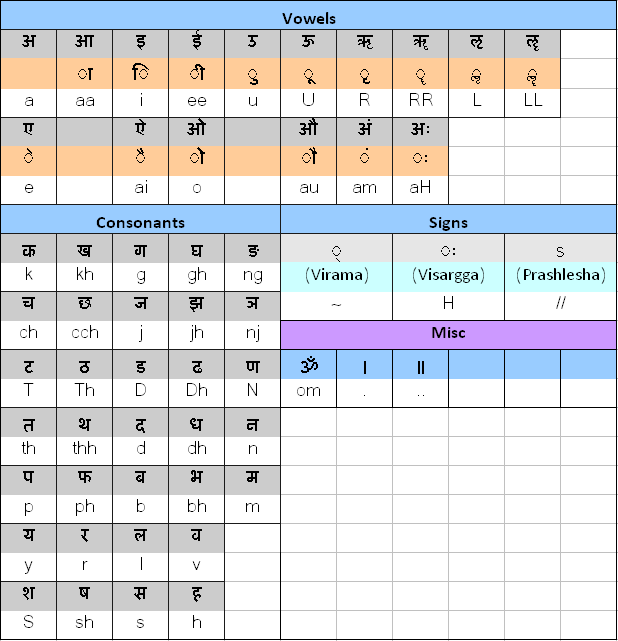
The Consonants (व्यंजन)
There are 33 core consonants, or vyanjan (व्यंजन), in Hindi. The most important thing to remember is that every consonant has an inherent, unspoken vowel sound built into it: the short 'a' (अ). So, the letter क isn't just 'k', it's 'ka'. The letter प isn't 'p', it's 'pa'. This is the central idea of the abugida system.
abugida
noun
A writing system in which consonant-vowel sequences are written as a unit. Each unit is based on a consonant letter, and vowel notation is secondary.
The consonants are organized very scientifically based on where in the mouth they are produced. This makes them easier to learn in groups.
| Group | Consonants |
|---|---|
| Velar (back of throat) | क (ka), ख (kha), ग (ga), घ (gha), ङ (ṅa) |
| Palatal (roof of mouth) | च (ca), छ (cha), ज (ja), झ (jha), ञ (ña) |
| Retroflex (tongue curled back) | ट (ṭa), ठ (ṭha), ड (ḍa), ढ (ḍha), ण (ṇa) |
| Dental (tip of tongue on teeth) | त (ta), थ (tha), द (da), ध (dha), न (na) |
| Labial (lips) | प (pa), फ (pha), ब (ba), भ (bha), म (ma) |
| Semivowels | य (ya), र (ra), ल (la), व (va) |
| Sibilants | श (śa), ष (ṣa), स (sa) |
| Glottal | ह (ha) |
The Invisible 'a'
As we covered, every consonant carries the 'a' sound (अ). When you combine consonants, you just pronounce them in sequence. For example:
क (ka) + म (ma) + ल (la) = कमल (kamal, meaning 'lotus')
Simple, right? But here's the crucial pronunciation rule you need to know: schwa deletion. In spoken Hindi, the inherent 'a' sound is often dropped at the end of a word. So, we write कमल (kamala) but we say "kamal". The final 'a' is silent.
This is one of the most common mistakes for beginners. Remember: if a word ends in a consonant, don't pronounce the final 'a' sound.
What if you actually need to write a consonant without its vowel sound in the middle of a word? You use a small diagonal stroke underneath it called a halant (हलन्त). For example, a क् is just the sound 'k', not 'ka'. You won't see this too often in everyday Hindi, but it's important to know.
Now you have the fundamental pieces of the Devanagari script. The next step is to see how vowels attach to consonants as matras to create all the syllables of Hindi.
Ready to test your knowledge of the letters?
What type of writing system is Devanagari, where consonants carry an inherent vowel sound?
What is the inherent vowel sound that is automatically included with every core consonant in Hindi?
Practice is key. Try writing the letters out yourself, paying attention to the stroke order and the sounds they represent. The more you use them, the more natural they will become.