Mastering the Hero's Journey
Introduction to the Hero's Journey
The Universal Story
From ancient myths to modern blockbusters, many of the most compelling stories follow a similar pattern. It’s a timeless template known as the Hero's Journey. This structure maps out a hero's adventure: they leave their comfortable, familiar world, venture into a region of supernatural wonder, face fabulous forces, win a decisive victory, and return from this mysterious adventure with the power to bestow boons on their fellow man.
A better framework for storytelling is “The Hero’s Journey.” Introduced in 1949 by Joseph Campbell, the hero’s journey (also known as a monomyth) is a narrative found in classic literature, pop culture, and even religious texts.
The term was popularized by scholar Joseph Campbell in his book, The Hero with a Thousand Faces. Campbell didn't invent this structure; he identified it. After studying myths from cultures all over the world, he realized that many of them shared the same fundamental sequence of events. He called this universal pattern the "monomyth."
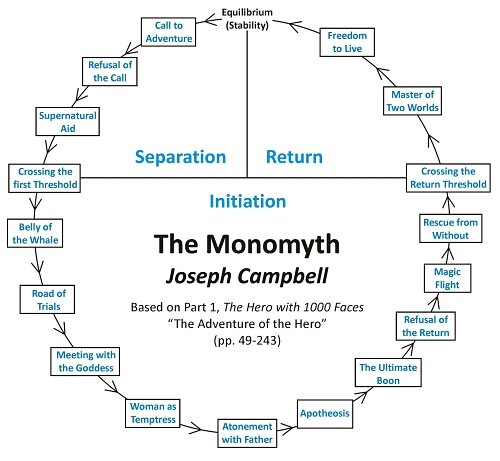
Campbell broke the Hero's Journey down into 17 distinct stages. While that might sound like a lot to keep track of, these stages are neatly grouped into three main acts, which mirror the classic three-act structure of many stories: Departure, Initiation, and Return.
The Three Acts
The three acts provide a high-level map of the hero’s transformation. Each act contains several of Campbell's 17 stages, guiding the hero from their ordinary life into a new reality and back again.
Act 1: Departure This is the beginning of the adventure. The hero receives a call to leave their ordinary world. After some hesitation, they cross the threshold into an unknown world, leaving the familiar behind.
Act 2: Initiation The hero ventures deep into the unknown, facing a series of trials and challenges that test their character and skills. This is where they confront their greatest fears, often in a central crisis, and experience a significant transformation. They gain new wisdom, skills, or a tangible reward.
Act 3: Return The hero begins their journey back to their ordinary world, but they are not the same person who left. They must bring their newfound wisdom or reward back home. The return can have its own challenges, but ultimately, the hero reintegrates into their old life, now a master of both worlds.
Here is how Campbell’s 17 stages fit within these three acts:
| Act | Stages |
|---|---|
| Departure | 1. The Call to Adventure 2. Refusal of the Call 3. Supernatural Aid 4. Crossing the First Threshold 5. Belly of the Whale |
| Initiation | 6. The Road of Trials 7. The Meeting with the Goddess 8. Woman as Temptress 9. Atonement with the Father 10. Apotheosis 11. The Ultimate Boon |
| Return | 12. Refusal of the Return 13. The Magic Flight 14. Rescue from Without 15. The Crossing of the Return Threshold 16. Master of Two Worlds 17. Freedom to Live |
This structure provides a powerful framework for creating stories that feel both familiar and deeply meaningful. By tapping into these universal patterns, writers can craft narratives that resonate with audiences on a fundamental level, telling a story that feels like it has always been known.