Mastering The Hero's Journey for Storytelling
Introduction to The Hero's Journey
The Universal Story
Think about your favorite stories. What do Luke Skywalker, Harry Potter, and Katniss Everdeen have in common? They might live in different worlds, but their journeys follow a remarkably similar path. This isn't a coincidence. It's a pattern that storytellers have used for thousands of years, a kind of blueprint for a compelling tale.
This powerful framework is called the Hero's Journey. It's a cyclical structure that appears in myths, legends, and religious stories across countless cultures. Whether it's an ancient Greek myth or the latest superhero movie, you'll find the Hero's Journey at its core.
The Hero: From Hercules and Odysseus to Rama and Moana, the hero’s journey is a near-universal pattern.
While the pattern is ancient, it was scholar Joseph Campbell who gave it a name and brought it into the spotlight. In his 1949 book, The Hero with a Thousand Faces, Campbell studied myths from around the world and noticed their stunning similarities. He boiled them down into one fundamental pattern.
monomyth
noun
The common template of a broad category of tales that involve a hero who goes on an adventure, wins a victory in a decisive crisis, and comes home changed or transformed.
Campbell called this universal pattern the monomyth. It describes the typical adventure of the archetype known as the hero. It’s a journey of departure, adventure, and return.
The Basic Structure
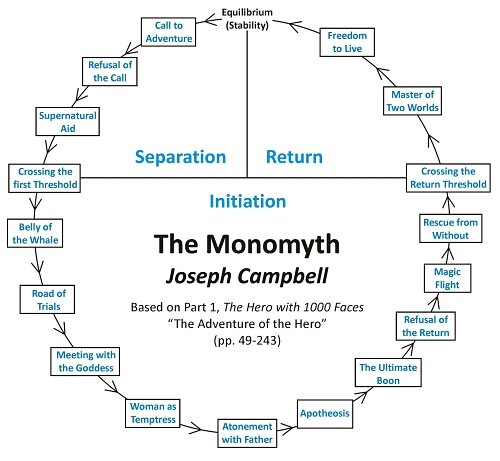
The full Hero's Journey has many distinct stages, but they all fit within a simple, three-act structure. Think of it as a cycle.
-
Separation (or Departure): The hero starts in a familiar, ordinary world. Something happens that calls them to adventure. They are reluctant at first, but a mentor figure often encourages them. They finally cross the threshold from their known world into a new, special world.
-
Initiation: This is the main body of the story. The hero faces a series of tests, meets allies, and confronts enemies. They learn the rules of this new world. Eventually, they face their greatest fear or challenge in a central crisis. By overcoming it, they gain a great reward or new insight.
-
Return: The hero must now travel back to their ordinary world with their reward. The journey back can have its own challenges. The hero returns transformed by their experience, ready to use their newfound wisdom to help others.
At its core, the Hero's Journey is about transformation. The hero leaves home as one person and returns as someone stronger, wiser, and fundamentally changed.
This structure provides a narrative arc that feels satisfying and complete. It resonates with us because, in many ways, it mirrors our own lives. We all face calls to adventure, overcome challenges, and are changed by our experiences. The Hero's Journey gives a framework to our own struggles and growth.
Ready to test your knowledge?
The scholar who studied world myths and popularized the concept of the 'monomyth' in his book The Hero with a Thousand Faces was...
What is the other name for the Hero's Journey, which describes the universal pattern of departure, adventure, and return?
Understanding this basic structure is the first step to recognizing it in the stories you love and using it to craft your own compelling narratives.