Mastering the Hero's Journey for Storytelling
Introduction to the Hero's Journey
The Hero's Blueprint
From ancient myths to modern blockbusters, many stories feel strangely familiar. A farm boy from a desert planet destroys a galactic superweapon. A young wizard discovers his magical heritage and confronts the dark lord who killed his parents. A humble hobbit journeys to destroy a powerful, corrupting ring.
These tales, though different on the surface, share a common structure. This underlying pattern isn't a coincidence; it's a narrative framework known as the Hero's Journey.
The Hero’s Journey is a pattern of narrative identified by the American scholar Joseph Campbell that appears in drama, storytelling, myth, religious ritual, and psychological development.
The term was popularized by Joseph Campbell, a mythologist who spent his life studying world myths. In his 1949 book, The Hero with a Thousand Faces, Campbell argued that countless stories from around the globe are fundamentally the same tale, which he called the “monomyth.” He believed this universal pattern reflects a deep, psychological need for stories of transformation and growth.
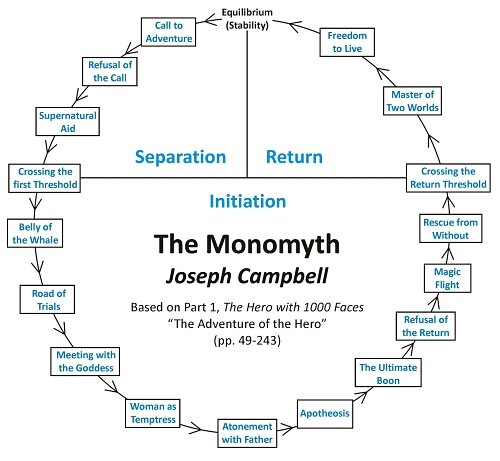
The Path of the Hero
Campbell's original framework contained 17 stages. However, a simplified 12-stage model, developed by screenwriter Christopher Vogler, has become a popular guide for modern storytelling, especially in Hollywood.
This structure is typically divided into three acts: the Departure, the Initiation, and the Return. In the first act, the hero is called away from their normal life. In the second, they face a series of trials in an unknown world. In the final act, they return home, transformed by their experience.
| Act | Stage |
|---|---|
| I. The Departure | 1. The Ordinary World |
| 2. The Call to Adventure | |
| 3. Refusal of the Call | |
| 4. Meeting the Mentor | |
| II. The Initiation | 5. Crossing the Threshold |
| 6. Tests, Allies, and Enemies | |
| 7. Approach to the Inmost Cave | |
| 8. The Ordeal | |
| 9. The Reward | |
| III. The Return | 10. The Road Back |
| 11. The Resurrection | |
| 12. Return with the Elixir |
Why It Resonates
The Hero's Journey provides a reliable blueprint for a compelling narrative. It taps into universal themes of struggle, growth, and transformation that audiences connect with on a fundamental level. For writers and creators, it's a powerful tool for structuring a story that feels both epic and deeply personal.
Think of Luke Skywalker in Star Wars. His Ordinary World is a moisture farm on Tatooine. His Call to Adventure is R2-D2's message. Obi-Wan Kenobi is his Mentor. He crosses the threshold into the Mos Eisley cantina and eventually returns as a Jedi Knight with the "elixir" of peace for the galaxy.
Or consider Frodo Baggins in The Lord of the Rings. The Shire is his Ordinary World. Gandalf's request to destroy the One Ring is the Call. After much struggle and with the help of allies, he completes his Ordeal at Mount Doom and returns, forever changed, to a peaceful Shire.
While not every story fits perfectly into this mold, the pattern appears so often that it's an essential concept for anyone interested in the craft of storytelling.
Ready to test your knowledge on this classic storytelling structure?
Who is the mythologist credited with popularizing the concept of the 'monomyth' in his book The Hero with a Thousand Faces?
The Hero's Journey is fundamentally a pattern describing a character's journey of...
Understanding this framework gives you a new lens through which to view the stories you love and a solid foundation for crafting your own.