Mastering The Hero's Journey for Storytelling
Introduction to The Hero's Journey
The Hero's Journey
Have you ever noticed a familiar pattern in your favorite stories? A reluctant hero from an ordinary world is called to a great adventure. They face challenges, overcome obstacles, and finally return home, changed forever. From ancient myths to modern blockbusters, this structure appears again and again.
This narrative blueprint is called the Hero's Journey. The term was popularized by scholar Joseph Campbell in his 1949 book, The Hero with a Thousand Faces. After studying myths from around the globe, Campbell discovered a single, universal pattern he called the “monomyth.” It’s a framework that taps into the core of human experience.
The Hero: From Hercules and Odysseus to Rama and Moana, the hero’s journey is a near-universal pattern.
While the details change, the fundamental journey remains the same. Campbell's full monomyth includes 17 stages, but they are typically simplified into three main acts.
The Three Acts
The Hero's Journey can be broken down into three essential parts: Departure, Initiation, and Return. Each act marks a major shift in the hero's adventure and personal transformation.
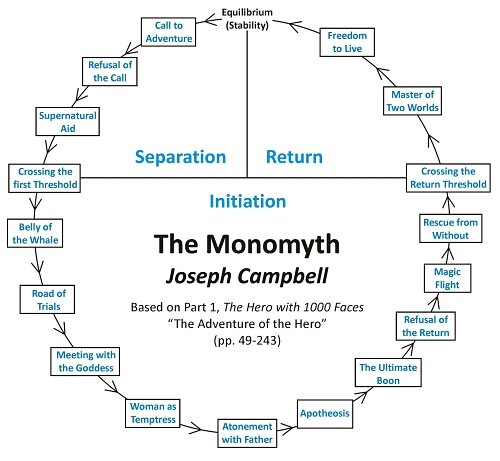
Act 1: Departure This is where the story begins. The hero lives in an ordinary world, but receives a call to adventure that would take them out of their comfort zone. Initially, they might refuse the call, but a mentor figure often appears to guide them. The act ends when the hero finally commits to the journey and crosses the threshold into the unknown.
Act 2: Initiation The hero ventures into the unfamiliar world, where they face a series of trials and tests. They meet allies who help them and enemies who stand in their way. This is where the hero confronts their greatest fears and undergoes a profound transformation. They achieve the goal of their quest, seizing a reward or gaining crucial insight.
Act 3: Return After their success, the hero must return to their ordinary world. The journey back is often fraught with its own challenges. The hero comes home with their reward, whether it’s a physical object or newfound wisdom. This boon is used to help others, and the hero, now a master of two worlds, has completed their transformation.
Why It Resonates
The Hero's Journey isn't just a formula for telling a good story. Its power comes from its reflection of our own lives. We all face calls to adventure, whether it's starting a new job, moving to a new city, or overcoming a personal challenge. We encounter obstacles, find allies, and hopefully return wiser and stronger.
By mirroring the fundamental pattern of trial, growth, and integration, the Hero's Journey creates stories that feel both epic and deeply personal.
Understanding this framework is the first step toward crafting stories that feel timeless and emotionally compelling. Now, let's check your understanding of these core concepts.
Who is the scholar credited with popularizing the concept of the "Hero's Journey" or "monomyth"?
A hero ventures into an unfamiliar world, faces a series of trials, and confronts their greatest fear. Which part of the Hero's Journey does this describe?
With this foundation, you can start to see the monomyth everywhere, from the books you read to the life you lead.