Mastering the Hero's Journey for Storytelling
Introduction to the Hero's Journey
The Universal Story
Have you ever noticed how many stories feel familiar? From ancient myths to modern blockbusters, a common pattern often emerges. This pattern is often called the Hero's Journey. It’s a framework that describes the typical adventure of a hero who goes on a quest, wins a victory, and comes home changed.
The Hero’s Journey is a pattern of narrative identified by the American scholar Joseph Campbell that appears in drama, storytelling, myth, religious ritual, and psychological development.
In his 1949 book The Hero with a Thousand Faces, mythologist Joseph Campbell studied myths from all over the world and found that they shared a fundamental structure. He called this structure the monomyth. The journey isn't just a series of events; it's a map of transformation, both for the character and often for the audience.
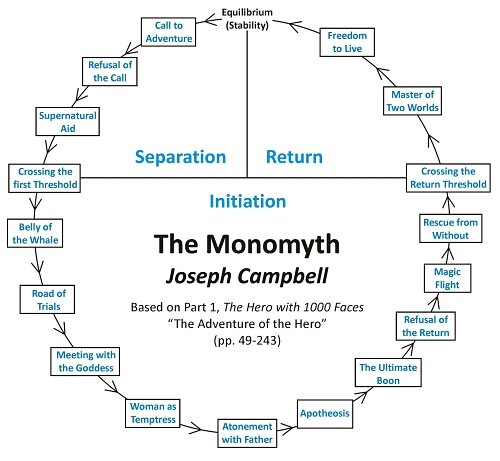
Campbell's original model had 17 stages, but a simplified 12-stage version is widely used by writers and filmmakers today. These 12 stages can be grouped into three main acts: The Departure, The Initiation, and The Return. Let's walk through them.
The 12 Stages
Each stage represents a crucial point in the hero's adventure, marking their growth from an ordinary person into a true hero.
Act 1: The Departure This is where the story begins. We meet our hero in their normal life before the adventure starts.
-
The Ordinary World: We see the hero's everyday life. This is the baseline, the world that will be disrupted.
-
The Call to Adventure: Something happens that pulls the hero out of their comfort zone. It's the first sign that change is coming.
-
Refusal of the Call: The hero is often hesitant or scared. They might doubt their abilities or fear the unknown, so they initially turn down the adventure.
-
Meeting the Mentor: The hero encounters a wise character who offers guidance, training, or a crucial tool for the journey ahead.
-
Crossing the First Threshold: The hero finally commits to the adventure. They leave their ordinary world behind and step into a new, unfamiliar one.
Act 2: The Initiation Now in the special world, the hero must face a series of challenges.
-
Tests, Allies, and Enemies: The hero learns the rules of the new world. They face tests, make friends who help them, and identify their enemies.
-
Approach to the Inmost Cave: The hero gets closer to their goal. This might be a dangerous location or an inner conflict they must prepare to face. It's a time of preparation for the biggest challenge.
-
The Ordeal: This is the central crisis of the story. The hero faces their greatest fear or a life-and-death moment. Everything is on the line. It's a dark moment, but one that leads to a rebirth.
-
Reward (Seizing the Sword): Having survived the ordeal, the hero takes possession of the treasure they were seeking. This might be a physical object, new knowledge, or reconciliation.
The Ordeal isn't just a big fight. It's the point where the hero must die, either literally or metaphorically, so they can be reborn stronger and wiser.
Act 3: The Return The final act is about bringing the reward back home.
-
The Road Back: The hero starts the journey back to their ordinary world. But the quest isn't over. They are often pursued by forces from the special world.
-
The Resurrection: The hero faces one last, final test. This is the climax where they must use everything they've learned to succeed. This final victory purifies and transforms them.
-
Return with the Elixir: The hero returns home as a changed person. They bring back something that benefits their community, like a treasure, wisdom, or a great story. The journey is complete.
Ready to test your knowledge? Let's see how well you remember the stages.
The mythologist who identified the shared structure in world myths and called it the 'monomyth' in his book The Hero with a Thousand Faces was:
The three main acts of the 12-stage Hero's Journey are The Departure, The Initiation, and _______.
This 12-step pattern provides a flexible yet powerful structure for creating stories that feel meaningful and resonant. It's a journey of transformation that we see again and again, in countless tales across time and cultures.