Mastering The Hero's Journey for Storytelling
Introduction to The Hero's Journey
The Hero with a Thousand Faces
Have you ever noticed that many of your favorite stories feel strangely similar? A farm boy from a desert planet destroys a galactic empire. A young wizard discovers his magical heritage and defeats a dark lord. A humble hobbit journeys to a volcano to destroy a powerful ring. These tales, though different on the surface, all follow a timeless pattern.
The Hero’s Journey is a pattern of narrative identified by the American scholar Joseph Campbell that appears in drama, storytelling, myth, religious ritual, and psychological development.
This powerful framework was popularized by Joseph Campbell, an American mythologist and writer. In his 1949 book, The Hero with a Thousand Faces, Campbell studied myths from cultures all over the world. He discovered that beneath the unique details of each story, there was a shared underlying structure. He called this universal pattern the monomyth, or the Hero's Journey.
monomyth
noun
A cyclical journey or quest undertaken by a mythical hero; the common template of a broad category of tales that involve a hero who goes on an adventure, wins a victory in a decisive crisis, and comes home changed or transformed.
The Core Structure
Campbell's monomyth isn't just a random series of events. It's a well-defined cycle with three main acts: Separation, Initiation, and Return. This structure maps the hero's transformation from an ordinary person into a true hero.
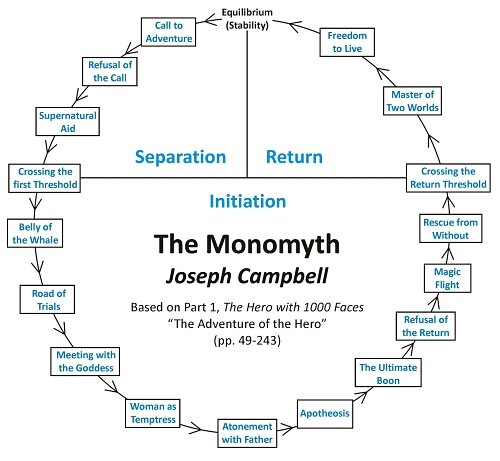
- Separation: The hero is pulled away from their ordinary, familiar world and into a place of adventure and danger. This often begins with a "Call to Adventure" they might initially refuse.
- Initiation: This is the heart of the story. The hero must face a series of challenges and trials, often with the help of a mentor or supernatural aid. They are tested, defeated, and ultimately transformed by a central crisis or ordeal.
- Return: After surviving their great test, the hero must journey back to their ordinary world. They bring with them a reward, a lesson, or a newfound wisdom that can benefit their community. The return itself often has its own set of challenges.
Each stage of the journey serves a purpose, systematically breaking down the hero's old self and building them into someone new.
A Universal Blueprint
The Hero's Journey resonates so deeply because it mirrors our own lives. We all face calls to adventure, whether it's starting a new job, moving to a new city, or facing a personal challenge. We undergo our own trials, learn from mentors, and hopefully return wiser and stronger.
This structure gives storytellers a powerful blueprint for crafting tales of transformation that feel meaningful and true. It's a pattern that has captivated audiences for thousands of years, and its influence can be seen in stories all around us, from ancient myths to modern blockbusters.
Now, let's test what you've learned about this foundational storytelling structure.
Who is the American mythologist credited with popularizing the "monomyth" or Hero's Journey in his book The Hero with a Thousand Faces?
What are the three main acts of the Hero's Journey, in the correct order?