Mastering The Hero's Journey for Storytelling
Introduction to The Hero's Journey
The Story We All Know
Have you ever noticed that many stories feel familiar? From ancient myths about gods and monsters to modern blockbusters about superheroes, a common pattern often emerges. A hero starts in a normal world, is called to an adventure, faces incredible challenges, and returns home changed. This is no accident. It’s a narrative structure known as the Hero's Journey.
The Hero’s Journey is a pattern of narrative identified by the American scholar Joseph Campbell that appears in drama, storytelling, myth, religious ritual, and psychological development.
The term was popularized by scholar Joseph Campbell in his 1949 book, The Hero with a Thousand Faces. Campbell studied myths from cultures all over the world and discovered that many shared this fundamental structure. He called it the "monomyth," or the one myth that connects all of humanity's stories. This framework provides a reliable blueprint for crafting a tale that feels both epic and deeply personal.
The Path of the Hero
The Hero's Journey is typically broken down into several stages. While Campbell originally identified 17, a more simplified 12-stage model is often used today. These stages act as a roadmap, guiding the hero from their comfortable beginning to a transformed end. The journey is cyclical, starting in the ordinary world and eventually returning to it, but the hero is never the same.
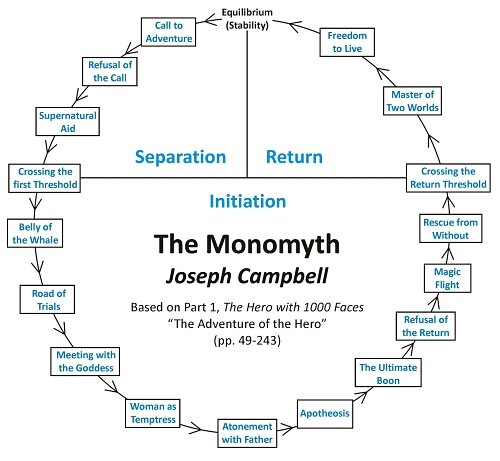
These stages are organized into three main acts: the Separation, where the hero leaves their familiar world; the Initiation, where they face their biggest trials; and the Return, where they come back with newfound wisdom or a special gift for their community.
An Overview of the 12 Stages
Here's a brief look at the 12 common stages of the Hero's Journey. You might recognize this pattern in stories like Star Wars, The Lord of the Rings, and Harry Potter.
| Stage | Name | Quick Description |
|---|---|---|
| 1 | The Ordinary World | The hero's normal life before the adventure. |
| 2 | The Call to Adventure | An event that disrupts the hero's life. |
| 3 | Refusal of the Call | The hero hesitates to accept the challenge. |
| 4 | Meeting the Mentor | The hero encounters a wise figure who helps them. |
| 5 | Crossing the Threshold | The hero commits to the journey and enters a new world. |
| 6 | Tests, Allies, and Enemies | The hero faces challenges and learns who to trust. |
| 7 | Approach to the Inmost Cave | The hero gets closer to the biggest danger. |
| 8 | The Ordeal | The hero faces their greatest fear or a life-or-death crisis. |
| 9 | Reward (Seizing the Sword) | The hero overcomes the ordeal and gains a reward. |
| 10 | The Road Back | The hero begins the journey back to their ordinary world. |
| 11 | The Resurrection | The hero faces a final, climactic test. |
| 12 | Return with the Elixir | The hero returns home, transformed, with a gift to share. |
From Luke Skywalker leaving his desert home to Frodo Baggins accepting the quest to destroy the One Ring, this structure gives stories a powerful, resonant shape. It's a timeless formula for adventure, growth, and transformation.