Mastering The Hero's Journey
Understanding the Monomyth
The Universal Story
Have you ever noticed how many stories feel familiar? From ancient myths to blockbuster movies, heroes often follow a similar path. They start in a normal world, face incredible challenges, and return home changed. This isn't a coincidence. It's a pattern.
In the mid-20th century, a scholar named Joseph Campbell studied myths from all over the world. He discovered this shared structure in countless tales, separated by oceans and centuries. He called it the monomyth, or the Hero's Journey.
The Hero’s Journey is a pattern of narrative identified by the American scholar Joseph Campbell that appears in drama, storytelling, myth, religious ritual, and psychological development.
The monomyth is a blueprint for transformation. It's a cycle of leaving home, venturing into the unknown, and coming back with a newfound wisdom or power. This structure resonates deeply with us because, in many ways, it mirrors our own lives and struggles.
Monomyth
noun
A common narrative template that involves a hero who goes on an adventure, wins a victory in a decisive crisis, and comes home changed or transformed.
The Three Main Acts
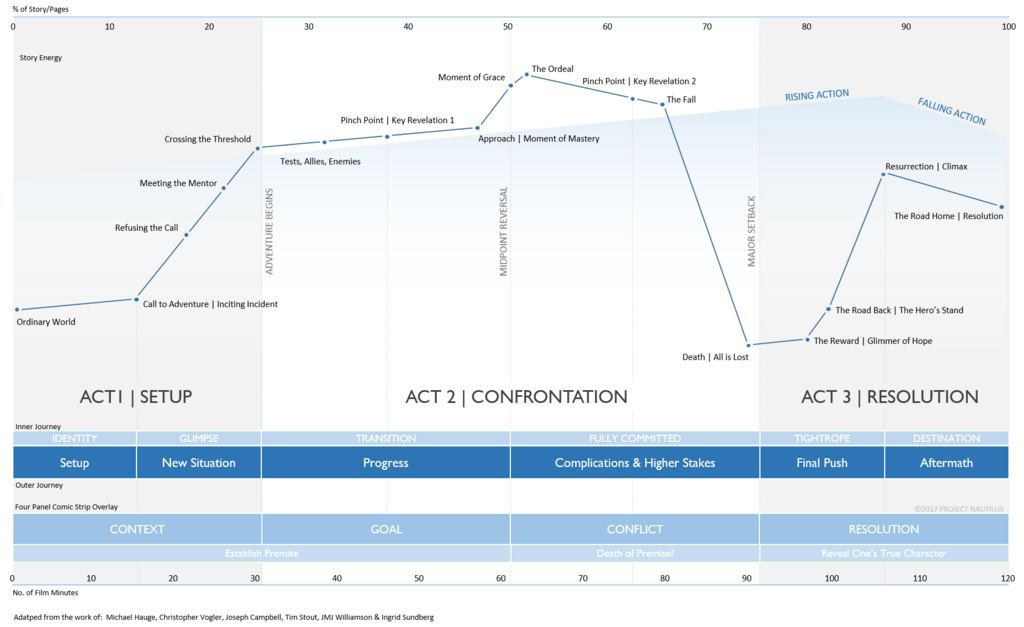
Campbell broke the Hero's Journey down into several stages, but they can be grouped into three main acts. This high-level view helps us see the big picture of the hero's progression.
-
Departure (or Separation): The hero starts in the ordinary world but is called to an adventure. They might be reluctant at first, but a mentor figure often encourages them to cross the threshold into a new, special world.
-
Initiation: This is the core of the journey. The hero faces a series of trials, meets allies and enemies, and confronts their greatest fear in a central crisis. By surviving this ordeal, they gain a reward, whether it's an object, knowledge, or a personal insight.
-
Return: The hero must now travel back to their ordinary world with their reward. The journey back can have its own challenges, but they eventually return, transformed by their experience. They bring back something that helps their community.
A Global Pattern
What makes Campbell's work so compelling is the universality of this pattern. The Hero's Journey isn't limited to one culture or time period. It appears everywhere, showing us that people across the world have always used stories to explore similar human experiences.
| Culture | Heroic Figure | Journey Highlights |
|---|---|---|
| Ancient Greece | Odysseus | Leaves home for the Trojan War, faces monsters, returns to Ithaca. |
| Ancient Sumeria | Gilgamesh | Confronts his mortality, seeks eternal life, returns with wisdom. |
| Buddhism | Siddhartha Gautama | Leaves his palace, seeks enlightenment, returns to teach. |
| Norse Mythology | Thor | Is cast out of Asgard, proves his worth on Earth, returns as a true hero. |
Each of these stories has unique details, characters, and cultural values. Yet, they all follow the fundamental rhythm of departure, trial, and transformation. This underlying structure is what makes them timeless tales of growth and discovery.
Ready to test your knowledge?
The scholar Joseph Campbell identified a shared narrative structure found in myths across the world. What did he call this pattern?
During which of the three main acts does the hero face a series of trials and confront their greatest fear?