Mastering the Handpan
Introduction to the Handpan
A New Sound
It looks a bit like a steel flying saucer and sounds like something from a dream. The handpan is one of the world's newest musical instruments, invented only in the early 2000s. Its resonant, soothing tones have captured the attention of musicians and listeners around the globe, making it a fixture in everything from street performances to meditation soundtracks.
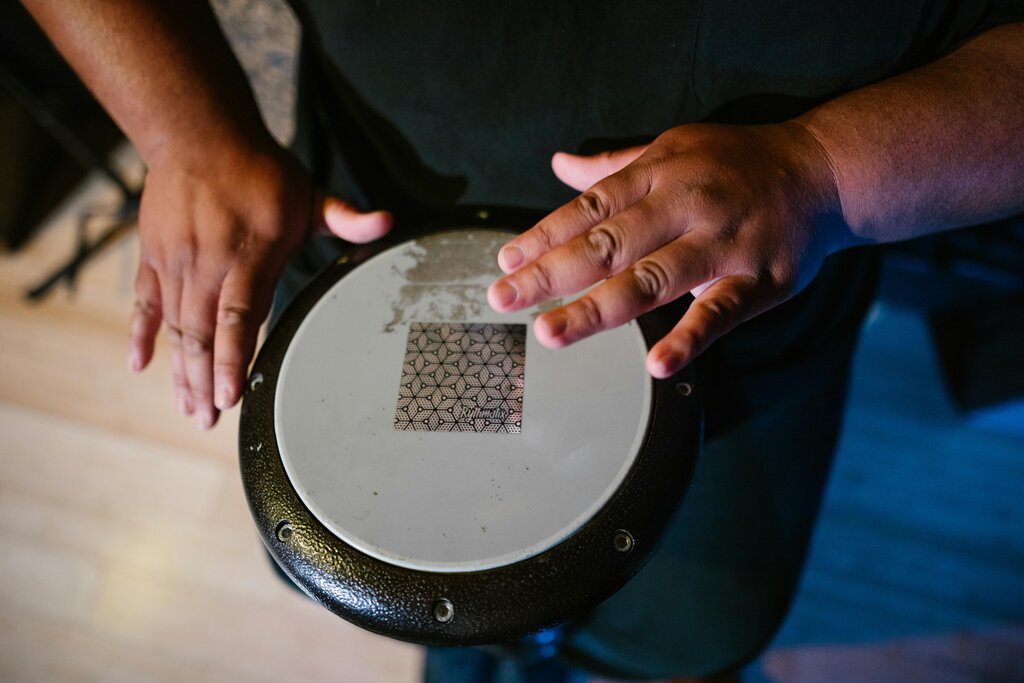
Despite its futuristic look, the handpan has roots in a much older tradition. Its story is a fascinating blend of cultural fusion and modern craftsmanship.
From Steelpan to Handpan
The direct ancestor of the handpan is the steelpan, the national instrument of Trinidad and Tobago. Developed in the 1940s, steelpans are made from oil drums hammered into a bowl shape, with different sections tuned to create specific pitches.
In the late 1990s, Felix Rohner and Sabina Schärer, two instrument makers from Bern, Switzerland, were known for their high-quality steelpans. Through their company, PANArt, they began experimenting with the form. They combined the principles of the steelpan with influences from other world instruments like the ghatam (an Indian clay pot drum) and the udu drum. The result of their innovation, unveiled in 2001, was the Hang.
The name "Hang" means "hand" in the Bernese German dialect, reflecting the intimate way the instrument is played.
The Hang was not mass-produced; each was a unique piece of sound sculpture. Its popularity exploded, and soon, other makers around the world began creating their own versions inspired by PANArt's design. The term "handpan" emerged as a generic name for this growing family of instruments.
Anatomy of a Handpan
A handpan is made of two convex half-shells of nitrided steel that are glued together at the rim. The top shell, or Ding side, has a central note hammered into it, called the Ding. This is the lowest note and acts as a central bass tone. Arranged in a circle around the Ding are several smaller tone fields, typically seven to nine of them, which form the instrument's scale.
The bottom shell is called the Gu side. It has a round opening in the center called the Gu, which acts as a Helmholtz resonator, similar to the sound hole on an acoustic guitar. Striking the rim of the Gu can produce a deep, resonant bass sound.
Because the sound is produced by the vibration of the instrument's body itself, the handpan is classified as an idiophone.
idiophone
noun
An instrument that creates sound primarily by the vibration of its own body, without the use of strings, membranes, or airflow. Cymbals and xylophones are other examples.
A World of Scales
Unlike a piano or guitar, a handpan is tuned to a single, fixed scale. This is one of its most defining characteristics. The notes are chosen to be harmonically pleasing, which means there are no "wrong" notes. This makes the instrument incredibly intuitive and accessible for beginners.
Handpan makers can create instruments in hundreds of different scales, each with its own unique mood and character. Scales are often inspired by music from around the world. For example:
- Kurd / Annaziska: A minor scale with a mysterious, melancholic feel, often associated with Middle Eastern music.
- Akebono: A pentatonic (five-note) scale with Japanese roots, creating a peaceful, meditative sound.
- Celtic Minor: A variation of a minor scale that evokes the feeling of Irish and Scottish folk music.
The choice of scale is the most important decision when acquiring a handpan, as it defines the entire musical palette the player will have. This is also why many enthusiasts eventually own multiple handpans, each offering a different emotional and sonic world to explore.
Let's check your understanding of the handpan's key features.
The direct ancestor of the handpan is the...
What is the primary function of the 'Gu' on the bottom shell of a handpan?
From a Swiss workshop to a global phenomenon, the handpan shows how modern innovation and ancient musical ideas can come together to create something entirely new.