Mastering the Guitar Fretboard
Fretboard Basics
Mapping the Fretboard
Think of the guitar neck as a grid. The strings run vertically, and the metal frets run horizontally. Every spot where your finger can press down is a specific musical note. Your first job is to learn the layout of this grid. It all starts with the open strings, the notes you get when you pluck a string without pressing it down on any fret.
In standard tuning, the six strings of the guitar are tuned to specific notes. From the thickest string (closest to you) to the thinnest, the notes are E, A, D, G, B, and E. A common mnemonic to remember this is Eddie Ate Dynamite, Good Bye Eddie.
Guitar string names can feel like a jumble of letters at first, but remembering them is a small yet vital step in your guitar journey.
Each fret on the guitar represents a half-step, which is the smallest interval in Western music. If you start on an open string and press down on the first fret, the note is one half-step higher. The second fret is two half-steps higher, and so on. This consistent pattern of half-steps is what allows you to find any note, anywhere on the neck.
Finding Your Way Around
Looking down at the fretboard, you’ll see dots or other inlays on the neck. These are fret markers, and they act as landmarks to help you navigate quickly. You don't have to count up from the first fret every time you want to find a note.
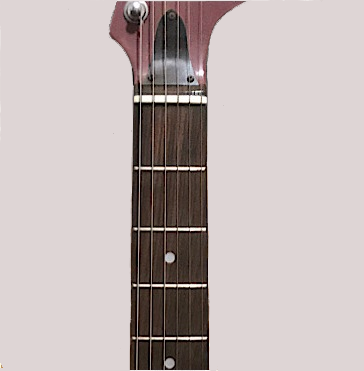
These markers are almost always on the 3rd, 5th, 7th, and 9th frets. The most important marker is at the 12th fret, which usually has a double dot or a unique inlay. This fret is special because it marks the octave.
Octave
noun
The same musical note at a higher or lower pitch. An octave is exactly double the frequency of the original note.
The note at the 12th fret of any string is the exact same note as the open string, just one octave higher. For example, the thickest string is an E when played open, and it's also an E at the 12th fret. After the 12th fret, the entire pattern of notes on the string repeats itself. This is a fundamental concept for understanding the fretboard's logic.
By understanding these three elements—standard tuning, the half-step nature of frets, and the octave at the 12th fret—you have the basic framework for finding every note on the guitar. You now know the starting note of each string and the point where its pattern repeats. This is the foundation upon which all chords, scales, and memorization techniques are built.
In standard guitar tuning, what are the notes of the six strings from the thickest (6th string) to the thinnest (1st string)?
What is the musical interval between an open string and the note played on the first fret of that same string?
With these basics in place, you're ready to start connecting the dots and truly learning the fretboard.