Mastering the Guitar Fretboard
Barre Chord Mechanics
Your Finger as a Capo
You already know how to play open chords like E major and A major. Barre chords take those familiar shapes and make them moveable. The trick is to use your index finger as a human capo, pressing down across all the strings at a single fret.
This single technique unlocks the entire fretboard. By learning just two primary shapes, you'll be able to play any major or minor chord, anywhere on the neck. It's all about repurposing shapes you already know.
The E Shape
Let's start with the E major chord shape. To turn it into a barre chord, you'll free up your index finger by using your other three fingers to form the shape.
- Place your index finger flat across all six strings at a fret—let's say the 3rd fret.
- Form the E major shape just in front of your barre, using your middle, ring, and pinky fingers on the 4th and 5th frets.
- Strum all six strings. You're now playing a G major chord.
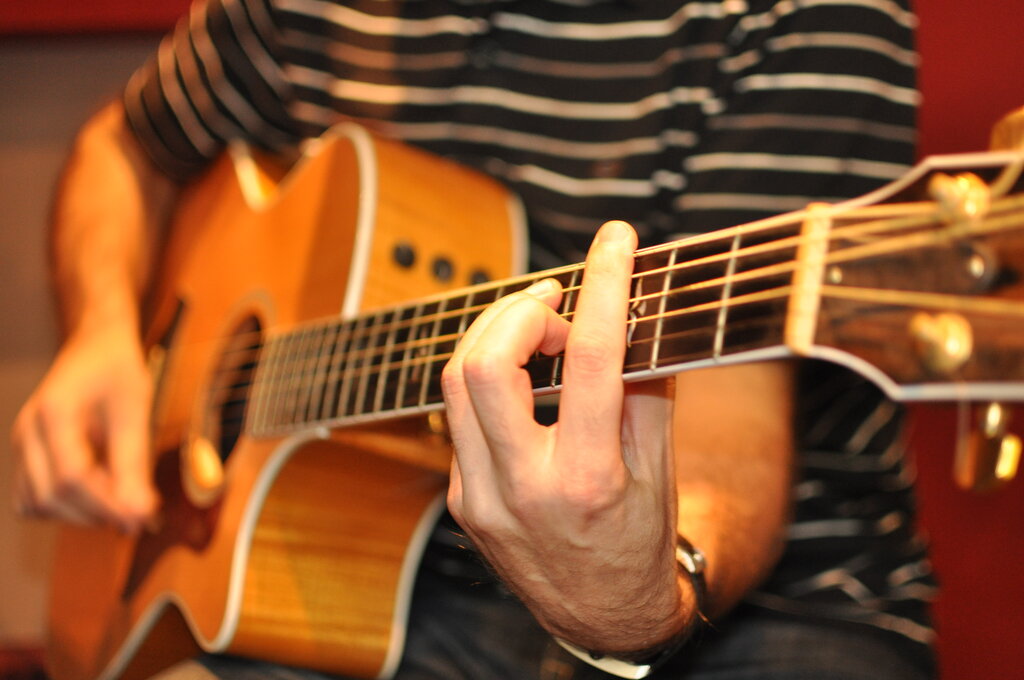
The chord gets its name from the your index finger is pressing on the thickest (6th) string. At the 1st fret, that note is F, so you get an F major chord. At the 3rd fret, it's G, giving you a G major. At the 5th fret, it's A, for an A major chord.
To play the minor version, simply lift your middle finger. That's it. This transforms the E major shape into an E minor shape, and you're now playing a G minor chord.
| Fret | Root on 6th String | E-Shape Major Chord | E-Shape Minor Chord |
|---|---|---|---|
| 1 | F | F major | F minor |
| 3 | G | G major | G minor |
| 5 | A | A major | A minor |
| 7 | B | B major | B minor |
The A Shape
The same principle applies to the A major shape. This time, the root note is on the 5th string (the A string). Since you won't play the low 6th string, your barre only needs to cover the top five strings.
- Place your index finger across the top five strings at a fret, for example, the 3rd fret. Mute the 6th string with the tip of your index finger or your thumb.
- Form the A major shape at the 5th fret using your other fingers. This can be tricky; many players use their ring finger to barre across the D, G, and B strings.
- Strum the top five strings. You've just played a C major chord.
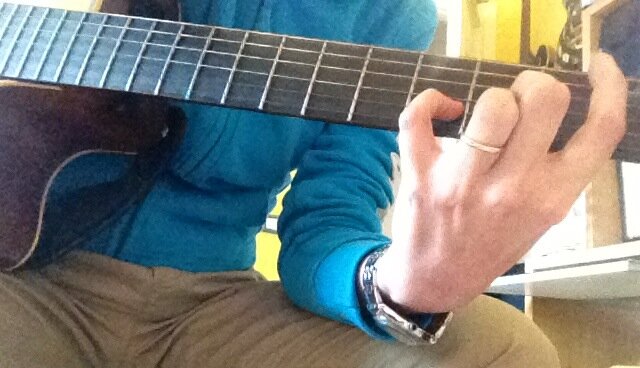
Because the root is on the A string, barring at the 2nd fret gives you a B major. Barring at the 3rd fret gives you a C major, and the 5th fret gives you a D major.
To make this an A-shape minor barre, you'll use the A minor open chord shape. This is often easier to finger than the major version.
| Fret | Root on 5th String | A-Shape Major Chord | A-Shape Minor Chord |
|---|---|---|---|
| 2 | B | B major | B minor |
| 3 | C | C major | C minor |
| 5 | D | D major | D minor |
| 7 | E | E major | E minor |
Avoiding Buzz and Pain
Getting a clean sound from every string is the biggest challenge with barre chords. It's not about raw strength, but technique. The most common mistake is thinking you need a death grip on the neck. Instead, focus on efficient pressure and proper hand position.
Your is crucial. Keep your thumb on the back of the neck, roughly behind your middle finger. This creates a pinching motion, giving you leverage without straining your wrist. Avoid letting your thumb creep over the top of the neck.
For the index finger, don't press with the soft, fleshy part. Roll it slightly onto its side, toward the thumb. This uses the bonier part of your finger, which applies more direct and even pressure. Finally, keep your wrist as straight as possible to prevent injury. A bent wrist is a weak wrist.
If you're getting Fret buzz on certain strings, test each one individually to see where the problem is. Often, a tiny adjustment in finger angle or pressure is all you need.
Building the necessary finger independence and strength takes time. Start with short, frequent practice sessions. It's better to practice for five minutes several times a day than for one frustrating half-hour session.
Ready to test your knowledge?
What is the primary function of your index finger when playing a barre chord?
If you use the E major shape to form a barre chord with your index finger at the 3rd fret, what chord are you playing?
With these two shapes, you've multiplied your chord vocabulary exponentially. Practice them slowly, focus on clean notes, and they will soon become second nature.