Mastering the Front Crawl
Body Position
Your Foundation in the Water
Before you even think about your arms or legs, the most crucial part of a fast and efficient front crawl is your body position. A good position cuts through the water with minimal resistance, a concept known as being streamlined. Think of it as the difference between pushing a flat board and a pointed spear through the water. Your goal is to be the spear.
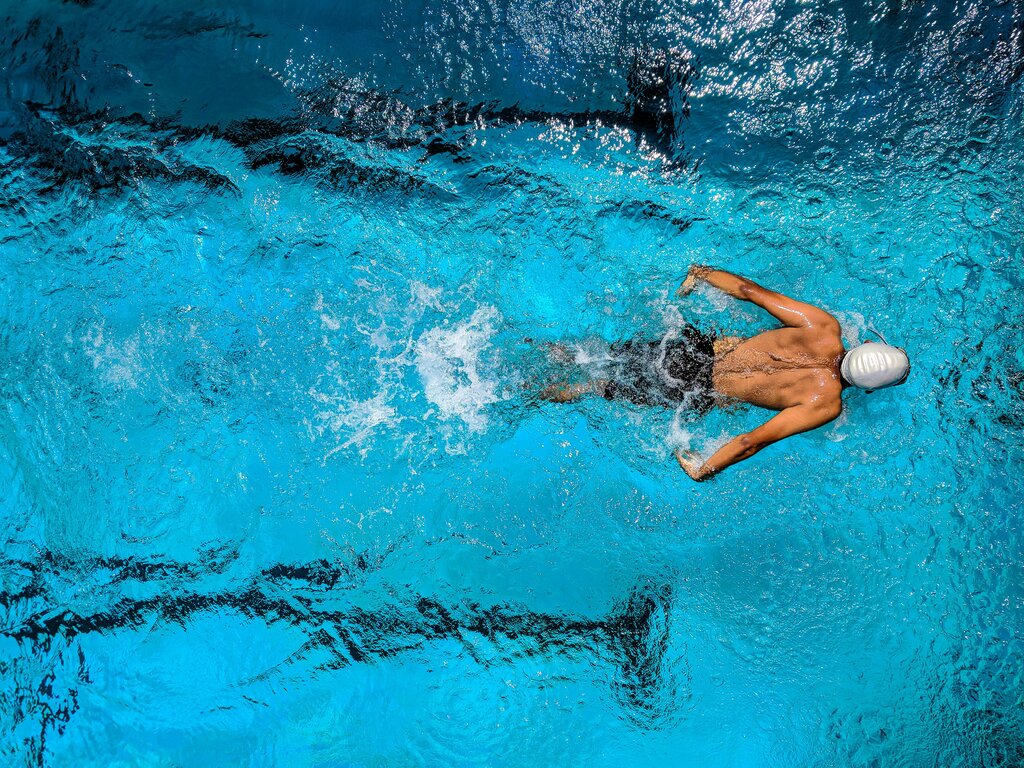
The foundation of a streamlined position is horizontal alignment. You want your body to lie flat on the surface, as if you were floating on your stomach. Many swimmers struggle with their legs and hips sinking, which creates a lot of drag and forces them to work much harder. To counteract this, engage your core muscles. This helps lift your hips and keeps your body level.
Try and swim with your body close to the surface of the water - imagine you are lying in a bed with your head on a pillow - and push your tummy up to the ceiling, keeping your midriff flat.
Where the Head Goes, the Body Follows
Your head position is the steering wheel for your body's alignment. If you lift your head to look forward, your hips and legs will sink like a seesaw. The correct position is neutral, with your head in line with your spine. Your face should be in the water, with your gaze directed mostly down at the bottom of the pool, but slightly forward. This keeps your entire body in a straight, efficient line.
Rotate for Power
A perfectly flat body is a good start, but the best swimmers incorporate a slight rotation. As one arm extends forward to enter the water, the body should rotate along its long axis, from the shoulders through the hips. This isn't a dramatic, jerky movement. It's a smooth, controlled roll from side to side with each stroke.
Why rotate? It allows you to use your stronger core and back muscles to power your stroke, not just your shoulders. It also makes your stroke longer by increasing your reach. Think of it like a corkscrew moving through the water. This rotation is the key to connecting your upper and lower body into one powerful unit.
Your shoulders and hips should rotate together. Avoid twisting your lower back by letting your hips follow your shoulders.
Mastering this stable, streamlined, and rotational body position is the first and most important step to swimming front crawl effectively. Once you feel balanced and comfortable in this posture, adding the propulsive movements of the arms and legs becomes much easier.