Mastering the Four Stroke Engine
Cycle Dynamics and Synchronization
The Engine's Mechanical Dance
You already know an engine's core components: the piston goes up and down, driven by combustion, turning the crankshaft. Meanwhile, the valves in the cylinder head open and close to let the air-fuel mixture in and the exhaust out. But how do these two separate actions stay perfectly synchronized? It's not magic; it's a precise mechanical relationship.
The key is a 2:1 rotational ratio. For every complete four-stroke cycle, the crankshaft must rotate twice, or 720 degrees. In that same period, the camshaft, which controls the valves, rotates only once, a full 360 degrees. This ensures each valve opens and closes just one time during the entire four-stroke sequence (intake, compression, power, exhaust).
When it comes to the many variables of combustion inside an engine, engineers measure the timing of key events in degrees of crankshaft rotation, a relative frame of reference that remains constant without needing to compensate for the engine’s changing rpm.
This synchronization is maintained by a physical link. In many engines, it's a or a timing chain connecting a gear on the crankshaft to a larger gear on the camshaft. The camshaft's gear has exactly twice the number of teeth as the crankshaft's gear, mechanically enforcing the 2:1 ratio. If this link breaks or slips, the piston can collide with a valve, causing catastrophic engine damage.
The Piston's Journey
The piston's entire range of motion happens between two precise points within the cylinder. The highest point it reaches is called (TDC), and the lowest point is (BDC). The distance between TDC and BDC is the engine's stroke length. Each stroke—intake, compression, power, or exhaust—corresponds to the piston moving from one dead center to the other.
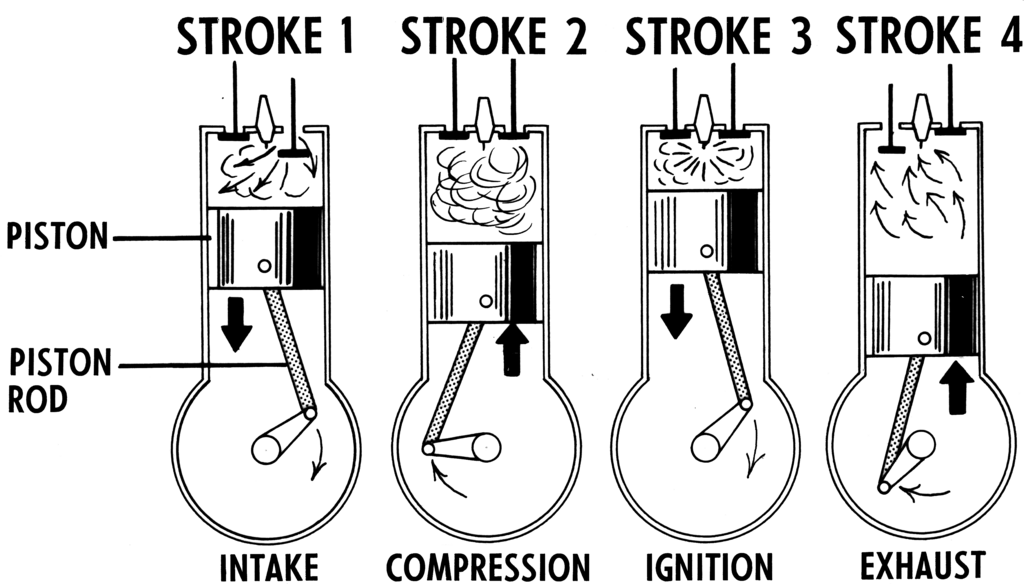
The piston doesn't move at a constant speed. It accelerates from TDC, reaches its maximum velocity around the middle of the stroke, and then decelerates as it approaches BDC. This constantly changing speed has a huge impact on how the engine breathes.
A faster-moving piston creates a stronger vacuum during the intake stroke, pulling the air-fuel mixture into the cylinder more quickly. This is a key factor in an engine's volumetric efficiency—its ability to fill its cylinders with air.
High Speed Challenges
At low RPM, this mechanical ballet is straightforward. But as engine speed increases, the physics gets more complicated. The inertia of the moving parts becomes a major force to manage.
One major issue at high RPM is This is when the valve springs aren't strong enough to close the valve completely before the camshaft lobe comes around to open it again. The valve literally 'floats' off its seat, leading to a loss of compression and power. To combat this, high-performance engines use stiffer valve springs and lightweight valve components.
Another challenge is maintaining air velocity. The air-fuel mixture has mass and inertia. At very high speeds, the intake valve might close before the rushing air has had a chance to completely fill the cylinder, hurting volumetric efficiency. Engineers design intake manifolds and ports with specific lengths and diameters—a process called intake tuning—to use the momentum of the air to help pack the cylinder as full as possible, even at high RPM.
Ready to test your knowledge on engine timing?
What is the rotational relationship between an engine's crankshaft and its camshaft during a complete four-stroke cycle?
What is the term for the highest point the piston reaches in its travel within the cylinder?
Understanding this precise timing is the key to seeing how an engine transforms simple up-and-down motion into controlled, usable power.