Mastering the Flow of Aikido
Dynamic Blending Mechanics
From Technique to Flow
You already know the shapes of Ikkyo and Shihonage. You can execute them from a static grab. But Aikido isn't about isolated techniques. It's about a continuous, adaptive flow of energy. The transition from static practice to dynamic application hinges on one core principle: , or blending. Instead of meeting force with force, you meet it with harmony.
Think of two streams of water merging. One doesn't block the other; they join and become a single, more powerful river. This is the essence of Awase. You're not stopping your partner's energy, you're joining it, redirecting it, and making it your own. This connection is called Musubi, the invisible tie that links you and your partner the moment an interaction begins. It's a state of unified energy, not just physical contact.
This principle fundamentally changes how you approach an attack. You are no longer just reacting; you are anticipating and merging.
The Art of Timing and Space
Dynamic blending requires a sophisticated understanding of , the correct interval of time and space between you and your partner. In static practice, Ma-ai is a fixed distance. In a dynamic encounter, it's constantly changing. Your job is to control that distance, not just maintain it.
Imagine a dancer moving around a fixed spotlight on a stage. The dancer can step into the light, out of it, or skirt its edge. Your partner's attack is that spotlight. Through your footwork—your Irimi (entering) and Tenkan (turning) movements—you control your position relative to their committed force. The key is to move before their force fully solidifies. If you wait until the punch is at full extension, it's too late. Your Irimi or Tenkan must begin as their intention forms, allowing you to enter a safe and advantageous position while they are still in motion.
The goal is to be where the attack isn't. By managing Ma-ai, you make their committed force strike empty space, creating an opportunity.
Continuous Off-Balancing
Kuzushi, or off-balancing, is not a single event. In dynamic practice, it's a process you maintain from the first touch to the final pin. As you blend with your partner's movement, your own centered, stable motion disrupts theirs. Every step you take, every turn you make, should further compromise their balance.
This is where your knowledge of Ikkyo and Shihonage comes alive. As you perform an Irimi movement to enter, you are not just positioning yourself for a throw. Your entry itself is the start of Kuzushi. By taking their center as you move, their balance begins to fail. As you Tenkan, you are not just turning away from force. You are turning with it, accelerating their momentum in a direction they didn't intend and can't control. Their own power becomes the source of their undoing.
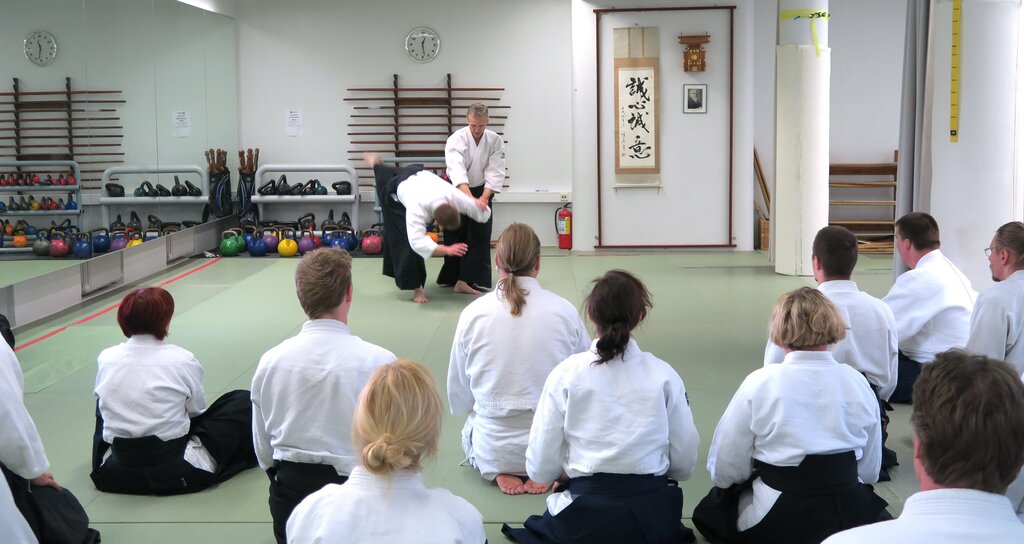
The final element that ties this all together is your breath. , the synchronization of breath and movement, is the engine of Aiki. When you enter, you exhale. When you turn, you exhale. This focused exhalation connects your physical movement to your center (hara), adding weight and power to your technique without muscular tension. It keeps you calm and focused, allowing you to feel your partner's intent more clearly.
A powerful, centered movement, synchronized with your breath, creates a continuous wave of Kuzushi that your partner cannot recover from. This is the heart of dynamic Aikido.
Let's review the key ideas before testing your understanding.
Now, let's see how well you've grasped these concepts.
According to the text, what is the core principle that enables the transition from static to dynamic Aikido?
In a dynamic context, what is the primary goal of footwork like Irimi (entering) and Tenkan (turning)?
Applying these principles turns your Aikido from a series of disconnected moves into a single, fluid expression of harmony and control. It's a challenging step, but it's where the art truly begins.