Mastering the English Language
Introduction to English Sounds
The Building Blocks of Sound
Spoken English is built from small units of sound called phonemes. Think of them like atoms for language. The word “cat” has three letters, but it also has three phonemes: the “c” sound, the “a” sound, and the “t” sound.
Here’s the tricky part: English spelling isn't always a reliable guide to pronunciation. The letters 'g' and 'h' in “enough” make an “f” sound. The letter 'a' sounds different in “apple,” “father,” and “make.” To talk about sounds accurately, we need to look past the letters and focus on the phonemes themselves.
Phoneme
noun
The smallest unit of sound in a language that can distinguish one word from another.
Vowels and Consonants
Every sound in English is either a vowel or a consonant. The difference is all about airflow.
When you make a vowel sound, air flows freely from your lungs out through your mouth. Your tongue and lips shape the sound, but they don't block the air. Try saying “ah” and you’ll feel that open flow.
Consonants are the opposite. To make a consonant sound, you have to obstruct the air in some way. When you say the “p” sound, your lips close for a moment to stop the air. For an “s” sound, your tongue gets close to the roof of your mouth, creating friction as the air squeezes through.
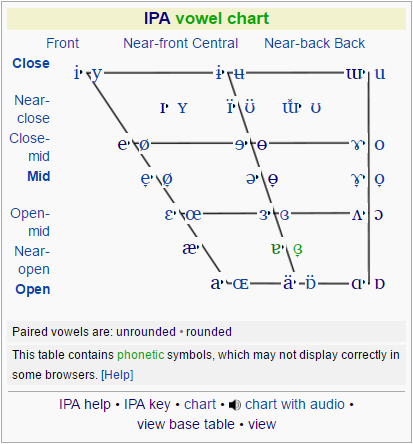
English has only five vowel letters (a, e, i, o, u), but it has around 20 distinct vowel sounds, depending on the dialect. This mismatch is a major reason English pronunciation can be so challenging. The single letter 'o' represents different sounds in the words “go,” “do,” “hot,” and “women.”
Consonants are a bit more straightforward, but they have their quirks too. For example, the letters 't' and 'h' combine to make two different sounds, as in “thin” and “this.”
A Universal Alphabet for Sounds
Because spelling is so inconsistent, linguists created the International Phonetic Alphabet, or IPA. The IPA is a system where every symbol represents exactly one sound. It works for any language, and it’s an incredibly useful tool for learning pronunciation.
Those symbols are the International Phonetic Alphabet (IPA), and learning to read them is one of the best ways to improve your English pronunciation.
Using the IPA removes the guesswork. For instance, the word “cat” is written as /kæt/. The symbol /k/ is the hard 'c' sound, /æ/ is the vowel sound in “cat” or “apple,” and /t/ is the 't' sound. The word “sheep” is /ʃip/. The symbol /ʃ/ represents the “sh” sound, and /i/ is the long vowel sound in “see” or “feet.”
| Letter(s) | IPA Symbol | Example Word |
|---|---|---|
| a (as in cat) | /æ/ | apple, bat |
| ee (as in feet) | /i/ | see, meet |
| sh (as in shoe) | /ʃ/ | crash, fish |
| ch (as in cheese) | /tʃ/ | watch, future |
Putting It Into Practice
Understanding the theory is great, but improving your pronunciation requires active practice. One of the best ways to train your ear and your mouth is by working with minimal pairs.
Minimal pairs are two words that are pronounced identically except for one sound. Examples include ship /ʃɪp/ and sheep /ʃip/, or pin /pɪn/ and pen /pɛn/. Practicing these helps you isolate and master difficult sounds.
Try saying a minimal pair out loud. Can you hear the difference? Can you feel the difference in your mouth as you make the sounds? For an extra challenge, record yourself speaking and play it back. It’s a powerful way to hear what you actually sound like and identify areas for improvement.
TIP: Record yourself saying these sounds and compare to native audio.
Ready to check your understanding? Let's try a few questions.
What is the primary difference between how vowel and consonant sounds are produced?
How many phonemes (distinct sounds) are in the word "enough"?
By focusing on the individual sounds of English, you're building a strong foundation for clear and confident speaking.