Mastering the Efficient Frontier
Introduction to Portfolio Management
What is a Portfolio?
Think of an investment portfolio like a playlist. You wouldn't create a playlist with just one song, or even just one artist. You'd mix different genres and tempos to fit various moods. A portfolio is simply a collection of different financial investments, like stocks, bonds, and cash, held by one person or organization.
The goal isn't just to own things; it's to combine them in a way that helps you reach your financial goals. Instead of putting all your money into a single company's stock, you spread it across various assets. This mix is what we call a portfolio.
The Risk and Return Trade-Off
Every investment involves a fundamental trade-off between risk and return. In simple terms, you can't get high returns without taking on some level of risk.
Return
noun
The profit or loss you make on an investment, usually expressed as a percentage.
Risk
noun
The chance that an investment's actual return will be different than expected, including the possibility of losing some or all of the original investment.
Generally, investments with the potential for higher returns also carry higher risk. For example, a government bond is considered very safe, but its returns are typically low. A stock in a small, new technology company could potentially skyrocket in value, but it could also become worthless. This relationship is a core concept in investing.
The Power of Diversification
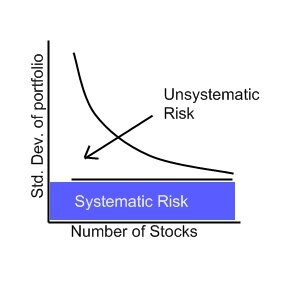
You've probably heard the saying, "Don't put all your eggs in one basket." This is the essence of diversification. It's a strategy for managing risk by investing in a variety of assets that are unlikely to all move in the same direction at the same time.
Imagine you own stock in two companies: one that sells sunscreen and another that sells umbrellas. If it's a sunny summer, your sunscreen stock will likely do well, while the umbrella stock might not. If it's a rainy season, the reverse might be true. By owning both, you smooth out your returns. A bad season for one company is offset by a good season for the other.
The goal of diversification is not necessarily to boost performance, but to reduce the volatility of your portfolio over time.
This principle applies to your entire portfolio. When you combine different types of assets, like stocks from different industries and countries, along with bonds and other investments, you reduce the impact that any single poor-performing asset can have on your overall wealth. While one part of your portfolio may be struggling, another part may be thriving.
Building Your Asset Allocation
Asset allocation is the practical application of diversification. It's how you decide to divide your portfolio among different categories, or asset classes. The three main asset classes are stocks, bonds, and cash.
| Asset Class | Description | Typical Risk Level |
|---|---|---|
| Stocks (Equities) | Ownership shares in a company. | High |
| Bonds (Fixed Income) | A loan made to a corporation or government. | Low to Medium |
| Cash & Equivalents | Money in savings accounts, money market funds. | Very Low |
Your ideal asset allocation depends on your personal situation. Key factors include your financial goals (e.g., buying a house, retirement), your time horizon (how long until you need the money), and your personal tolerance for risk. A younger investor with decades until retirement can typically afford to take on more risk by holding a higher percentage of stocks. Someone nearing retirement might prefer the stability of a portfolio with more bonds.
For example, an aggressive allocation might be 80% stocks and 20% bonds. A more conservative mix could be 40% stocks and 60% bonds.
Deciding on your asset allocation is one of the most important decisions you'll make as an investor. It sets the foundation for your portfolio's long-term performance and risk profile.
What is the primary purpose of creating an investment portfolio?
Which statement best describes the fundamental relationship between risk and return in investing?