Mastering the Distance Formula
Pythagorean Derivation
From Triangles to Distance
You already know that the shortest distance between two points is a straight line. But how do you measure that line on a coordinate plane? You can't just count the squares if the line is diagonal. The answer comes from a familiar shape: the right-angled triangle.
Let's take any two points on the plane, say Point A at and Point B at . If we draw a straight line connecting them, that line becomes the hypotenuse of a right-angled triangle. The other two sides are simply the horizontal and vertical distances between the points.
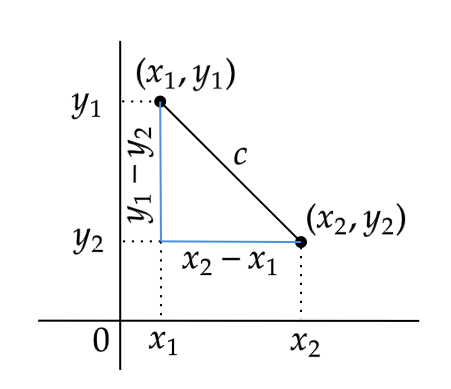
The length of the horizontal leg is the difference between the x-coordinates. We can write this as . The length of the vertical leg is the difference between the y-coordinates, or .
These two lengths, and , are the two shorter sides of our right-angled triangle. The distance we want to find, let's call it , is the hypotenuse.
The Distance Formula is a variant of the Pythagorean Theorem that you used back in geometry.
Building the Formula
With our triangle's sides defined, we can apply the which states . In our case, is the horizontal change , is the vertical change , and is the distance .
Substituting our values into the theorem gives us:
If we replace and with their coordinate definitions, we get:
To solve for , we just need to take the square root of both sides. This gives us the final Distance Formula.
An important feature of this formula is the squaring of the differences. It doesn't matter if or is negative. For instance, the distance from (2, 5) to (7, 1) is the same as the distance from (7, 1) to (2, 5). Squaring any number, positive or negative, results in a positive value. This makes perfect sense, as distance cannot be negative.
A Practical Example
Let's find the distance between the points (–3, 2) and (5, –4).
First, we'll label our points to stay organised:
- Point 1 = (–3, 2)
- Point 2 = (5, –4)
Now, plug these values into the distance formula.
The distance between the two points is exactly 10 units. Notice how the negative coordinates didn't cause any problems. The act of squaring handles the signs automatically, ensuring the result reflects a true —the straight-line length we perceive in the real world.
Let's test your understanding of this concept.
The distance formula is a direct application of which fundamental mathematical theorem?
Calculate the distance between Point A at (2, 3) and Point B at (5, 7).
By building a right-angled triangle between any two points, we can use a timeless geometric theorem to measure any straight line on the coordinate plane.