Mastering the Countercurrent Mechanism
Thick Ascending Limb Mechanisms
The Diluting Segment
As the tubular fluid leaves the thin ascending limb and enters the thick ascending limb (TAL), it encounters a dramatically different environment. The cells lining this segment are thick, packed with mitochondria, and metabolically very active. Most importantly, the TAL is completely impermeable to water. No aquaporins are present, so water is trapped inside the tubule, regardless of the osmotic gradients.
This impermeability is the key to the kidney's ability to create concentrated urine. While water is held back, the TAL actively pumps solutes out of the tubular fluid and into the surrounding interstitial space. This section effectively dilutes the urine while concentrating the interstitium.
The Solute Pump
The primary engine of this process is a powerful protein on the apical membrane (the side facing the tubular fluid) called the Na-K-2Cl cotransporter, or NKCC2. This transporter simultaneously moves one sodium ion (Na⁺), one potassium ion (K⁺), and two chloride ions (Cl⁻) from the tubular fluid into the TAL cell. It's a form of secondary active transport, meaning it doesn't use ATP directly. Instead, it harnesses the energy stored in the sodium concentration gradient.
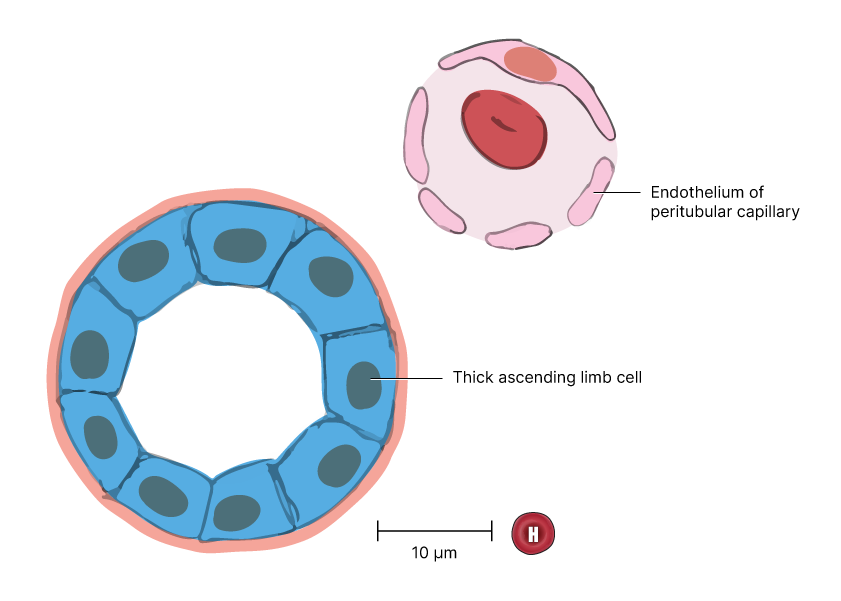
This gradient is maintained by another crucial player: the Na⁺/K⁺-ATPase pump. Located on the basolateral membrane (the side facing the interstitium and blood), this pump uses ATP to actively transport sodium out of the cell and potassium into it. By keeping the intracellular sodium concentration very low, it creates a powerful electrochemical pull that drives the NKCC2 cotransporter to bring more sodium, potassium, and chloride into the cell from the lumen.
There's a clever trick with the potassium. While it's brought into the cell by NKCC2, much of it leaks right back out into the lumen through a channel called ROMK. This recycling of a positive ion makes the tubular fluid electrically positive compared to the cell. This positive charge then helps push other positive ions, like magnesium (Mg²⁺) and calcium (Ca²⁺), across the tight junctions between cells into the interstitium via paracellular transport—a crucial mechanism for reabsorbing these minerals.
The Single Effect
The net result of all this activity is the constant removal of NaCl from the tubular fluid into the interstitium. Since water cannot follow, the tubular fluid becomes progressively more dilute (hypotonic), while the interstitium becomes more concentrated (hypertonic).
This process establishes a consistent osmotic gradient of about 200 mOsm/L between the fluid inside the TAL and the interstitial fluid outside.
This creation of a 200 mOsm/L difference is known as the single effect. It might not seem like a huge gradient on its own, but it is the fundamental step that, when multiplied along the length of the loops of Henle, allows the kidney to generate the massive concentration gradient in the medulla needed to produce highly concentrated urine.
What is the direct consequence of the thick ascending limb (TAL) being impermeable to water while actively reabsorbing solutes?
What is the primary role of the Na-K-2Cl cotransporter (NKCC2) on the apical membrane of TAL cells?