Mastering the Core Kicks
Kicking Mechanics and Kinetics
The Body as a Whip
An effective kick doesn't start with the leg. It starts with the ground. Think of your body as a whip, with your foot as the tip. The handle is your connection to the floor. Power is generated by pushing off the ground and channeling that energy sequentially up through your body. This sequence of movement is called the —a linked system where movement in one joint transfers energy to the next.
When you initiate a kick, you first shift your weight. This initial movement seems subtle, but it's loading the spring. The force travels up your leg, into your hips, which then rotate or thrust forward. The leg itself is the last part of the chain to move, accelerating rapidly to deliver the accumulated energy to the target. Simply lifting and extending your leg without this ground-up sequence results in a weak, pushy motion with little impact.
The Universal Chamber
Before any kick is thrown, the leg must be brought into a preparatory position called the 'chamber'. This is a non-negotiable step for generating power and maintaining balance. To chamber your leg, you lift your knee up and towards your chest, keeping your lower leg tucked underneath. From this coiled position, you can unleash a variety of strikes.
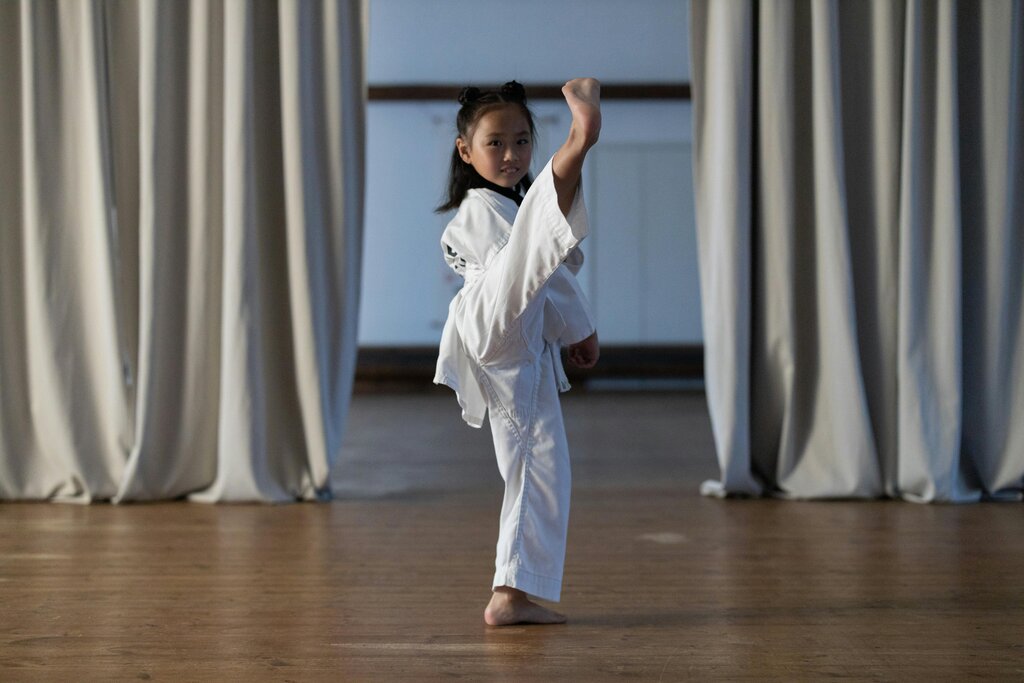
The chamber serves two main purposes. First, it pre-loads the muscles of your hips and legs, much like drawing back a bowstring. The higher and tighter the chamber, the more potential energy you store. Second, it masks your intentions. From the same chambered position, you could throw a front kick, a side kick, or a roundhouse kick, making it difficult for an opponent to predict your next move.
Linear vs. Rotational Force
While both the front kick and roundhouse kick begin from a similar chamber, their power delivery is fundamentally different. The front kick is a linear strike. Your hips thrust forward, driving your foot straight into the target like a piston. All the energy is directed in a straight line, making it a powerful pushing or piercing tool.
The roundhouse kick, in contrast, generates rotational torque. To achieve this, you must pivot on the ball of your supporting foot. This is the anchor point around which your entire body rotates. As your hips turn over, they pull your kicking leg through in a powerful arc. The force is delivered sideways, like a baseball bat swing. Without a proper pivot, the kick loses its power and puts dangerous twisting stress on your own knee and ankle.
After impact, balance recovery is crucial. Whether pushing or rotating, you must be able to retract your leg quickly back to the chambered position or place it down smoothly into your stance. Letting your leg fall uncontrolled leaves you vulnerable and off-balance. The key is core engagement—keeping your abdominal muscles tight throughout the entire motion provides the stability to control both the extension and retraction of the kick.
Understanding the kinetic chain can help identify and correct movement dysfunctions, reducing the risk of injuries.
Let's review these core concepts.
Now, test your understanding of these principles.
According to the text, where does the power for an effective kick originate?
What are the two main purposes of bringing the leg into a 'chamber' position before a kick?
By mastering these biomechanics, you transform a simple leg movement into a powerful, efficient, and safe striking technique. It's the difference between flailing and fighting.