Mastering the Classics
Subjunctive Mood Mastery
Beyond Simple Statements
You already know the indicative mood. It’s the mood of facts, of statements, of reality. "Caesar conquers Gaul." "The sun is shining." But what about the vast world of non-reality? How did Romans express wishes, commands, possibilities, or doubts? For this, they turned to the subjunctive mood.
The subjunctive doesn't state what is, but what might be, what should be, or what someone wants to be. It's the mood of potential and persuasion. Mastering it is the key to unlocking the subtle, persuasive power of authors like Cicero, who didn't just report events but tried to shape them with his words.
Building the Forms
Before we see the subjunctive in action, we need to know how to build it. Each of the four tenses (present, imperfect, perfect, and pluperfect) has a unique subjunctive form.
Present Subjunctive: The Vowel Shift The easiest way to remember the present subjunctive is with a mnemonic for the vowel changes: She wears a diamond tiara. This corresponds to the vowel shifts for each conjugation:
1st conjugation (-āre) verbs change their stem vowel to -e-. 2nd conjugation (-ēre) verbs change their stem vowel to -ea-. 3rd conjugation (-ere) verbs change their stem vowel to -a-. 3rd -iō & 4th (-īre) verbs change their stem vowel to -ia-.
| Conjugation | Indicative | Subjunctive Vowel | Example (he/she/it) |
|---|---|---|---|
| 1st | amat | e | amet |
| 2nd | monet | ea | moneat |
| 3rd | regit | a | regat |
| 3rd -iō | capit | ia | capiat |
| 4th | audit | ia | audiat |
For the other tenses, the process is more straightforward.
The imperfect subjunctive is wonderfully simple to form. You just take the present active infinitive and add the standard active personal endings (-m, -s, -t, -mus, -tis, -nt).
The perfect active subjunctive is formed from the perfect stem, just like the perfect indicative. You add the ending series -erim, -eris, -erit, -erimus, -eritis, -erint.
Perfect Stem of amō: amāv- Perfect Active Subjunctive: amāverim, amāveris, amāverit... (I may have loved)
Finally, the pluperfect active subjunctive also uses the perfect stem. This time, you add the endings -issem, -isses, -isset, -issemus, -issetis, -issent.
Perfect Stem of amō: amāv- Pluperfect Active Subjunctive: amāvissem, amāvissem, amāvisset... (I might have had loved)
Passive subjunctive forms follow a similar pattern, combining the perfect passive participle with the present subjunctive of esse (sim, sis, sit...) for the perfect passive, and the imperfect subjunctive of esse (essem, esses, esset...) for the pluperfect passive.
Speaking with Intent
Now let’s look at how the subjunctive works on its own, in main clauses. These independent uses are direct expressions of the speaker's will or perspective.
The Hortatory subjunctive encourages action. It appears in the first-person plural and is best translated as "Let us..." It’s a call to arms, an invitation, or a group suggestion.
Pugnēmus! – Let us fight! Ad forum eāmus. – Let us go to the forum.
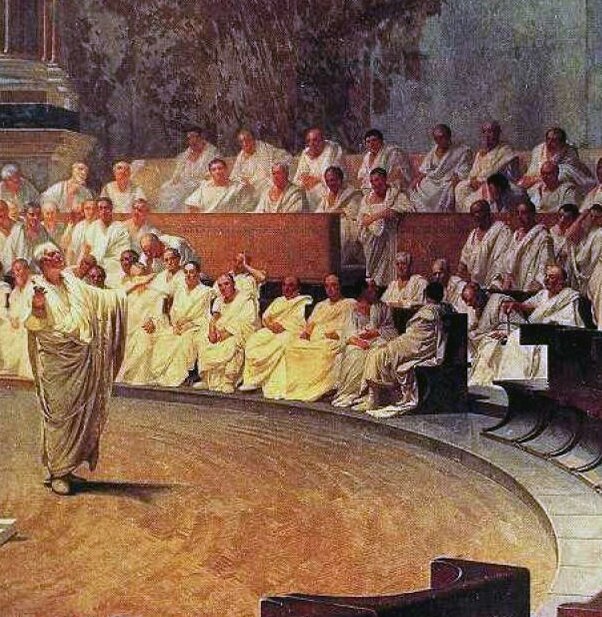
Closely related is the Jussive subjunctive, which expresses a command or order, usually in the third person. Think of it as a less direct, more formal command than the imperative. It translates as "Let him/her/it/them..." This was a favourite tool of orators like Cicero to suggest what course of action others should take.
Dīcat sententiam. – Let him speak his opinion.
The negative for both the hortatory and jussive is nē.
Nē id faciamus. – Let's not do that.
The Optative subjunctive expresses a wish. If you see the word utinam ("if only," "would that"), you're almost certainly looking at an optative subjunctive. The tense used reveals whether the wish is possible or not.
- Present Subjunctive: A wish for the future (which might come true). Utinam veniat! – If only he would come!
- Imperfect Subjunctive: A wish about the present (that is not true). Utinam adesset! – If only he were here (but he isn't).
- Pluperfect Subjunctive: A wish about the past (that did not happen). Utinam vēnisset! – If only he had come (but he didn't).
Two other uses round out the independent subjunctives. The Potential subjunctive suggests an action that could or might happen. The subject is often indefinite, like "one" or "someone."
Crēdās – You might believe (or: One might believe). Quis hoc crēdat? – Who would believe this?
Finally, the Deliberative subjunctive is used to ask a rhetorical question, often expressing doubt or indignation. The speaker is deliberating about what to do or think.
Quid faciam? – What am I to do? Rōmae maneam an rūs eam? – Should I stay in Rome, or go to the country?
Understanding these independent uses is your first major step into the nuanced world of Roman rhetoric and thought. It's the difference between reading a simple report and hearing a persuasive speech as a Roman would have.
What is the primary function of the subjunctive mood in Latin?
How is the imperfect active subjunctive typically formed?