Mastering the Circle of Fifths
Introduction to the Circle of Fifths
The Musician's Map
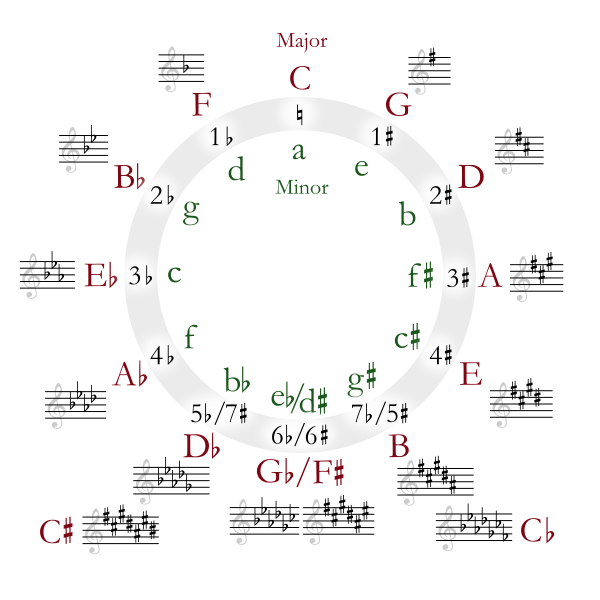
The Circle of Fifths is a visual map of all 12 notes in Western music. It arranges them in a specific way that reveals how they relate to each other. Think of it like a color wheel, but for musical keys. Just as some colors look good together, some keys sound good together, and the circle shows us which ones.
It’s called the Circle of Fifths because each note on the circle is a perfect fifth away from the one next to it. A perfect fifth is a specific musical interval. If you sing the first two notes of “Twinkle, Twinkle, Little Star,” you're singing a perfect fifth.
Building the Circle
Let’s build the circle piece by piece. We start at the top with C major, the simplest key, which has no sharps or flats.
If we move clockwise, we go up by a perfect fifth each time. A fifth up from C is G. The key of G major has one sharp (F♯). Move another fifth up from G, and you get D. The key of D major has two sharps (F♯ and C♯). This pattern continues all the way around the circle, adding one sharp for each step.
Now let’s go the other way. If you move counter-clockwise from C, you go down a perfect fifth. A fifth down from C is F. The key of F major has one flat (B♭). Move another fifth down from F, and you land on B♭. The key of B♭ major has two flats (B♭ and E♭). This pattern also continues, adding one flat for each step.
At the bottom of the circle, the sharp and flat keys meet. For instance, the key with six sharps (F♯ major) sounds exactly the same as the key with six flats (G♭ major). These are called enharmonic equivalents—same sound, different name.
Major and Minor Keys
The circle isn't just for major keys. Each major key has a sibling, called its relative minor, which shares the exact same key signature.
relative minor
noun
A minor key that has the same sharps or flats as its corresponding major key.
On the Circle of Fifths, the relative minor keys are usually shown on an inner circle. For example, C major's relative minor is A minor. Both have zero sharps and flats. G major's relative minor is E minor; both have one sharp. The relationship is consistent all the way around.
A simple trick to find any relative minor is to go down three half-steps from the major key's root note. From C, go down to B, then B♭, then A. That's A minor.
Why It Matters
So, why is this circle so important? Its main job is to show closeness. Keys that are next to each other on the circle are very closely related. They sound similar because they share almost all of the same notes.
For example, C major (C, D, E, F, G, A, B) and its neighbor G major (G, A, B, C, D, E, F♯) share six out of seven notes. The only difference is that C major has an F, while G major has an F♯. This close relationship is why moving between adjacent keys sounds smooth and natural in music.
Keys that are far apart on the circle, like C major and F♯ major, share very few notes and create a much more dramatic shift in sound when you move between them.
Understanding this map of musical relationships is a huge step. It helps you see the underlying structure of songs, understand why certain chords work together, and ultimately gives you a framework for writing your own music.
Ready to test your knowledge?
What is the primary purpose of the Circle of Fifths?
Starting from C major, if you move clockwise two steps on the Circle of Fifths, which key do you land on, and how many sharps does it have?
Now that you have a map of the keys, you can start to explore how they connect.