Mastering the Canon of English Literature
Medieval Literary Foundations
From Spoken to Written Word
The Norman Conquest of 1066 was more than a change in leadership; it was a linguistic shockwave. For centuries, Old English, or Anglo-Saxon, was the primary language. But the new Norman rulers brought their language, a dialect of Old French, to the courts and official life. Latin remained the language of the Church and scholarship, but on the streets and in the fields, a new language was being forged.
Over the next two centuries, Anglo-Saxon and Norman French slowly blended. This fusion created Middle English, a language that felt both familiar and new. It was the vernacular, the common tongue, and it began to find its voice in writing. This shift marked a crucial moment: literature was no longer just the domain of monastic scribes writing in Latin. Stories, poems, and plays began to be written in the language people actually spoke.
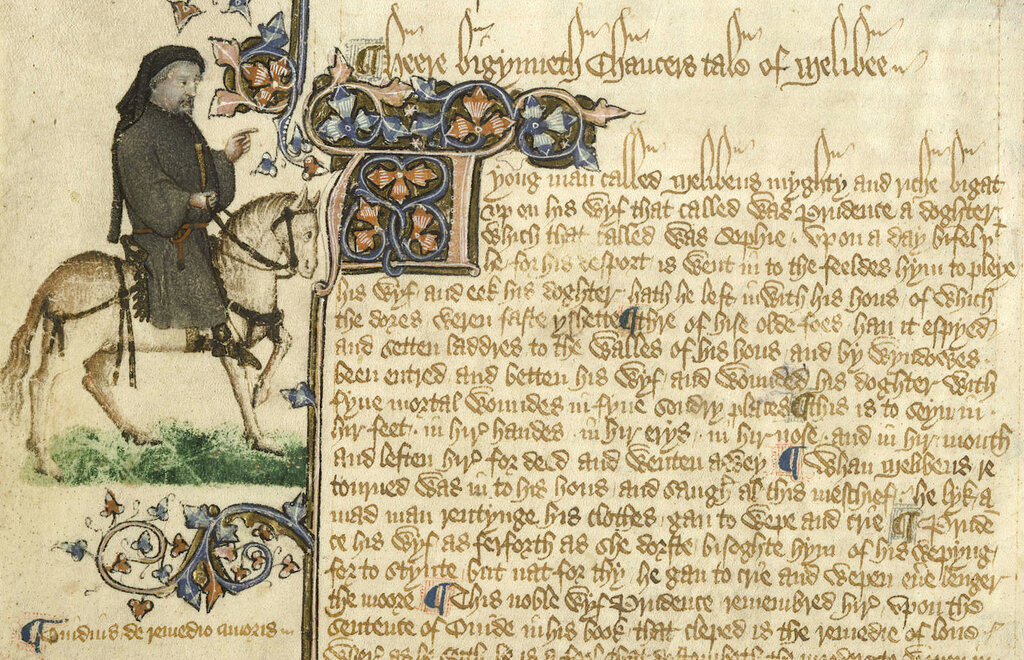
This new literature wasn't created in a vacuum. It was shaped by the world around it, reflecting the rigid social structures and deep religious beliefs of the time. But it also carried echoes of an older, pre-Conquest poetic tradition.
The Alliterative Revival
In the 14th century, while poets like Chaucer were experimenting with new, rhyming forms influenced by French and Italian poetry, another movement looked back to England's Anglo-Saxon roots. This was the Alliterative Revival.
Instead of rhyme, alliterative verse uses the repetition of initial consonant sounds to structure its lines. A typical line is split into two half-lines by a pause, or caesura. Each half-line has two stressed syllables, and at least three of these four stresses must alliterate. This technique gives the poetry a strong, percussive rhythm, making it ideal for oral recitation, hearkening back to the days of scops in mead halls.
Key works from this revival, like 'Sir Gawain and the Green Knight', 'Piers Plowman', and 'Pearl', were written in regional dialects of the North and West Midlands, far from the London-centric language of Chaucer.
Society on the Page
Medieval society was often understood through the model of the 'three estates': the clergy who prayed (oratores), the nobility who fought (bellatores), and the peasantry who worked (laboratores). This was the divine order, a neat hierarchy where everyone had a place. Literature of the period often reinforced this structure, but it also became a powerful tool for critiquing it.
This is where Geoffrey Chaucer's 'The Canterbury Tales' shines. Through his cast of pilgrims on their way to Canterbury, Chaucer creates a cross-section of 14th-century English society. He presents idealized figures like the Knight and the Parson, who perfectly embody the virtues of their estates. But he places them alongside characters who fall short of those ideals, exposing the gap between theory and reality. The Monk loves hunting more than prayer, the Friar is more interested in money than souls, and the Summoner is corrupt. This form of social commentary is known as 'estates satire'.
Chaucer doesn't just condemn; he observes. His satire is gentle, filled with a fascination for human inconsistency. He uses the vernacular to capture the distinct voices and perspectives of his characters, from the noble Knight to the bawdy Wife of Bath, giving a new legitimacy to the English language as a medium for serious, and seriously funny, literature.
Codes, Quests, and Christ
Alongside social commentary, two other forces dominated medieval literature: the chivalric code of the nobility and the Christian allegory of the Church. Often, they were deeply intertwined.
Works like 'Sir Gawain and the Green Knight' explore the ideals of chivalry. A knight was expected to be brave in battle, loyal to his lord, courteous to ladies, and devout in his faith. Gawain's journey to find the Green Knight is a test of these very virtues. He faces physical dangers, but the true challenges are moral temptations that test his integrity and honour.
Gawain's shield, with its pentangle, is a perfect symbol of this fusion of secular and religious values. The quest is not just a knightly adventure but a spiritual trial. This blending of religious allegory with tales of romance and adventure was common. It allowed writers to explore complex moral questions within familiar story structures.
By writing these sophisticated works in the vernacular, authors like Chaucer and the Gawain-poet were making a bold statement. They were claiming that English, not just Latin, could be a language of high art, deep thought, and cultural authority. They laid the foundation for the entire tradition of English literature that followed.
Which two languages were the primary contributors to the formation of Middle English following the Norman Conquest?
What is the primary structural device used in the poetry of the Alliterative Revival?