Mastering the Butterstroke
Introduction to Butterfly Stroke
The Butterfly Stroke
Powerful, graceful, and rhythmic, the butterfly is often seen as the most challenging swimming stroke to master. It's also one of the most mesmerising to watch. The stroke is defined by its symmetry: both arms move together, and both legs kick in unison.
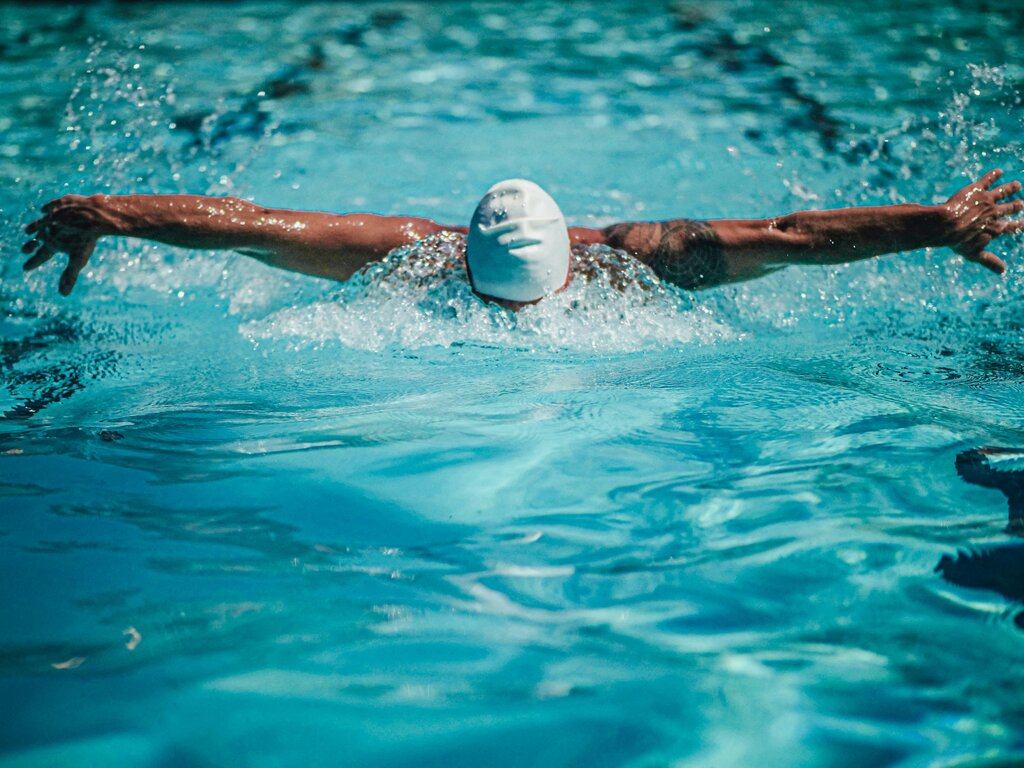
Unlike the other competitive strokes, the butterfly involves a distinctive, undulating body motion that flows from the head to the feet. This wave-like action, combined with a powerful double-arm pull and a 'dolphin kick', propels the swimmer forward with impressive speed. It's a full-body workout that demands strength, timing, and precise coordination.
A Stroke Born from Breaststroke
The butterfly's origins are tangled up with the breaststroke. In the 1930s, swimmers and coaches were experimenting with ways to make the breaststroke faster. The rules at the time were less strict, particularly regarding the arm recovery. American coach David Armbruster at the University of Iowa developed a method where the swimmer recovered both arms over the water.
This overwater arm recovery was faster, but incredibly taxing. It was the first key component of what would become the butterfly.
Around the same time, one of Armbruster's swimmers, Jack Sieg, tweaked the kick. Instead of the frog-like kick of the breaststroke, he turned on his side and kicked with both legs together, like a dolphin's tail. He soon adapted this kick to be performed face down. This powerful new kick, when paired with the double-arm recovery, created a dramatically faster stroke. For years, this technique was used as a variation within breaststroke races. Eventually, officials decided the new style was so different that it deserved its own category. The butterfly was officially recognised as a distinct competitive stroke in 1952 and made its Olympic debut at the 1956 Melbourne Games.
The Mechanics in Motion
Mastering the butterfly is all about timing and flow. The entire body works as a single, connected unit to create a wave-like motion. Let's look at the basic components.
Body Undulation: This is the heart of the butterfly. The swimmer generates a wave that travels through the body, starting with a press of the chest downwards into the water. This action causes the hips to rise, and the wave continues down through the legs.
Arm Movement: The arms move in a symmetrical pattern. They enter the water at the front, pull down and back under the body in a keyhole shape, and then exit the water near the hips to recover over the surface.
Leg Kick: Known as the 'dolphin kick', both legs move together in a powerful up-and-down motion. The power comes from the core and hips, not the knees. Typically, there are two kicks for every one arm cycle.
Illustrations of the active muscles for starts, turns, and the four competitive strokes (freestyle, breaststroke, butterfly, and backstroke) show you how each exercise is fundamentally linked to swimming performance.
While these components are distinct, they must be blended into one seamless, coordinated movement. The timing of the kicks with the arm pulls is crucial for an efficient and powerful stroke. This initial overview provides the foundation for breaking down and mastering each part of this dynamic stroke.
The butterfly stroke originated as an experimental variation of which other competitive stroke?
What is the common name for the powerful leg kick used in the butterfly stroke?