Mastering the Basics of Fractions
Introduction to Fractions
What is a Fraction?
Imagine you have a pizza and you want to share it equally with a friend. You cut it right down the middle into two equal slices. Each of you gets one of those slices. You didn't get a whole pizza, just a part of it. That's exactly what a fraction represents.
Fractions are a way to represent parts of a whole.
They show up everywhere, from splitting a dinner bill to following a recipe that calls for half a cup of flour. Fractions help us talk about amounts that are not whole numbers.
The Anatomy of a Fraction
Every fraction has two key numbers, stacked on top of each other and separated by a line. Let's look at the fraction for one slice of that two-slice pizza:
The top number is called the numerator. It tells you how many parts you have. In this case, you have 1 slice.
The bottom number is the denominator. It tells you how many equal parts the whole was divided into. Our pizza was divided into 2 equal slices.
Numerator = How many parts you have. Denominator = Total parts in the whole.
Types of Fractions
Fractions come in a few different flavors, each telling a slightly different story about the relationship between the parts and the whole.
Proper Fraction
other
A fraction where the numerator is smaller than the denominator. It represents a quantity less than one whole.
Proper fractions are the most common type you'll see. They're always just a piece of the pie, never the whole thing or more.
Improper Fraction
other
A fraction where the numerator is greater than or equal to the denominator. It represents a quantity equal to or greater than one whole.
Imagine you have two pizzas, each cut into four slices. If you eat five slices, you've eaten 5/4 of a pizza. That's one whole pizza and one extra slice.
Mixed Number
other
A number consisting of a whole number and a proper fraction.
Mixed numbers are just another way to write improper fractions. Saying you ate pizzas is often easier to picture than saying you ate pizzas.
Seeing Fractions
Sometimes the easiest way to understand a fraction is to see it. We can use diagrams called area models and number lines to visualize them.
An area model, like a circle or a rectangle, shows a whole shape divided into equal parts. Shading some of those parts shows the fraction.
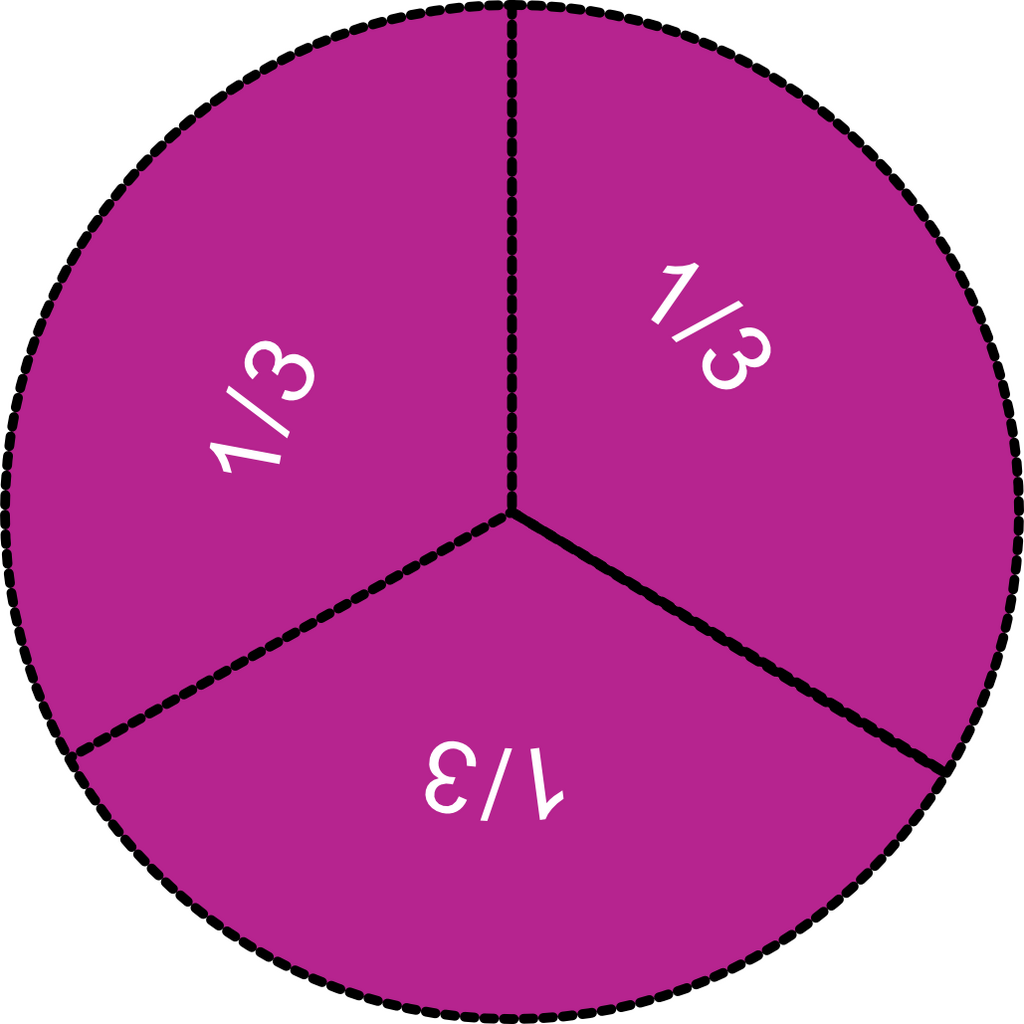
A number line helps us see where a fraction lives in relation to other numbers. To find , you take the space between 0 and 1, divide it into 3 equal sections, and count over 2 sections from 0.
Fractions can also be thought of as division. The fraction is another way of writing the division problem . If you share 3 cookies among 4 friends, each friend gets of a cookie.
Finally, fractions express ratios. A ratio compares two quantities. If there is 1 teacher for every 20 students in a class, the ratio of teachers to students is 1 to 20, which we can write as the fraction .
Now that you've got the basics, let's test your understanding.
In the fraction , what does the number 5 represent?
Which of the following is an improper fraction, meaning it represents a value greater than or equal to one whole?