Mastering the Arts of Combat
Striking Power Biomechanics
The Kinetic Chain
A powerful strike doesn't start in the fist or the foot. It begins with the ground. Every punch, kick, or knee is the final expression of a wave of energy that travels through the body. This sequence of movement is called the kinetic chain—a series of interconnected body segments that work together to generate and transfer force.
Think of it like cracking a whip. The handle moves first, creating a wave that travels down the leather, accelerating until the very tip breaks the sound barrier. Your body works the same way. The 'handle' is your connection to the floor. By pushing off the ground, you generate an initial force known as ground reaction force. This is the starting block for all power.
Your feet initiate the movement, but your hips and core are the engine that amplifies it.
This force travels up your legs, and this is where the magic happens. Your hips and core act as a transmission, converting the linear drive from your legs into powerful rotational torque. This rotation is what separates a weak arm-punch from a knockout blow.
Rotational Torque
The hips and core are the primary generators of rotational torque in striking. For a straight punch like a cross, the sequence is clear: the back foot pivots, the hip rotates forward, the torso follows, and the arm extends. This entire sequence is about transferring momentum from the largest, most powerful parts of your body to the smallest and fastest—your fist.
A roundhouse kick uses the same principle but on a different axis. The standing leg pivots while the hip of the kicking leg opens and rotates horizontally, swinging the leg like a gate. Without this core rotation, a kick is just a leg lift. With it, it becomes one of the most powerful weapons in martial arts.
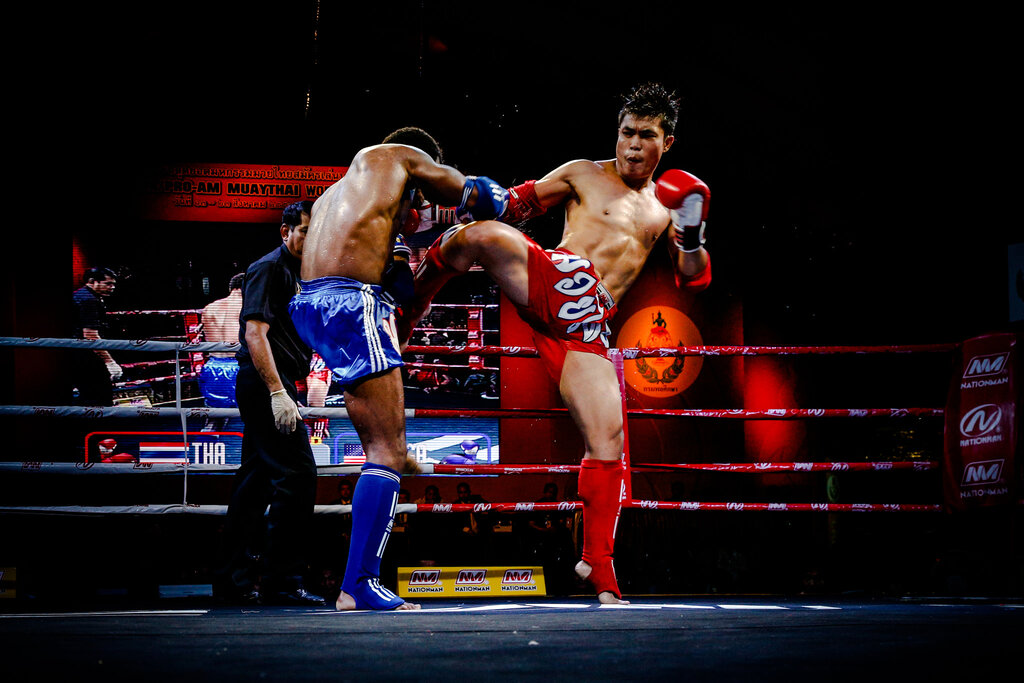
The key is to connect the movement. A common mistake is to segment the motion—pivoting the foot, then turning the hips, then throwing the punch. Elite strikers blend these into one seamless, explosive action. The energy flows uninterrupted from the ground to the target.
Heavy Hits vs. Snapping Strikes
Not all powerful strikes feel the same. Physics gives us a useful concept to understand the difference: impulse. Impulse measures the change in momentum and is the product of the force applied and the duration of the impact.
This gives us two ways to generate a powerful strike. We can deliver a huge amount of force over a very short time (a snapping strike), or a slightly lesser force over a longer time (a heavy strike).
A 'snapping' strike, common in Karate, focuses on maximum acceleration and quick retraction. The goal is to minimize the contact time (), which requires a massive peak force () to create the desired impulse. This is what allows practitioners to break boards.
A 'heavy' strike, more typical in boxing or Muay Thai, emphasizes weight transfer and follow-through. The practitioner drives their body mass into the target, aiming to maintain contact for a fraction of a second longer. This increases and transfers more momentum, creating the sensation of a thudding, heavy impact that can move an opponent. Both are effective; they just optimize different parts of the impulse equation.
The power of a punch comes from generating force through your legs, core, and upper body, then efficiently transferring that energy to your fist.
Structural Alignment
Generating force is only half the battle. Delivering it is the other. The body must be properly aligned to transmit the force from the ground to the target without 'leaking' energy. Good structural alignment means your bones are stacked in a way that provides a solid path for the force to travel.
In a straight cross, this means your wrist is straight, not bent. Your elbow is behind the punch, not flared out. Your shoulder, hip, and ankle form a relatively straight line at the moment of impact. Any break in this alignment—a bent wrist, a collapsing shoulder—and the energy dissipates before it reaches the target. It's the difference between hitting someone with a steel rod versus a wet noodle.
This principle of alignment is why drilling fundamental movements is so critical. It trains your body to instinctively find the most efficient path for force, ensuring that all the power you generate from the ground up actually arrives at its destination.
Let's review the key ideas we've covered.
Ready to test your understanding?
According to the principles of the kinetic chain, where does the power for a powerful strike originate?
What is the primary role of the hips and core in generating a powerful strike like a cross or a roundhouse kick?
By understanding these biomechanical principles, you can move beyond simply throwing techniques and start truly analyzing your movement. This allows you to generate more power, improve efficiency, and build a more intelligent and effective striking game.