Mastering the Art of Sketching
Complex Form Construction
Seeing in 3D
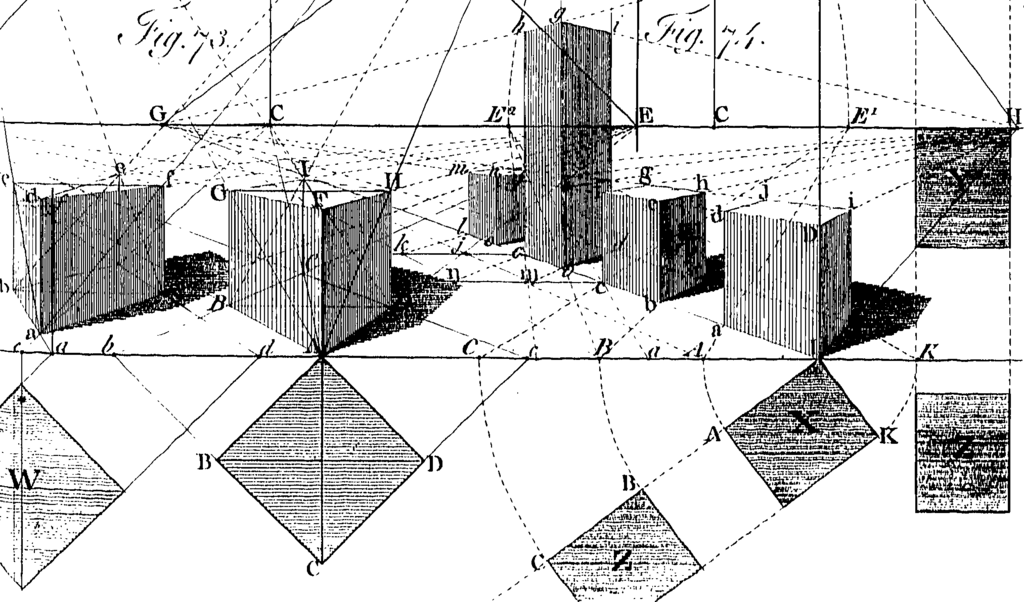
You already know how to draw lines and basic shapes. Now, let's move beyond flat outlines and start thinking in three dimensions. The key is to see the world not as a collection of complex surfaces, but as an assembly of simple geometric volumes. A human arm isn't just an outline; it's a series of connected cylinders and a sphere for the shoulder. A car is a combination of boxes, wedges, and cylinders.
This process, called geometric decomposition, is like having X-ray vision for structure. It allows you to break down any subject into manageable building blocks: spheres, cubes, cylinders, and cones.
Before committing to a final line, you need a plan. This is where construction lines come in. These are light, preliminary marks that map out the size, placement, and form of your subject. They are the scaffolding of your drawing.
Ghosting is the physical practice of making these lines. Hover your pencil over the paper and move your entire arm in the motion of the line you intend to draw. Rehearse the curve of an ellipse or the angle of a box. This builds muscle memory and confidence, so when your pencil finally touches the paper, the mark is deliberate and controlled, not hesitant.
Building Skeletons
For organic forms like people or animals, start with a structural skeleton. This isn't a detailed anatomical study, but a simple stick figure that defines the pose, proportions, and flow of movement. Think of it as the gesture of the form.
Start with a line of action, a single, flowing line that captures the primary energy of the pose. Then, build a simple skeleton around it, using lines for limbs and simple shapes for the head, ribcage, and pelvis. This skeleton ensures your figure is balanced and proportioned correctly before you start adding mass.
After you’ve mapped out the basic shapes in your sketch’s foundation, try lightly drawing the muscle groups, posture, and bone alignment of your subject.
Once your skeleton is in place, you can flesh it out using the geometric volumes we discussed earlier. This is an additive process: you build the form by connecting cylinders for the arms and legs, spheres for the joints, and an egg shape for the head. You are literally adding volumes together to create a believable three-dimensional figure.
This method isn't just for organic subjects. You can construct a building by starting with a large box and adding smaller boxes for wings or windows. This is the additive approach.
Combining these techniques allows you to tackle any subject with confidence. You start by seeing the simple volumes within the complex form. You use ghosting and light construction lines to build a structural skeleton. Finally, you build up or carve into these foundational shapes to bring your drawing to life. This structural thinking is the bridge between a simple sketch and a professional illustration.
According to the provided text, what is the key to drawing three-dimensional forms instead of flat outlines?
What is the primary purpose of 'ghosting' in the drawing process?