Mastering the Art of Scopa
Italian Deck Mechanics
The Italian Deck
To master Scopa, you first need to understand its tools. The game is played with a 40-card Italian deck, which is different from the standard 52-card French deck you might be used to. It's shorter, faster, and has its own unique character.
The deck is divided into four suits. Instead of hearts, diamonds, clubs, and spades, you’ll find suits that reflect a different history. These are called Latin suits.
Clubs or Batons
These represent rural or peasant life.
Cups
These are associated with the church or clergy.
Coins
These symbolize the merchant class.
Swords
And these represent the nobility or military.
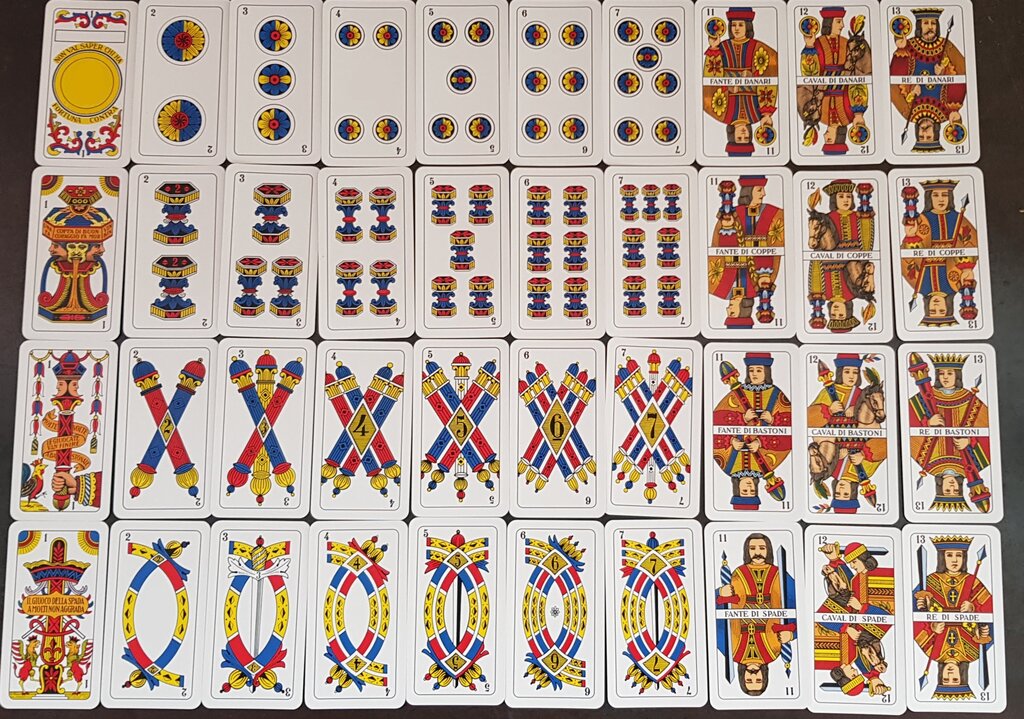
Card Ranks and Values
Each of the four suits has ten cards. The numbering is simple: cards run from 1 through 10. The number cards are 1 through 7. The remaining three are face cards.
Unlike in many other card games, the face cards in Scopa have specific numerical values for capturing cards.
| Card | Name (Italian) | Value |
|---|---|---|
| Jack | Fante | 8 |
| Knight | Cavallo | 9 |
| King | Re | 10 |
The 1-card is the Ace, or Asso. It's the lowest and often most versatile card. The other numbered cards, 2 through 7, simply hold their face value. So, a 5 of Cups is worth 5, and a 2 of Swords is worth 2.
This ranking system is key to the game's central action: capturing cards from the table by matching their value.
A key takeaway: the Jack is an 8, the Knight is a 9, and the King is a 10. Memorize this, as it's fundamental to every move you'll make.
The Deal
The setup for Scopa is consistent. A dealer is chosen, and they shuffle the 40-card deck. The player to their left cuts the deck.
The dealer then deals three cards, face down, to each player. After every player has their cards, the dealer places four cards face up in the center of the table. These four cards form the initial playing field.
If the four face-up cards include three or four Kings, the deal is considered invalid. This is a rare but important rule. The cards are collected, reshuffled, and dealt again by the same dealer. This prevents a game state where it's nearly impossible for the first player to make a capture.
Let's check your understanding of the deck.
How many cards are in a standard Italian deck used for Scopa?
Which of the following is NOT one of the four traditional Latin suits in a Scopa deck?
With the deck's structure and dealing protocol clear, you're ready to learn how these pieces come together in the flow of the game.