Mastering the Art of Movement
Dynamic Anatomical Alignment
Finding Alignment in Motion
Good posture is more than just standing still correctly. For a dancer, true alignment is dynamic. It's the ability to maintain a stable, efficient core while moving through space, shifting weight, and executing complex steps. This isn't about being rigid; it's about creating a strong, adaptable foundation that protects your body and unlocks greater freedom of movement.
Think of your alignment not as a static position to hold, but as a central axis you constantly return to during movement.
The Neutral Pelvis
The command center for this dynamic stability is your pelvis. Finding and maintaining a neutral pelvis is crucial. Imagine your pelvis is a bowl of water. If you tip it forward (an anterior tilt), water spills out the front. If you tuck it under (a posterior tilt), water spills out the back. A neutral pelvis keeps the water level, aligning your spine naturally and engaging your deep core muscles.
An anterior tilt often leads to a swayed lower back and tight hip flexors, limiting your arabesque and increasing strain. A posterior tilt, or tucking, disengages your glutes and hamstrings, reducing power for jumps and extensions. By working from a neutral pelvis, you allow your leg to move freely from the hip socket. This is the key to achieving a true anatomical turnout, where the rotation initiates deep in the hip joint rather than being forced from the knees or ankles, a common cause of injury.
The Vertical Axis
Now, let's connect this to your body's vertical alignment. Imagine a dropping from your ear through your shoulder, hip, knee, and just in front of your ankle when you are standing. As you move, this line is your reference point. When you plié, the line should remain vertical, not shifting forward or backward. In a tendu, as your leg extends, your goal is to keep your torso and pelvis perfectly placed, maintaining that plumb line over your supporting leg.
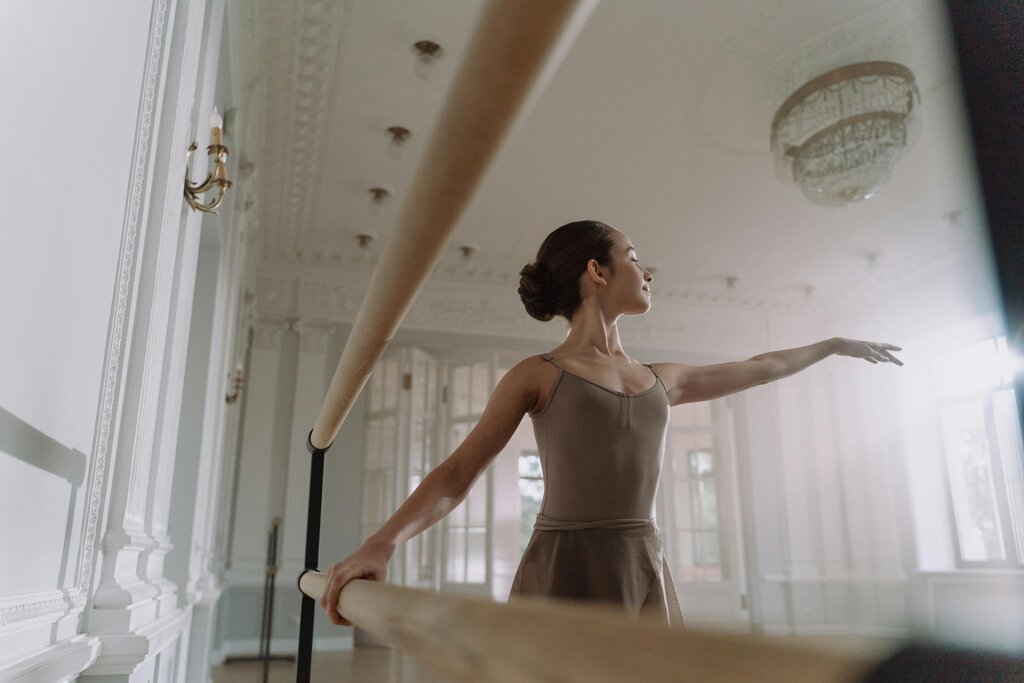
This principle applies to all movements, from a simple weight shift to a complex pirouette. The challenge isn't just finding the line, but maintaining it through transitions. This requires immense core control, ensuring the hips don't sway or lift and the torso remains stable. Your supporting side must work to maintain that verticality, creating the stable axis required for the gesturing leg or turning body to move around.
The Upper Body Frame
Fluidity in the upper body begins with a stable, yet mobile, foundation in your back. The scapulae, or shoulder blades, should lie flat against your ribcage, not pinching together or winging out. This stability allows your arms to move with grace and expression in without introducing tension into your neck and shoulders.
Equally important is ribcage placement. Many dancers have a tendency to flare their ribs, which disconnects the upper abdominals and creates a break in the line of the spine. Think of gently "knitting" your front ribs down and together toward your pelvis. This engages your core and aligns your ribcage directly over your hips.
Proper ribcage placement should not restrict your breathing. Focus on diaphragmatic breathing, allowing your breath to expand sideways and into your back, rather than just into your chest.
By uniting a neutral pelvis, a dynamic plumb line, and a stable upper body, you create an integrated system. This is dynamic alignment: a body that is ready to move with power, efficiency, and artistry.
Ready to test your knowledge? Let's see how these concepts have landed.
What is the primary goal of "dynamic alignment" for a dancer?
A dancer with an anterior pelvic tilt, where the pelvis tips forward, is likely to experience which of the following?
Mastering these principles takes consistent practice and body awareness, but it is the foundation upon which all advanced technique is built.