Mastering the Art of Influential Public Speaking
Advanced Delivery Methods
The Vocal Toolbox
You already know how to project your voice. Now, let’s refine it. Think of your voice not just as a tool for volume, but as an instrument with a full range of notes. The three most powerful tools in your vocal toolbox are pitch, pace, and pause.
Pitch is the highness or lowness of your voice. A monotone delivery, where your pitch stays flat, signals disinterest. Varying your pitch adds emotional texture and highlights key ideas. When you introduce a surprising fact, let your pitch rise slightly. When you deliver a serious, concluding thought, let it fall. This subtle modulation keeps your audience's brains engaged, as they unconsciously track the emotional current of your speech.
Pace is your rate of speech. Rushing through your material makes it hard to follow and suggests nervousness. Speaking too slowly can make you sound hesitant or patronizing. The key is to vary your pace purposefully. Speed up slightly when telling an exciting story to build energy. Slow down dramatically when you want to emphasize a critical point, forcing the audience to lean in and listen.
Finally, there's the pause. Silence is not empty space; it's a powerful rhetorical tool. A well-placed pause can create suspense, give your audience a moment to absorb a complex idea, or signal a transition to a new topic. It's the verbal equivalent of a paragraph break. A pause before a key phrase makes it important. A pause after a powerful statement gives it weight. Mastering the is a sign of a confident, controlled speaker.
By mastering pitch, pace, and pause, you can enhance your communication and build a vocal presence that captures attention and conveys confidence.
Mastering Stage Presence
Effective delivery is as much about your body as your voice. Stage presence isn't some mystical charisma; it's the result of deliberate physical choices. The goal is to make every movement and position serve a purpose.
Random pacing or fidgeting drains your authority. Purposeful movement, on the other hand, enhances it. If you are telling a story with three parts, you can physically move to a new spot on the stage for each part. This technique, known as blocking, helps the audience visually track the structure of your presentation. Moving forward toward the audience can create a sense of intimacy or urgency, while stepping back can signal a moment of reflection.
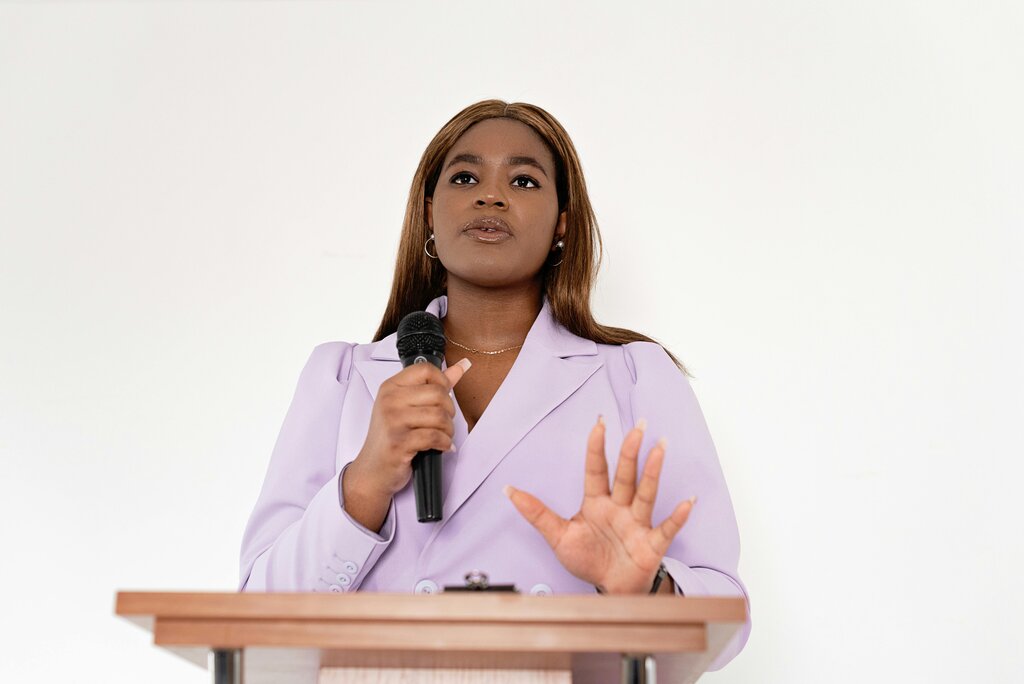
For engaging the entire room, especially a large one, use the triangle technique. Imagine three points in the audience: one on the far left, one on the far right, and one in the center back. Throughout your talk, move your body and focus to address each of these points. Don't just turn your head; turn your core. This makes each section of the audience feel directly addressed and ensures your presence fills the entire space.
By moving between these three points, you physically open your body up to every section of the room. It prevents you from unconsciously favoring one side and creates a more inclusive and dynamic experience for everyone.
Ready to check your understanding?
According to the principles discussed, what is the primary purpose of varying your vocal pitch?
The technique of purposefully moving to a different spot on the stage to signify a new section of your presentation is known as ________.
Combining intentional vocal variety with purposeful movement will transform your delivery. You'll move from simply presenting information to creating an engaging experience for your audience.