Mastering the Art of Grace Preaching
Redemptive Historical Frameworks
The Bible's Grand Story
Many people approach the Bible as a collection of separate stories, moral lessons, or a rulebook for life. While it contains all those things, it's fundamentally one unified story with a single, overarching plot. This is the core of a to Scripture. It reads the Bible not as a flat encyclopaedia of spiritual facts, but as a drama unfolding across four main acts: Creation, Fall, Redemption, and Restoration.
- Creation: God makes a perfect world, in perfect relationship with humanity.
- Fall: Humanity rebels, breaking that relationship and introducing sin, suffering, and death into the world.
- Redemption: God initiates a plan to rescue and redeem His people, a plan that climaxes in the life, death, and resurrection of Jesus Christ.
- Restoration: God promises to one day renew all of creation, completely eradicating sin and restoring humanity to a perfect relationship with Him forever.
Seeing this arc helps us understand that every smaller story, from Noah's ark to David's kingship, is a chapter in this grand narrative. They aren't just isolated events; they are all pushing the main plot forward toward its ultimate conclusion in Christ.
God Acts, We Respond
Once we see the Bible as one story of redemption, a crucial pattern emerges: the . This sounds academic, but it's a simple, powerful idea. The 'indicative' is a statement of fact—it's what God has done. The 'imperative' is a command—it's what we are to do in response.
In Scripture, the indicative always comes before the imperative. God doesn't say, "If you obey me perfectly, I will rescue you." He says, "I have rescued you, therefore live in a way that reflects this new reality." Grace is the engine, not the reward.
Think about the Ten Commandments. They don't appear out of nowhere. They are given to Israel only after God declares, "I am the Lord your God, who brought you out of Egypt, out of the land of slavery" (Exodus 20:2). The rescue (indicative) comes first, and the commands for living (imperative) follow. This structure is the foundation of grace. Our actions are a grateful response to His finished work, not an attempt to earn it.
The message shifts from 'try harder' to 'trust more deeply in what has already been done'.
Finding Jesus in Every Story
This framework radically changes how we find the main point of any biblical passage. A man-centred interpretation asks, "How can I be brave like David?" A Christ-centred interpretation asks, "How does David's story show us our need for Jesus and point to His ultimate victory?"
The first approach leads to moralism—a list of things to do to be a better person. The second leads to worship. We don't read the story of David and Goliath and conclude, "I need to face my giants with more courage." Instead, we see that David is a prefigurement of Christ. He is the unlikely king who fights on behalf of his people to defeat an enemy they could never defeat on their own. The story isn't mainly about our bravery; it's about God's anointed one winning the victory for us.
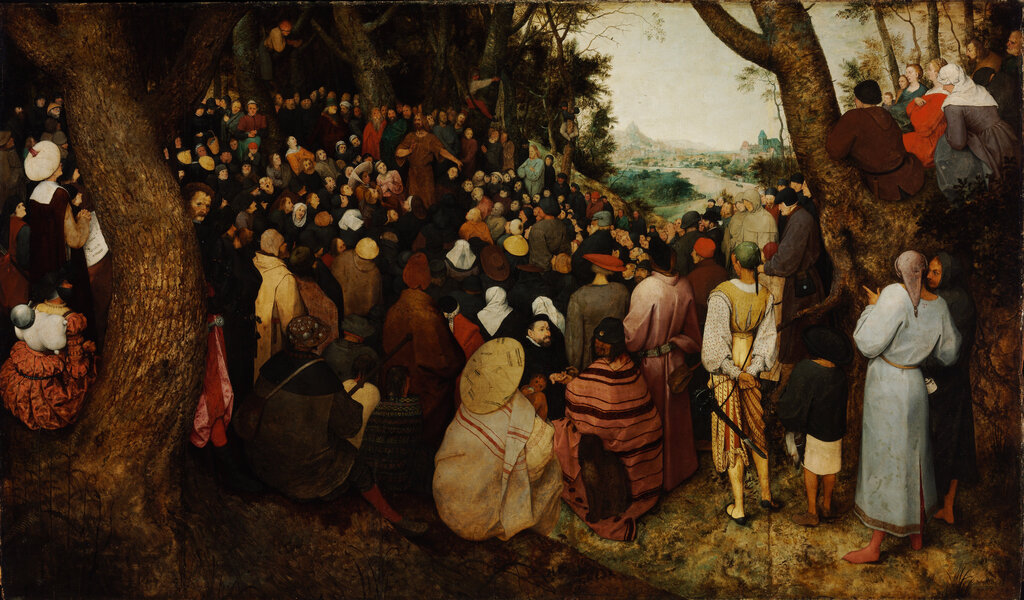
This Christ-centred thread is woven through the entire Bible using a structure of promises and fulfilment. This is where a basic understanding of becomes helpful for preaching. It is a framework for understanding how God has consistently related to His people throughout history. From the covenant with Adam in the garden to the New Covenant established by Jesus, God has been unfolding a single plan of redemption.
Seeing these covenants helps us connect the dots between the Old and New Testaments. We see how the sacrificial system pointed to Christ's ultimate sacrifice, how the kings of Israel pointed to the one true King, and how the promised land pointed to the final restoration of all things. It provides the narrative skeleton for the whole redemptive story.
So, when preparing to preach from a text, the goal is to identify its 'Big Idea' through this gospel lens. A helpful way to do this is to ask: What aspect of our fallen human condition does this passage address? This is often called the Fallen Condition Focus (FCF). Every passage, whether it's a story, a psalm, or a law, exposes a problem that we cannot solve on our own.
Once you've identified that problem, the next question is: How does the person and work of Jesus Christ provide the ultimate solution to this problem? This ensures that the sermon doesn't end with a moralistic to-do list, but with the good news of what God has already done. It moves the focus from our performance to Christ's.
Chapell seeks to show how sermons from all of Scripture can be Christ-centred without resorting to twisting the text, or jumping to the cross.
Now, let's test your understanding of these core frameworks.
What is the fundamental idea behind a 'redemptive-historical approach' to the Bible?
The four main acts of the Bible's overarching story are Creation, Fall, Redemption, and ______.
Understanding these structures—the grand narrative, the indicative-imperative flow, and the covenantal storyline—is the key to unlocking sermons that are not just informative, but truly transformative. It allows the grace of the gospel to be the central point of every message.