Mastering the Art of Drawing
Structural Sketching
Beyond the Outline
Most beginners draw what they see: a flat outline. A structural approach asks you to draw what you know is there. It’s the difference between tracing a silhouette and sculpting a form. You need to think about an object's volume, its front, back, and the space it occupies.
The key to this is the 'draw-through' method. Imagine you have X-ray vision. Instead of stopping your lines at the visible edges of an object, you continue them as if the object were transparent. This forces you to consider its full three-dimensional structure.
Drawing through an object ensures it has weight and occupies real space on the page, preventing it from looking like a flat sticker.
Building with Primitives
Nearly any complex object can be simplified into a combination of basic geometric primitives like cubes, spheres, cylinders, and cones. This is the essence of structural construction. Instead of getting lost in the details of a car's fender or a building's facade, you start by mapping out the big, simple forms that make up its core structure.
Breaking down complex subjects into simpler shapes can provide you with a roadmap for more accurate drawing.
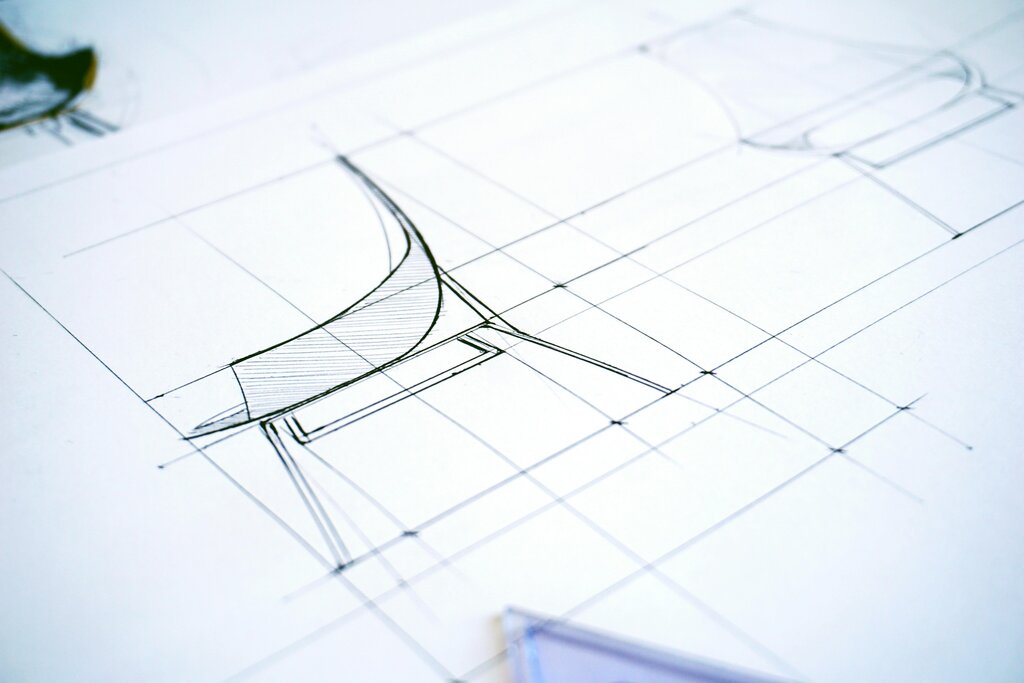
Think of a modern chair. It might be two thin boxes for the seat and backrest, connected by four long cylinders for the legs. An apple isn't just a circle; it's a sphere with an indentation at the top. By starting with these foundational volumes, you ensure your proportions and perspective are correct before you invest time in surface details. This method helps you manage symmetry and alignment naturally. If you draw a centerline through your initial box, it's much easier to place features like headlights on a car symmetrically.
Defining Form with Contours
Once you have your basic structure, are the best way to describe its volume. These are lines that wrap around the form, following its surface. Think of them as the latitude and longitude lines on a globe, or the seams on a baseball. They're not outlines; they describe the three-dimensional topography of the object.
Drawing cross-contours over your primitive shapes helps turn a simple cylinder into a convincing arm or a box into the nuanced body of a car. These lines make the volume tangible to the viewer. When you practice this, you’re not just copying a surface; you’re developing a deep, tactile understanding of the object’s form.
By combining these methods—drawing through, building with primitives, and defining with contours—you create a robust wireframe. This structural sketch is the skeleton that supports all subsequent details, ensuring your final drawing is believable and solid.