Mastering the Art of Drawing
Introduction to Drawing
Learning to See
Drawing isn't just about what your hand can do. It's about what your eyes can see. The biggest hurdle for beginners is learning to draw what's actually there, not what your brain tells you is there. This is the core of observational drawing: training your eyes to notice the specific lines, shapes, and shadows that make up an object.
Think about drawing a coffee mug. Your brain says, "That's a mug." It knows what a mug generally looks like. But to draw that specific mug, you need to see its unique details. How wide is the opening? How much does the handle curve? Where does the light hit it? Drawing forces you to slow down and truly observe the world around you.
Observational drawing is a fundamental practice that bridges the gap between the real world and your creative expression.
This skill of seeing like an artist—breaking down the world into visual components—is the foundation we'll build on.
Your First Toolkit
You don't need a lot of fancy equipment to get started. A few basic tools will take you a long way. The goal is to become comfortable with how they feel and what they can do.
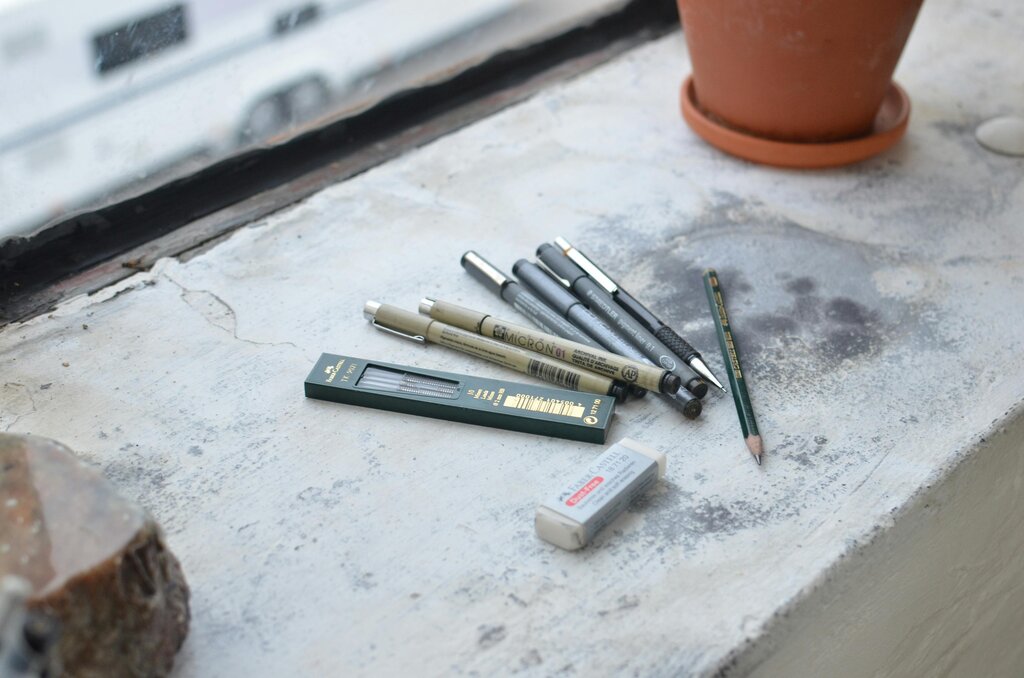
Pencils come in different grades of hardness. A standard HB pencil is great for general sketching. Pencils marked with a "B" (like 2B or 4B) are softer and create darker lines. Pencils with an "H" are harder and make lighter lines, perfect for initial sketches. Your eraser is more than a mistake-fixer; you can use it to lift graphite and create highlights, making it a drawing tool in its own right.
| Tool | Purpose |
|---|---|
| HB Pencil | A good middle-ground pencil for general sketching. |
| 2B Pencil | Soft lead for making darker lines and simple shading. |
| Sketch Paper | Any plain paper will do, but a sketchbook keeps your work organized. |
| Kneaded Eraser | Lifts graphite without smudging and can be shaped to a fine point. |
Break It Down
Every complex object in the world can be simplified into basic shapes. A tree isn't just a tree; it's a cylinder (the trunk) topped with spheres or cones (the leaves). A car is a collection of boxes. Learning to see these underlying forms is the key to drawing anything accurately.
Forget about drawing “things.” Start by seeing the fundamental shapes: circles, squares, cylinders, and cones.
When you look at an object, try to mentally deconstruct it. This practice helps you understand its structure and proportions before you even put your pencil to paper.
Once you can see the simple shapes, you have a map for your drawing. You start with the big, basic forms and slowly add the smaller details.
Your First Drawing
Let's put it all together. Find a simple object in your room, like an apple, a bottle, or a book. Place it in front of you under a good light source.
When it comes to starting to sketch, draw out basic shapes first and start with loose lines that you can refine later.
First, just look at the object for a full minute. Notice its main shape. Is it a sphere? A rectangle? A cylinder?
Next, pick up your pencil and lightly sketch that basic shape. Don't press hard. These are just guide lines. Then, start refining the outline, or contour, of the object. Look back and forth between your paper and the object, adjusting your lines to match what you see. Is one side flatter? Is there a subtle curve you missed?
This isn't about creating a masterpiece. It's about practicing the connection between your eyes, your brain, and your hand.
Here are the steps to follow:
- Observe: Look carefully at your subject.
- Simplify: Identify the basic geometric shapes.
- Sketch Lightly: Draw the basic shapes without pressing hard.
- Refine: Add the contour lines and small details, darkening the lines that feel right.
- Practice: Do this every day, even for just 10 minutes. Each drawing builds your observational muscle.
Time to review what you've learned.
Now, let's test your understanding with a few questions.
What is the biggest hurdle for beginners in observational drawing?
If you want to create a light line for an initial sketch, which type of pencil is most suitable?
The more you practice these foundational skills, the more natural drawing will become. Keep observing, keep sketching, and have fun with the process.