Mastering the Art of Cricket
Batting Mechanics and Execution
The Engine of the Shot
A balanced stance is just the launchpad. The real power in batting comes from a sequence of controlled, explosive movements. Think of it as a chain reaction starting from your feet and ending with the bat striking the ball. This is the essence of the kinetic chain in batting, where energy is transferred efficiently through the body.
Batting in cricket is a biomechanical sequence where kinetic chain efficiency, neuromuscular coordination, and force transfer are critical.
The first link in this chain is weight transfer. Your initial stance distributes your weight evenly, but to play a shot, that balance must be purposefully broken. For a front-foot shot, like a cover drive, your weight moves forward, into the shot. Your front foot strides towards the line of the ball, creating a stable base to swing through. This proactive movement allows you to meet the ball early and dictate the terms of engagement.
Conversely, for a back-foot shot against a shorter delivery, the weight transfer is reactive. You push back and across your stumps. This movement buys you precious fractions of a second to read the ball's bounce and height, allowing you to play shots like the cut or the pull with control and power. Each type of transfer is a deliberate commitment to a style of shot, initiated the moment you pick up the bowler's intent.
Head, Shoulders, and Direction
Ask any top-level coach what the most important aspect of batting is, and they'll likely say, "a still head." This isn't just a cliché; it's a biomechanical necessity. Your head is the heaviest part of your body, and it dictates your balance. If your head sways, your center of gravity shifts, and your shot will be off-balance and weak.
A still head allows your eyes to stay level, making it easier to judge the line and length of the delivery. It acts as an anchor, allowing the rest of your body to rotate around it powerfully and efficiently. It's the gyroscope that keeps the entire system stable.
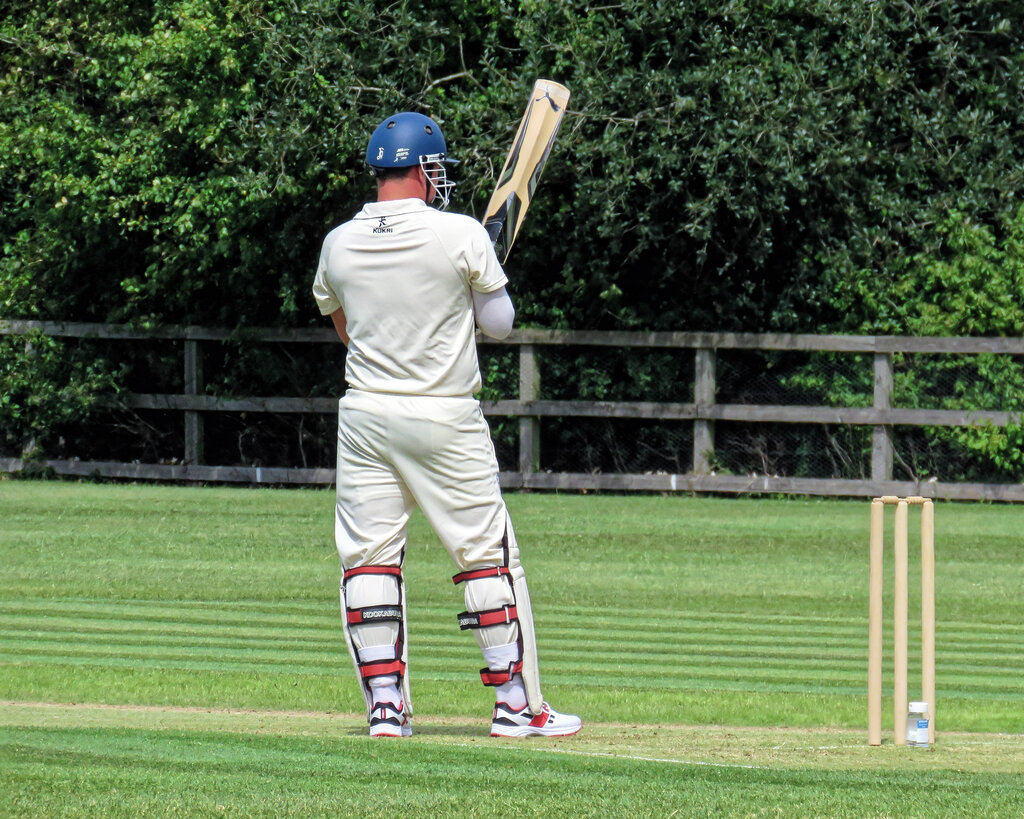
Working in tandem with the head is your shoulder alignment. This is the steering wheel for your shot. For shots down the ground, played in the traditional 'V' area between mid-on and mid-off, your shoulders should remain aligned with the pitch. This ensures the bat swings in a straight path towards the ball.
For cross-batted shots like the pull or sweep, your front shoulder must open up, rotating away from the bowler. This clears a path for the bat to swing horizontally across the line of the ball. Getting this alignment right is the difference between a powerful shot into a gap and a mistimed edge into the wicket-keeper's gloves.
Rhythm and Timing
Facing a fast bowler isn't a static activity. You can't just stand still and react. To get your body's complex series of movements firing in the correct sequence, you need rhythm. This is where the trigger movement comes in.
A trigger movement is a small, preparatory motion a batter makes just before the bowler releases the ball. It can be a slight shuffle of the feet, a tap of the bat, or a subtle press forward or back. Its purpose is to transition the body from a static stance to a dynamic, ready state. It prevents you from being flat-footed and helps synchronize your own movements with the bowler's run-up.
The trigger movement isn't about moving for the sake of it. It's about finding a personal rhythm that primes the kinetic chain to fire at the right moment.
The final piece of the puzzle is the contact point. Where you meet the ball drastically changes depending on the type of bowling you're facing. Against pace bowlers, the ball comes onto the bat quickly. The ideal contact point is typically right beside or slightly in front of your front pad. This uses the bowler's pace to your advantage, requiring more timing than raw power.
Against spin, the ball travels slower, giving you more time but also introducing deviation off the pitch. To counter this, you want to make contact either as far forward as possible (smothering the spin) or as far back as possible (giving you maximum time to read the turn). Meeting a spinning ball halfway is a recipe for disaster, as it's at the peak of its deviation. Making the right choice about the contact point is a crucial tactical skill.
Understanding these mechanics transforms batting from a simple act of hitting a ball into a technical and tactical discipline. By mastering weight transfer, alignment, and timing, a batter can build an innings against any type of bowling.
What is the primary purpose of a "trigger movement" in batting?
For a front-foot shot like a cover drive, where should the batter's weight be transferred?