Mastering the Art of Bharatnatyam
Araimandi and Geometry
The Geometric Foundation
For the intermediate Bharatanatyam dancer, Araimandi is no longer just a half-sitting posture. It's the central axis, the geometric core from which all movement originates. You've mastered holding the pose; now, the focus shifts to maintaining its structural integrity through dynamic sequences. This is where core stability becomes paramount.
Think of your torso as the unwavering anchor. While your limbs execute complex adavus, your core must remain engaged and stable. This prevents the upper body from swaying or collapsing, ensuring that the power and precision of your footwork aren't diluted. A stable core in Araimandi is what transforms a series of steps into a seamless, powerful narrative.
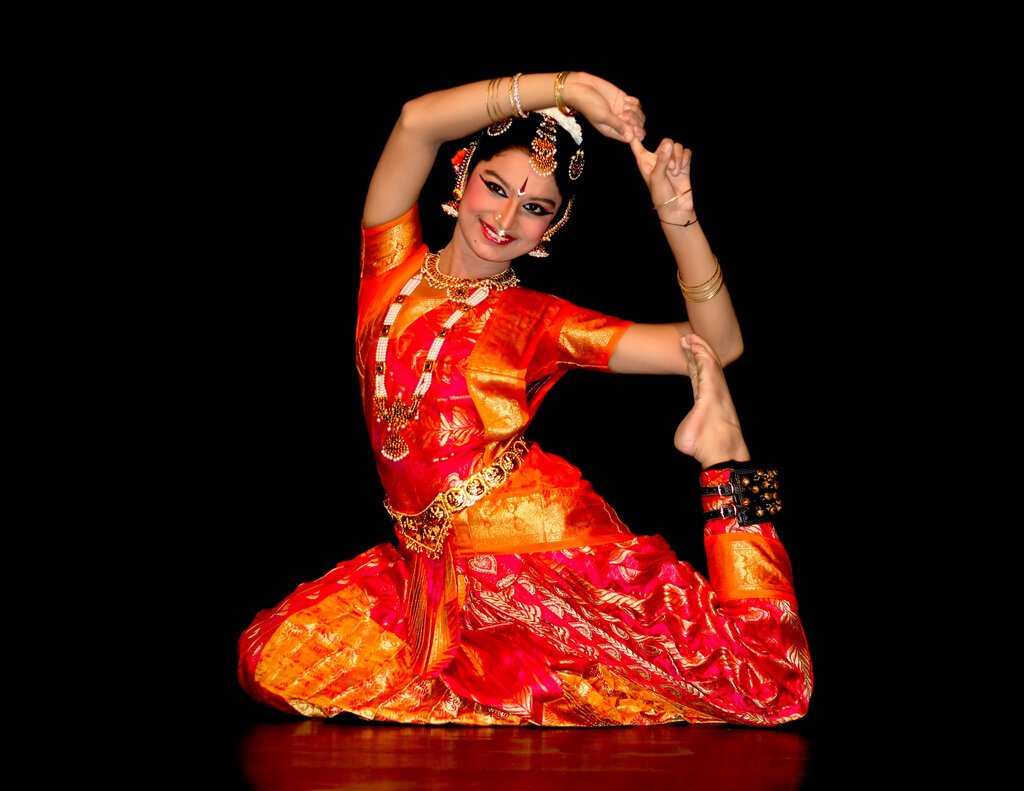
Lines of Power
Bharatanatyam is a dance of precise lines and angles. In Araimandi, your body creates a distinct geometric pattern. The Angas (major limbs) and Upangas (minor limbs) are not positioned arbitrarily; they follow strict principles of alignment laid out in the Natya Shastra. The goal is to achieve perfect symmetry and clarity in every shape you create.
Central to this is the concept of Susthu, the principle of maintaining a straight, aligned vertical median from the crown of your head down through your spine. This imaginary plumb line ensures your torso is perfectly erect, not leaning forward or backward. Your bent legs should form a clean diamond shape, with your knees pointing directly outwards, aligned over your toes. This alignment isn't just for aesthetic appeal—it's the source of your stability and power.
Dynamic Stability
Maintaining this precise geometry while moving is the real challenge. As you execute adavus that involve shifting, jumping, or turning, your weight distribution becomes critical. A common mistake is to allow the hips to sway or the torso to lean into a turn. This breaks the Susthu line and compromises your balance and clarity of movement.
The key is to distribute your weight evenly across both feet whenever you are in the central Araimandi stance. When you move, the transfer of weight must be deliberate and controlled. Imagine your pelvis is a steady platform. As you lift a leg or extend an arm, you should feel your core muscles engage to counteract the shift and keep that platform perfectly level. This is the essence of —the purity and correctness of the body lines in motion.
Posture is the most important thing when dancing, yet many struggle to maintain it, not least when performing and the nerves or the pure joy of dancing starts kicking in!
Practice transitioning between different adavus while focusing solely on your Araimandi. Use a mirror to check your alignment. Are your knees still pointing out? Is your spine straight? Is your weight centred? Recording yourself can also reveal subtle postural habits that may be undermining your clarity. The goal is to make the perfect Araimandi your default, an unshakable foundation that supports even the most complex choreography.
Ready to test your understanding of these core principles? Let's see how they apply in practice.
For an intermediate Bharatanatyam dancer, what is the primary focus when it comes to the Araimandi posture?
What is the principle of 'Susthu' in the context of Araimandi?
Mastering the geometry and stability of Araimandi is a continuous journey. By focusing on these principles of alignment and weight distribution, you will build a stronger, more expressive, and injury-resistant dance practice.