Mastering the Analog Clock
Clock Face Geometry
A Circle of Time
An analog clock is more than just a tool for telling time; it's a perfect circle divided with geometric precision. The entire system of hours and minutes is built on the fact that a circle contains 360 degrees of arc. This simple rule dictates the position of every number and every tick mark on the clock face.
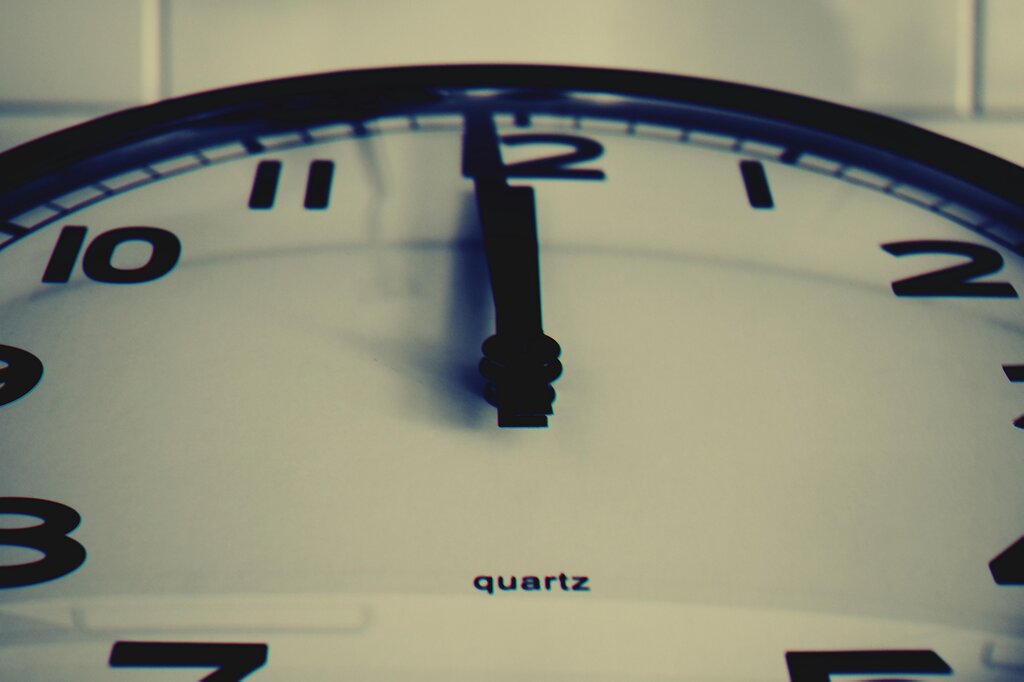
The Big Twelve
The most prominent features on a clock face are the numbers 1 through 12. They are spaced evenly around the circle, dividing it into 12 equal sections. Since a full circle is 360°, the angle between each hour marker, as measured from the center, is a clean 30°.
This consistent 30° spacing is what allows the hour hand to sweep across the clock face at a steady, predictable rate.
Sixty Steps in a Circle
Between the hour numbers, you'll find smaller tick marks. There are 60 of these marks in total, one for each minute in an hour. These marks further divide the circle into smaller, more precise segments. Each hour number also serves as an anchor for a five-minute interval. The 1 represents 5 minutes, the 2 represents 10 minutes, and so on.
| Hour Marker | Corresponding Minutes |
|---|---|
| 1 | 5 |
| 2 | 10 |
| 3 | 15 |
| 4 | 20 |
| 5 | 25 |
| 6 | 30 |
| 7 | 35 |
| 8 | 40 |
| 9 | 45 |
| 10 | 50 |
| 11 | 55 |
| 12 | 00 or 60 |
Just as we calculated the angle for each hour, we can do the same for each minute. With 60 minutes making a full 360° rotation, each minute mark represents a movement of 6°.
Notice how the math lines up perfectly. The space between two hour numbers, like from the 1 to the 2, is 30°. This space also contains five minute marks. Five minutes, each moving 6°, equals 30° (). This elegant geometry ensures that the hour and minute hands move in perfect harmony.
How many degrees are in a full circle, which is the shape of an analog clock face?
An analog clock face is divided into 12 sections for the hours. What is the angle between any two consecutive hour numbers (e.g., between the 2 and the 3)?