Mastering the AMC 8
Arithmetic Fundamentals
The Building Blocks
Math is like building with LEGOs. You start with the most basic bricks. In arithmetic, our bricks are the four basic operations: addition, subtraction, multiplication, and division. You've been using these for years with whole numbers, which are the simple, non-fractional numbers you count with (0, 1, 2, 3, and so on).
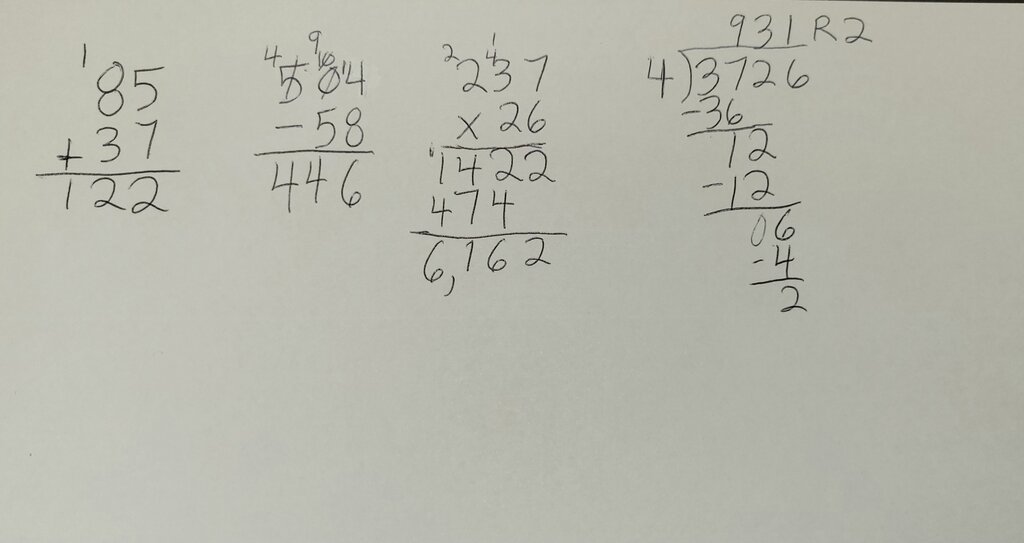
Mastering these operations isn't just about getting the right answer. It's about speed and confidence. In a competition, you want these calculations to feel automatic. For example, knowing your multiplication tables by heart saves precious seconds. The same goes for long division. These aren't just school exercises; they are the essential tools for solving much bigger problems.
Working with Parts
Things get more interesting when we move beyond whole numbers to fractions and decimals. They're just ways of talking about parts of a whole. A fraction like means you have 3 parts of something that was divided into 4 equal parts. A decimal like represents the exact same amount.
When adding or subtracting fractions, the key is to find a common denominator. You can't add thirds and fourths directly, just like you can't add apples and oranges. You need to convert them to a common unit, like twelfths.
Multiplication and division are more direct. To multiply fractions, you just multiply straight across: numerator times numerator, and denominator times denominator. To divide, you flip the second fraction (find its reciprocal) and then multiply.
Percentages are another way to express these parts. The word "percent" literally means "out of 100." So, 50% is just another way of saying 50 out of 100, which simplifies to the fraction or the decimal . Being able to switch between these three forms quickly is a huge advantage.
| Fraction | Decimal | Percent |
|---|---|---|
| 1/2 | 0.5 | 50% |
| 1/4 | 0.25 | 25% |
| 3/4 | 0.75 | 75% |
| 1/5 | 0.2 | 20% |
| 1/10 | 0.1 | 10% |
The Rules of the Road
When a problem has multiple operations, the order you do them in matters. A lot. For instance, what is ? If you go left to right, you get . But if you do the multiplication first, you get . Only one of these is correct.
To avoid confusion, mathematicians agreed on a standard order of operations. A common way to remember it is the acronym PEMDAS.
PEMDAS: Parentheses, Exponents, Multiplication and Division (from left to right), Addition and Subtraction (from left to right).
Multiplication and division are a team; you do whichever comes first as you read the problem from left to right. The same is true for addition and subtraction. Let's look at a more complex example: .
Following PEMDAS ensures everyone gets the same correct answer, which is 7.
Smart Shortcuts
Some properties of numbers can help you rearrange problems to make them much easier to solve. Think of them as clever shortcuts.
The Commutative Property says you can swap numbers in addition or multiplication and get the same result. For example, $13 + 59$ is the same as $59 + 13$. This is useful for grouping numbers that are easy to add together.
The Associative Property says that when you are only adding or only multiplying, you can change how you group the numbers. For instance, calculating might be a bit slow. But if you regroup it as , you can quickly see that , making the problem an easy .
Finally, the Distributive Property is one of the most powerful tools. It links multiplication and addition. It lets you "distribute" a multiplier to each term inside a parenthesis. For example, to calculate , you could rewrite it as . Then you can distribute the 7 to get , which is . This is often much faster than doing the direct multiplication.
Understanding these properties helps you see the structure inside the math, turning tricky calculations into simple steps.
What is the value of the expression ?
Rewriting the calculation as is an application of which property?