Mastering the AI Product Lifecycle
The AI Product Lifecycle
From Predictable to Probable
In traditional software development, you operate in a deterministic world. If a user clicks a button, a predictable action occurs. An input reliably produces a specific output. This is the foundation of most product management: define the inputs and outputs, and the engineering team builds the logic in between.
AI product management is fundamentally different. It's a shift from a deterministic to a probabilistic mindset. Instead of programming explicit rules, you train a model to find patterns in data. The output is never a certainty; it's a probability. A recommendation engine doesn't know you'll like a movie; it calculates a high probability that you will based on past behavior. This uncertainty changes everything, starting with the product lifecycle itself.
Your role changes from specifying rules to curating the data and defining the success metrics for a system that learns its own rules.
The AI Lifecycle
Forget the linear progression of Waterfall or the familiar sprints of Agile. The AI lifecycle is an iterative loop built around experimentation and learning. It’s less about building a feature and more about cultivating a system that improves over time. This cycle has six distinct stages, each with its own challenges and a new cast of characters.
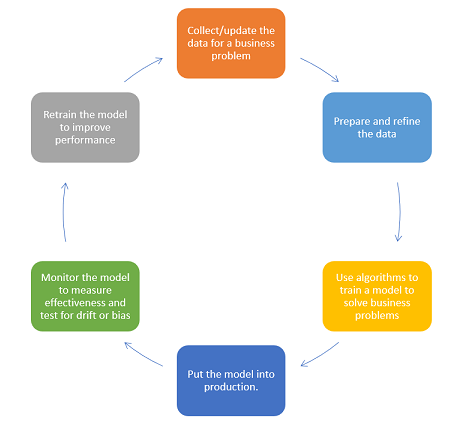
1. Discovery This isn't your typical product discovery phase. In AI, the first question isn't "What problem are we solving?" but "Is solving this problem technically feasible with the data we have?" Before you can even write a one-pager, you need to work closely with a to assess whether your data contains the signals necessary to train a useful model. This technical feasibility check is a hard prerequisite. Many promising AI product ideas die at this stage because the data simply isn't there.
This is the beginning of what's often called the 'Fog of AI.' Requirements are ambiguous. Instead of a detailed Product Requirements Document (PRD), you start with a hypothesis and a set of evaluation metrics. The goal isn't to define a finished feature, but to define a successful experiment.
2. Data Once you've established feasibility, the focus shifts entirely to data. This stage involves collecting, cleaning, and labeling massive datasets. If you're building a model to identify cats in photos, you need thousands of photos, many of which must be manually labeled 'cat' or 'not cat.' This is where you encounter a new stakeholder: the Data Labeler or a data labeling service. The quality of your AI product is a direct function of the quality of your labeled data. Garbage in, garbage out has never been more true.
3. Modeling With clean, labeled data, the Data Scientist can begin training models. This is an experimental process of selecting algorithms and tuning their parameters to achieve the best performance against your evaluation metrics. As a product manager, you won't be building the models, but you must understand the trade-offs. Should you prioritize precision (minimizing false positives) or recall (minimizing false negatives)? The answer depends entirely on the user problem. For a medical diagnosis model, recall is critical. For a spam filter, precision is more important.
4. Testing Testing an AI model is different from testing traditional software. You're not just looking for bugs in the code. You're testing the model's performance on unseen data to check for accuracy, bias, and unexpected failures. This involves splitting your data into training, validation, and test sets. You'll also perform qualitative testing: how does the model 'feel' to a user? Does it produce sensible results in edge cases?
5. Deployment Getting a model into production is the job of a Machine Learning Engineer (ML Engineer). This role is a hybrid of software engineering and data science, focused on building robust, scalable systems for deploying and serving models. Unlike traditional software, you're not just deploying code. You're deploying the model artifact (the trained model itself) and the pipeline required to feed it data and serve predictions. This infrastructure is often complex.
AI Product Managers need to understand ML concepts, model evaluation, and data pipelines, but success ultimately comes from product thinking: identifying the right problems to solve, aligning stakeholders, and delivering measurable business impact.
6. Monitoring This is where the 'build once, run forever' model truly breaks. An AI model's performance can degrade over time, a phenomenon known as . The real world changes, and if the new data no longer matches the data the model was trained on, its predictions become less accurate. Monitoring involves tracking the model's performance metrics in production and having a plan to trigger retraining when performance dips below an acceptable threshold. The lifecycle isn't finished at deployment; it's a continuous loop of train, monitor, and retrain.
Embracing the Loop
Transitioning to AI product management means letting go of certainty. It's about embracing a scientific method of hypothesis, experimentation, and iteration. You guide a process of discovery rather than dictating a list of features. The AI lifecycle provides the framework for this journey, turning the 'Fog of AI' into a structured, repeatable process for building products that learn and adapt.
Let's test your understanding of these core lifecycle concepts.
What is the fundamental mindset shift required for AI product management compared to traditional software development?
In the 'Discovery' stage of the AI product lifecycle, what is the first and most critical question to answer?
Managing this cycle successfully requires a deep partnership with your technical counterparts and a comfort with ambiguity that goes beyond traditional product roles.