Mastering the AI Inference Stack
Inference Stack Overview
From Training to Action
An AI model's life has two main phases: training and inference. Training is the learning phase. It's where the model pores over massive datasets, adjusting its internal parameters to recognize patterns. This process is computationally expensive and can take days or even weeks on powerful hardware.
Inference is the action phase. It's what happens when the trained model is put to work, making predictions on new, unseen data. If you ask a chatbot a question or use a translation app, you're kicking off an inference task. While training is a slow, heavy lift done behind the scenes, inference needs to be fast, efficient, and reliable for real-world applications.
Think of it this way: training is like studying for an exam, while inference is like taking the exam itself. The studying part is long and hard, but the goal is to answer questions quickly and accurately when the time comes.
The Inference Stack
Getting a model from a training environment to a live application requires a layered set of technologies known as the inference stack. Each layer has a specific job, and they all work together to deliver a prediction to the end-user. A typical stack handles everything from receiving a request to performing the calculations and sending back a response.
Let's break down the interplay between these layers, specifically hardware and software.
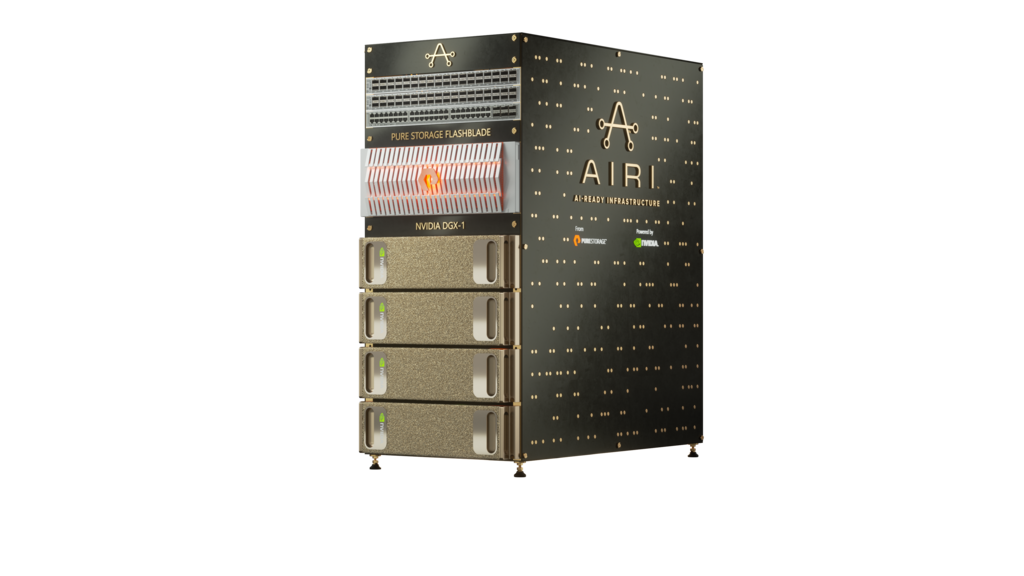
Hardware forms the foundation. While general-purpose CPUs can run AI models, specialized hardware like Graphics Processing Units (GPUs) and Tensor Processing Units (TPUs) are far more efficient. They are designed to perform the massive number of parallel matrix multiplications that are at the heart of neural networks.
Software acts as the bridge. Runtimes and libraries like CUDA (for NVIDIA GPUs) or ONNX Runtime provide a way for the AI model to communicate with the specialized hardware. Above that, an inference server is a specialized software application that manages incoming prediction requests, routes them to the correct model and hardware, and scales to handle many users at once.
The Scaling Challenge
Deploying a model that works for one user is one thing. Deploying it to serve millions is another challenge entirely. As organizations scale their AI applications, they run into several key hurdles that must be managed carefully.
| Challenge | Description |
|---|---|
| Latency | The time it takes for the model to make a single prediction. For user-facing applications like real-time translation, this needs to be incredibly low. |
| Throughput | The number of predictions the system can make in a given period. A popular service needs high throughput to handle thousands of requests per second. |
| Cost | The expense of running the necessary hardware and software 24/7. Specialized AI hardware can be costly to purchase and operate. |
| Resource Utilization | Ensuring the expensive hardware is being used efficiently. An idle GPU is a wasted resource. |
These factors are often in conflict. For instance, you could decrease latency by using a more powerful, expensive GPU, but that increases cost. You could also use a smaller, less accurate model to improve speed, but that might degrade the user experience. Finding the right balance is a critical part of designing a scalable inference system.
Now that you understand the pieces of the puzzle, let's test your knowledge.
Which phase of an AI model's life is focused on learning from large datasets by adjusting its internal parameters?
If an AI model's life were compared to a student's education, inference would be the equivalent of...
Understanding the inference stack is the first step toward building and deploying effective AI applications. It provides the framework for tackling the optimization and deployment strategies we'll explore next.