Mastering Texas Hold'em
Pre-Flop Fundamentals
Starting Hand Selection
The first decision you make in any poker hand is based on the two cards you're dealt. These are your hole cards, and they're the only pieces of information you have that nobody else has. The strength of your starting hand is the foundation for everything that follows.
Some hands are obviously strong, like two Aces (A-A) or two Kings (K-K). These are called premium pairs, and you should almost always play them aggressively. Other hands, like a 7 and a 2 of different suits, are weak and should usually be folded immediately. Most hands fall somewhere in between.
Besides big pairs, you're looking for cards that can work together. High cards like Aces, Kings, Queens, and Jacks are valuable. Cards of the same suit (suited) can make powerful flushes. And cards that are close in rank (connected) can make straights. A hand like an Ace and a King of the same suit (A-K suited) is extremely strong because it has the potential to make the best pair, a straight, or a flush.
A good rule for beginners is to be selective. Playing fewer, stronger hands will put you in better situations and make your decisions easier later on.
Here's a quick look at the top ten starting hands in Texas Hold'em. These are the hands you're almost always excited to see.
| Rank | Hand | Nickname |
|---|---|---|
| 1 | A-A | Pocket Rockets |
| 2 | K-K | Cowboys |
| 3 | Q-Q | Ladies |
| 4 | A-K (suited) | Big Slick |
| 5 | J-J | Fishhooks |
| 6 | 10-10 | Dimes |
| 7 | A-Q (suited) | Big Chick |
| 8 | A-K (unsuited) | Big Slick |
| 9 | 9-9 | German Virgin |
| 10 | A-J (suited) | Ajax |
The Power of Position
The cards in your hand are only half the story. The other half is your position at the table relative to the dealer button. In poker, information is power, and acting last gives you the most information.
The dealer button rotates one spot to the left after each hand. The player on the button is in the best position because they act last in every betting round after the flop. The players to their right are in
Position influences every poker decision you make.
Positions are generally broken into three categories:
- Early Position: The first few players to act after the blinds. You have the least information here, so you must play very cautiously.
- Middle Position: The players between early and late position. You can start to play a wider range of hands here.
- Late Position: The dealer (button) and the player to their immediate right (the cutoff). These are the most profitable seats because you get to see how everyone else acts before you have to make a decision.
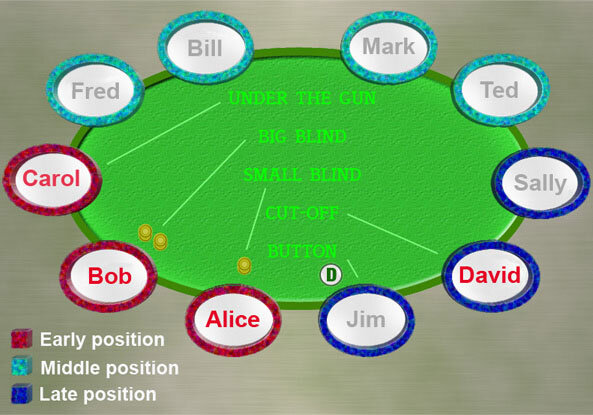
Imagine you're in early position with a medium-strength hand like K-J. If you bet, you have no idea if someone behind you is holding A-A and waiting to re-raise. Now, imagine you're on the button with the same K-J. If everyone before you has checked or folded, your hand suddenly looks much stronger. You can bet with more confidence, knowing you're likely ahead.
Opening Ranges
Combining the concepts of starting hands and position gives us an opening range. An opening range is a set of hands that you should consider playing from a specific position, assuming no one has entered the pot before you.
Think of it as a pre-approved list of hands. Instead of deciding from scratch every single time, you have a baseline strategy. From early position, your range will be very tight and consist of only the strongest hands. As you move to later positions, you can afford to
As your position improves, your range of playable hands expands.
Having a structured approach with opening ranges prevents you from playing based on whims or boredom. It instills discipline and ensures you're consistently putting yourself in profitable situations. Over time, you can adjust these ranges based on the other players at the table, but starting with a solid foundation is key.
Here is a simplified chart to get you started. This shows hands you might open-raise with if you are the first player to enter the pot.
| Position | Hands to Open-Raise (Examples) |
|---|---|
| Early | A-A, K-K, Q-Q, J-J, 10-10, A-K (suited), A-Q (suited) |
| Middle | All early position hands, plus 9-9, 8-8, A-J (suited), K-Q (suited) |
| Late | All middle position hands, plus any pair, any suited Ace, many suited connectors (like 8-7 suited) |
Remember, this is just a starting point. Poker is a dynamic game. But by understanding which hands to play from which position, you've already mastered the most important pre-flop fundamentals.
Ready to test what you've learned?
Besides high pairs (like A-A or K-K), what combination of factors makes a starting hand in Texas Hold'em strong?
Why is late position considered more advantageous than early position?
With these concepts in mind, you're now equipped to make much stronger decisions before the flop is even dealt.