Mastering Systems Thinking
Feedback Loops
The Engine of Change
Systems are not static. They change, evolve, and adapt over time. The engine driving this behavior is the feedback loop. A feedback loop is a circular chain of cause and effect, where an output from one part of the system eventually circles back to affect the same part. The result of an action travels through the system and influences future actions.
One of the key concepts in systems thinking is recognising feedback loops – the ways in which actions create reactions that either reinforce or counteract the original situation.
Understanding these loops is like having a peek under the hood of a system. It allows us to see why things grow, why they stabilize, and why they sometimes spiral out of control. There are two fundamental types of feedback loops: reinforcing and balancing.
Reinforcing Loops
Reinforcing loops amplify change. Whatever direction the system is moving in, a reinforcing loop pushes it further and faster in that same direction. Think of them as snowballs rolling downhill; they generate exponential growth or collapse. The more they change, the more they can change.
A classic example is population growth. More births lead to a larger population. A larger population leads to even more births. The effect reinforces itself, causing the population to grow at an accelerating rate (assuming unlimited resources).
We can visualize this with a simple diagram. This is a basic Causal Loop Diagram (CLD). The arrows show the direction of influence. The '+' sign indicates that the two variables change in the same direction—as one increases, the other increases.
Reinforcing loops are responsible for viral marketing campaigns, the spread of rumors, and market bubbles. A popular product gets good reviews, leading to more sales, which generates more reviews, and so on. But this amplification can also work in the opposite direction, creating a vicious cycle. A company's declining sales might lead to budget cuts, which hurts product quality, leading to even fewer sales.
Balancing Loops
Balancing loops, also known as negative feedback loops, are stabilizers. They seek equilibrium or a goal. When the system deviates from its target, a balancing loop pushes it back. These loops counteract change and are responsible for the stability we see in many systems.
Your home thermostat is a perfect example. The goal is a set temperature. If the room gets too cold (a deviation from the goal), the thermostat turns the heat on. The heat warms the room until it reaches the target temperature, at which point the thermostat turns the heat off. The system self-regulates.
In a Causal Loop Diagram, we represent this with a '-' sign, indicating that the variables move in opposite directions. As one increases, the other decreases. The 'B' in the center signifies a balancing loop.
Balancing loops are everywhere: our bodies regulating blood sugar, a company managing inventory to meet demand, or an ecosystem maintaining a predator-prey balance. They are the forces that provide stability and resistance to change.
Mapping System Behavior
In most real-world systems, you won't find just one loop. You'll find many reinforcing and balancing loops interacting in complex ways. The behavior of the system over time is determined by which loops are dominant. Causal Loop Diagrams (CLDs) are the primary tool for mapping these interactions.
A CLD helps visualize the structure of a system by showing the key variables and the causal relationships between them. By identifying the reinforcing (R) and balancing (B) loops, we can begin to understand why a system behaves the way it does. For example, a model of a market might include a reinforcing loop of product popularity and several balancing loops related to supply, demand, and pricing.
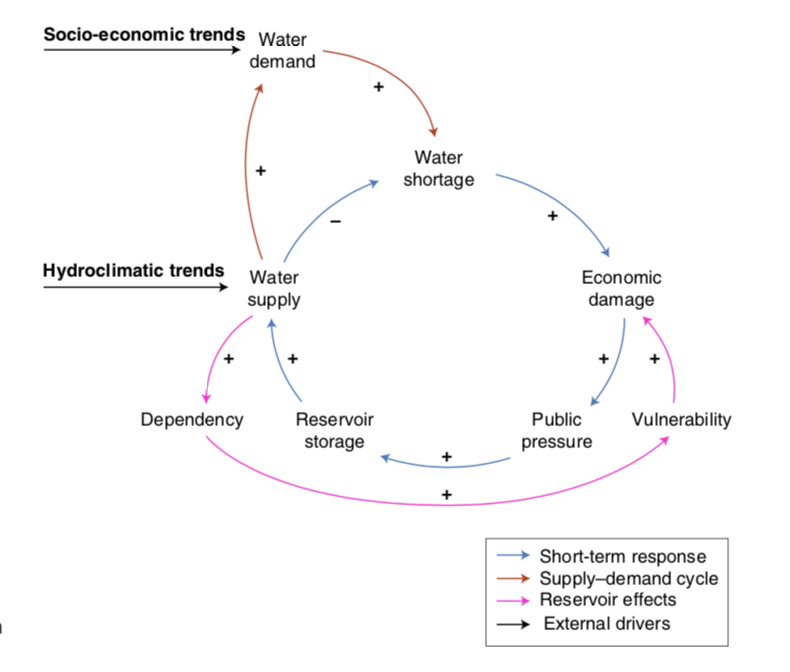
Mapping these loops reveals the underlying structure that drives events. It shifts our focus from simply reacting to problems to understanding and influencing the system that creates them.
Ready to test your understanding?
Which of the following scenarios best describes a reinforcing feedback loop?
What is the primary function of a balancing feedback loop within a system?
By learning to see feedback loops, you gain a powerful lens for interpreting the dynamics of business, society, and the natural world.